E-Paper



Election In Pincodes: Ballia’s oppressive heat takes toll on lives, livelihoods
Kiran Paswan, a farm laborer in Ballia, dreams of a toilet and a fan to survive the extreme heatwave that has claimed 70 lives in 3 days.

 Prefer HTon Google


Kiran Paswan has worked for as long as she can remember. She has three children – two teenage sons and an 11-year-old daughter – and is 40 years old. Yet, all her aspiration, chiselled away by penury and a life of hard labour, is now reduced to two desires. The first is a toilet, so women like her do not have to bear the indignity of relieving themselves along the road or farms in the open. The second is to save enough from the ₹100 she earns as a farm labourer everyday, to buy a ceiling fan for the kutcha home she shares with 12 others. It is a question not of comfort or honour, but life and death. For the heat in Ballia is killing.
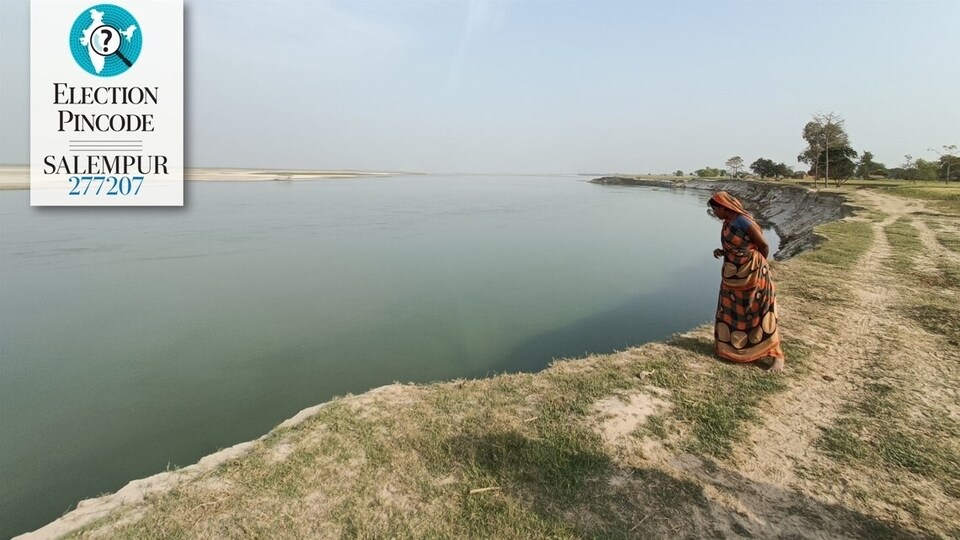
About 40km from her village of Chitouni is Ballia’s district hospital, where in three days in June 2023, 70 people lost their lives from extreme heat. Most of the dead were the elderly, or those who worked as labourers on the farms that dot the banks of the Ghagra and Ganga in the northern and southern borders of the district. For women such as Paswan, the 9-10 hours under the searing sun is compounded by the five to six times they have to go to the farm around 300m away to relieve themselves.
Read here: Climate crisis impacts citizens’ right to life: Supreme Court
And yet, choosing not to work is not an option at all. “If there is work, I will do it at all times of the day to make some money. I want a toilet for myself and my daughter. And a fan,” she said.
Across Ballia, in village after village, there is a marked separation and two clear worlds. There are the bhoomiheen — the landless — whose lives depend on work in the farms of communities higher than them in the social hierarchy. There are around 20 million landless agricultural labourers in Uttar Pradesh according to the 2011 census. It is the landless whose homes have no toilets, ceiling fans or pucca walls; and they find themselves most susceptible to Ballia’s growing crisis in recent years — patchy, unpredictable monsoon, extreme humid heat and long months of unrelenting heat, a potent combination that is causing death.
As election season approaches this desolate land, the travails of people such as Paswan comes into sharper relief — the mercury is already rising across the Gangetic plains, the weather office has predicted a harsher summer to follow the warmest year on record in 2023. But the danger of extreme heat baking the heartland, and of such climate vagaries on the marginalised, elides the bustle of the poll campaign.
HT reported on March 31, 2020 that an India Meteorological Department (IMD) study found a significant increase in heavy rainfall (6.5cm or more) days in Gujarat’s Saurashtra and arid regions of Kutch and south-eastern Rajasthan, as well as northern Tamil Nadu and northern Andhra Pradesh which are otherwise considered arid regions. The study also found a decrease in rainfall over the years in states in the Gangetic basin. CEEW found that nearly 11% of Indian tehsils witnessed a decrease in the past decade (2012-2022) by at least 10% compared to the climatic baseline, and that these were regions in the Indo-Gangetic plains, which contribute to more than half of India’s agricultural production, northeastern India, and the Himalayas.
In Ballia’s district hospital, chief medical officer Dr Vijaypati Dwivedi has seen the number of patients suffering from heat exhaustion and strokes multiply every summer. “Our body’s enzymes are produced normally at a certain temperature – around 37°C. What happens when it is two degrees higher? The body feels exhausted and the pulse increases. We sweat profusely to regulate our temperature but there is also a stage when sweating stops and body temperature increases losing control triggering a heat stroke and loss of consciousness. These have been recorded carefully and Ballia is seeing an increase in these cases,” he said, adding that Ballia was also chosen as a model district for heat wave death prevention this year.
In 2023, the three summer months of April, May and June saw 340 cases related to heat exhaustion brought to the Ballia district hospital, one surveillance officer said.
“Heat exhaustion was common earlier also but what we saw in 2023 was unprecedented,” said the surveillance officer, requesting anonymity. Between June 15 and 18 in particular, three days when Ballia recorded temperatures between 43°C and 45°C, there was “excess mortality” with around 70 deaths.
“What we observed was that mortality was being seen mostly in those above 70; those with multiple comorbidities such as high blood sugar and high blood pressure. Some of them were recording sugar levels above 300mg/dL. We also found that a majority of these people were outdoors in peak hours between noon and 3pm. So heat was an additional factor, but perhaps not the only factor,” he explained.
The Ballia health department also found that most deaths came from people that lived near the Ghagra and Ganga river beds. “We consulted with the meteorological department and they found that the mix of high humidity along the rivers and extreme temperatures may have led to an extreme heat index that became unbearable for some people,” Dwivedi said.
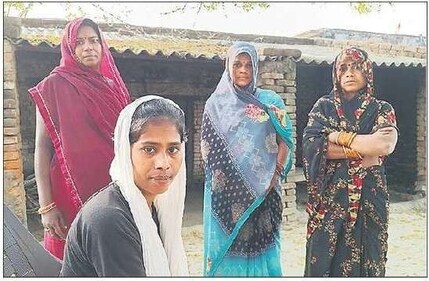
The string of deaths have struck fear in the hearts of the bhoomiheen, who face the double scourge of spending long hours in the sun outside, whether it be as agricultural or construction labourers, and then coming back to the oppressive heat of their tin shed and tarpaulin homes that have been baked by the heat, bereft of any cooling. Every basic human function such as ablutions becomes arduous, given the lack of toilets in many homes.
But what can they do? In Chitouni village, 60-year-old Champati Devi said the option not to work simply didn’t exist. “I support my family and my husband is too old to work. That ₹100 a day that I earn brings us our food. Thinking of the heat is a luxury others have and I don’t,” she said.
Tip of the iceberg
The desolation of Ballia’s bhoomiheen is the proverbial tip of the iceberg of a problem that is only going to get more severe as more intense heatwaves scorch India, as is predicted this summer. HT’s analysis of unit level data from the Periodic Labour Force Survey (PLFS), the official source of employment statistics in India, showed 18% of India’s non-farm workforce works outdoors. The overall share of workers who must work outdoors, irrespective of how hot it might be, increases to 49.4% once the share of workers employed in agriculture is counted. In absolute terms, this translates into an estimated 231.5 million workers. As the testimonies of Kiran Paswan and Champati Devi show, these workers are the ones with the lowest incomes and the most difficult work conditions which leaves them with no income cushion to opt for cooling devices or leave even if the heat makes them sick.
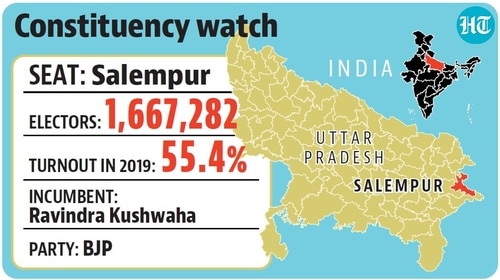
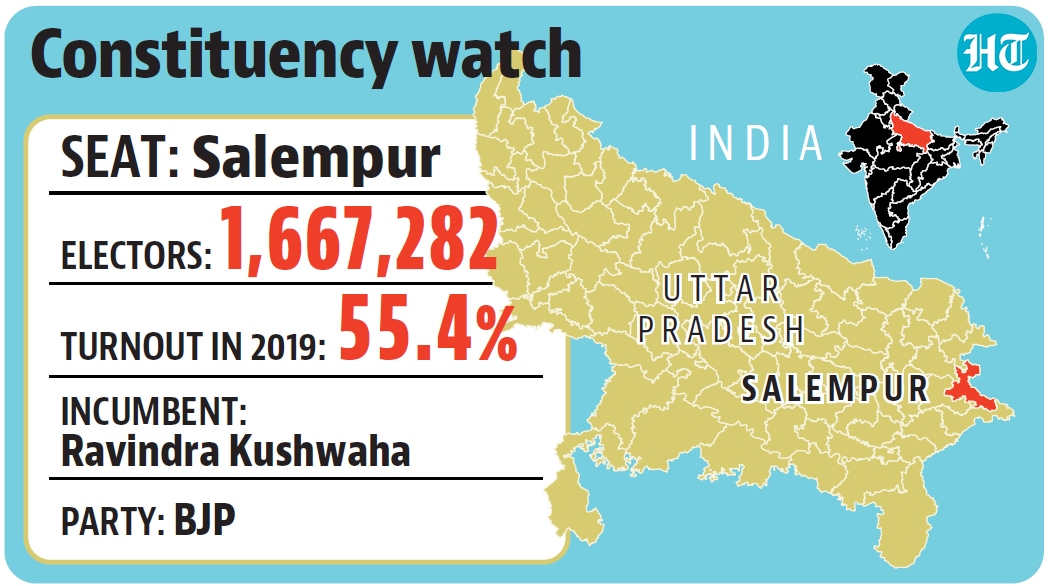
But despite the scale of the problem, it sometimes fades in front of livelihood and other everyday issues of caste, communalism and jobs. Salempur Lok Sabha constituency will go to the polls on June 1 as part of the seventh and last phase of the general elections. The seat is held by Ravindra Kushwaha of the Bharatiya Janata Party (BJP) who also won it in 2014. Before that, the seat was held alternatively by the two erstwhile regional giants, Samajwadi Party and Bahujan Samaj Party. There are five assembly segments in the parliamentary constituency; the BJP and its ally, the Suheldev Bharatiya Samaj Party hold four of them, and the Samajwadi Party holds one.
Karishma Rajbhar, 20, also from Chitouni village, waved her hand impatiently. She will only decide her vote on polling day. “How does it matter? It is not like votes make a difference to our lives,” she said, cradling a three-month old baby.
In Kharid village, Savitri Devi, a Dalit farm labourer, appears to have made up her mind. “The BJP has already told us what they will give. They have given us an empty jhola,” she laughed. But that opinion is far from unanimous. Almost immediately, another villager disappeared inside her home, and emerged with a sack : “Modi sarkar ki guarantee – agle 5 baras muft anaj (Modi’s guarantee to provide free ration for next 5 years). The SP has not promised anything.”
There is some resentment among farmers against the BJP on the escalating costs of agriculture. “Every farmer is in debt,” said Vinod Chaudhry, a farm leader from Sikanderpur. But others point to the infrastructure uplifts that have connected this part of Purvanchal with the only big city in the region, Varanasi. “All the roads that you see here have been built under BJP’s regime. People used to be scared to step out both in Ballia and neighbouring Bihar districts because of high criminal activities. BJP has managed to change that,” said Alok Pandey, a driver originally from Varanasi who now lives in Ballia.
Along the banks of the Ghagra, in Kharid, labourers are staring at not just an intense summer, but a threat to their homes that they hope parties will address. The Ghagra’s course is shifting, they say, ostensibly impacted by the construction of a bridge along Kharid village. “The river has started eating into the banks and has come very close to our village. This monsoon it may wipe out our homes and we have had no trustworthy assurance from the governments. We are poor Dalits that till the land that the Yadavs own. Both communities will suffer,” said Savitri Devi.
Campaign promises
The heat is making people change their work pattern and hours. “If some labourers wish, they can finish harvesting wheat by working the entire day. Some people choose to work only in the morning hours because the heat is unbearable in the day. Some who are paid daily wages may need to work full day,” said 20-year-old Shilpa Kumari, a graduate from Hardia village who teaches at a private school for ₹2,000 a month.
The BJP has kept its campaign focussed on Prime Minister Narendra Modi’s popularity and the welfare schemes that have his name and photo stamped on them.
“We are trying to get the benefits of all central schemes to the ground level. We are focusing on roads, electricity, ration and so on. Toilets have been constructed in nearly all homes. An Ayurvedic Medical College has started in the Lok Sabha region and it’s OPD is already functional. Based on Modiji’s promise of Vikshit Bharat, we took out a procession called ‘guarantee ki gaadi’ which settled issues related to toilets, ration, pension, has, housing then and there,” said the BJP candidate Kushwaha.
Read here: Pappu Yadav ignores Congress advice, remains in fray from Purnea Lok Sabha seat
The SP blamed unemployment. “Economic hardship is very high which can be seen in villages. The other major problem that several districts including Ballia are facing is complete collapse of health care systems,” said Juhie Singh, national president, women’s wing, Samajwadi Party.
Heat might not make it to the campaign narratives, but it’s ever-present in Ballia. On June 1 last year, the mercury reached 43°C and IMD has already predicted a series of heat waves this year. The brief respite that villages such as Paswan receive every night is also likely to fade, with minimum temperatures likely to be three to five degrees above normal.
At the district hospital, the administration has readied a roadmap for what is set to be another punishing summer – ample drinking water in all government hospitals; structural modifications such as cool, reflective paint on hospital walls; wet curtains; use of coolers; planting of trees to block sunlight ; and providing cotton gowns to patients. For what is clear, election or no election, is that in Ballia’s torturous summer, the patients will come.
And Kiran still doesn’t have a fan.
This is the fourth in a series of election reports from the field that look at national and local issues through an electoral lens.