
 E-Paper



Election notes from a city of salvation that’s now a political capital
Is the dream of Kashi turning into Kyoto still alive?

 Prefer HTon Google


Saroj Saini has been a boatman on the ghats of the Ganga in Varanasi for 25 years. His rundown boat, three decades old, with freckles of blue, is actually not his -- it is rented from a cousin and costs half his daily earnings.
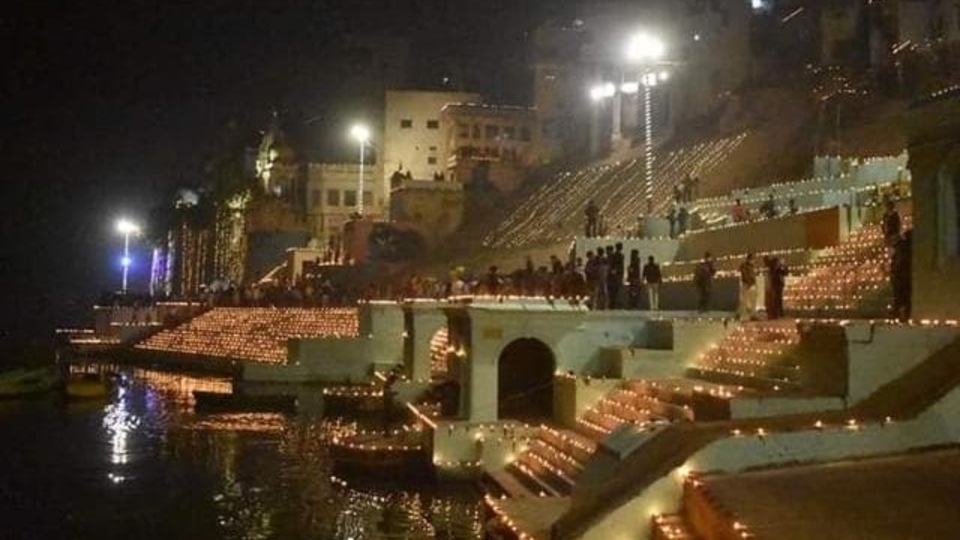
Rowing through the speckled waters of the Ganga, watching noisy motorboats and the sleek, white and blue liners glide by, he wistfully speaks about his dream of owning a “CNG boat”. His rented boat needs frequent repairs and though he is confident of being able to take it out on the waters for the next decade, Saini would prefer a CNG boat that would mean more money for less effort and more comfort for passengers.
The dream will cost him upwards of ₹5 lakh and even with all his resources and a loan from the bank, he says he will not even raise one-third the cost of his dream boat.
“Par Sapna to hai…” (but I still dream), he says in Hindi.
Kumar (he uses a single name) sells snacks on Assi Ghat where Saini awaits customers has a dream too. He had heard about a plan to widen the river, and setting up a marketplace on the embankment on the opposite side of the ghats.
“The government will give everyone a pacca dukaan (proper shop). If I can get one too then business will be good, life will be easier,” he smiles.
Dreams and aspirations are the corner stones in Varanasi also known as Kashi and Benaras. Like the gossamer silk weaves crafted on the many clattering looms across the city, dreams of a better life are also being woven here.
The city’s lawmakers want to transform one of the oldest, living cities in the world (some say it dates back at least 5000 years), with its bustling crowds, incessant noise, heaps of garbage but indescribable charm into another Kyoto -- Japan’s cultural capital. And the residents have found in that aspiration a toehold to mount their own dreams.
In 2014, as the prime ministerial candidate of the Bharatiya Janata Party, Narendra Modi, who symbolically chose to contest from Varanasi, promised to usher in changes in the city.
And according to people like Saini, the changes have started.
“The work (of transforming the city) has begun, even if there is very little you can see. The ghats are cleaner, there is regular garbage collection, bodies are no longer dumped into the river. We are finally on road to getting there. When people ask what has changed in the last five-seven years, I say all that didn’t in the last 75,” Saini says.
The pace of change does not worry Saini or Kumar. Varanasi lives in its own time -- the unhurried, lyrical pace of the ghats coexists with the bustling, non-stop city. And the people are proud of their therav (patience).
“It is not that changes have not taken place. If you look around, you will see that the city is much cleaner than before, decongesting (it) will take time, because there is only so much scope for the city to grow. The roads are being improved, the law and order is better and there is expectation of an imminent change. You will not encounter anger against the government, only dissatisfaction in some quarters,” says an employee of the Banaras Hindu University who does not wish to be identified.
A change in the government at the centre in 2014 followed by a change in the state itself has paved the way for better living conditions, adds this person. “Ahead of every festival there used to be groups that would go around seeking donations, it was called rangdari, and you couldn’t refuse to pay. The police too was like an organised mob of the ruling party. We used to look forward to (former minister in the Samajwadi Party government) Shivpal Yadav’s visits because that was the only time we would have uninterrupted power,” the employee recalls.
In August 2014 during the PM’s visit to Japan, officials from New Delhi and Tokyo signed an agreement that sought to transform Varanasi into Kyoto. The replication was based on the similarities such as both cities being situated on a riverbank, dotted with pilgrimage sites, and bustling with people.
According to a government press statement issued in January 2015, Kyoto was picked as the city to model Kashi on because of similarities that brought the two places together. “...Kyoto attracting about 50 million tourists every year and Varanasi receiving about 5 million visitors; three rivers flowing through both the cities; besides being the locations of rich cultural heritage with Kyoto known as the city of 1000 shrines and Varanasi as the temple town.”
Even as the contours of the agreement were being shaped, there were dreams taking shape on the ground about the magnificent changes that were awaited -- fast metro trains, decongested roads, inland waterways, a functional sewage system, garbage disposal and amenities such as clean water and uninterrupted power supply.
The magnificence of the proposal tempted even the sceptics to rest their disbelief.
“There was a lot of hope… people thought dramatic differences will be visible in no time. After all the PM was leading the charge. There was excitement about more tourists coming from foreign (countries) and it would certainly give us a chance to earn more money,” says Kishore, a guide who spends most of his time tailing tourists in the hope that he would make a little more than the previous day.
Over the past seven years several projects have been initiated and completed in Varanasi. Projects worth ₹3,350 crore were inaugurated in February 2019, followed by the inauguration of another set of projects worth ₹614 crore, which includes the Sarnath light and sound show, sewerage related work, infrastructure facilities for protection and conservation of cows, and unveiling of a 63 feet statue of RSS ideologue Pandit Deendayal Upadhyay. In October 2021, the Prime Minister launched development projects worth ₹5,200 crore for the makeover of the Ghats, cleanliness of the Ganga, construction of bridges, parking places and facilities in Banaras Hindu University; this was followed by the inauguration of the grand Kashi Vishwanath corridor in December.
While some of these projects are still in their nascent stages, people seem prepared to wait for the development to take shape on the ground. They say as the PM’s constituency they are not unduly worried about bureaucratic red tape, man-made impediments or a cash crunch . “No matter what the opposition says or how long it takes, people are assured that work will be done as long as there is (PM) Modi,” says the BHU employee.
So, what has changed in the city of salvation that has now also earned itself the sobriquet of a political capital? “It would be presumptuous to think that there would be quick changes, but a lot that happened. The road connectivity has improved, the Kashi Vishwanath corridor has transformed, pehle light aati thi, ab light jaati hai (loosely translated as earlier power cuts were rampant now cuts are rare),” says Hemang Agarwal, designer-entrepreneur and a Varanasi resident.
Sitting in his office—with its red oxide floors and white windows—that overlooks the mighty river, he says political apathy over the years had nudged Kashi into a “blind spot” and even the slightest change often made people happy. “We started at a low baseline. Even though this was a spiritual city, political parties did not focus on Kashi, so (what is happening) now is a start,” he says.
Is the dream of Kashi turning into Kyoto still alive?
“That was well intended, but nothing except a convention centre has come of it and a few other things have been set in motion,” he laughs.
Still, bits of the Kyoto dream can be seen in the paved promenade leading to the busiest ghat, the Dhashashwamedh. The similarity probably ends there. The busy road; chocked with shoppers, sellers, passers by and the ubiquitous bovines is just a repaved version of itself.
It has none of Kyoto’s picture book prettiness, the manicured outdoors and spotlessly clean roads.
Not everyone is bothered by the so far unrealised Kyoto transformation. The mahant or the chief priest of the Sankat Mochan Temple, one of the most respected and recognised crusaders for the clean Ganga, Vishmabhar Misra, is irritated by the comparison with Kyoto.
“Why should a city that is older, culturally richer be transformed into another city. Why implement other models and what for? Jerusalem, Mecca, Kashi and Peking all have their own identities even if they have similar ambience, but should one be made to look like the other?” asks Mishra who is a member of faculty in the department of electronics engineering at IIT (BHU).
Mishra has been a very vocal critic of the redevelopment that is underway. He thinks the ₹339 crore Kashi Vishwanath corridor, inaugurated by PM Modi in December last year and showcased as the vertex of the government’s remodelling plans has “destroyed the city’s aesthetic and tampered with its history”.
“The corridor has been designed by a Gujarat-based company; the project is being looked after by a foreign company, so what has Kashi gained? Has the problem of untreated sewage flowing into the Ganga changed or the traffic congestion? There is a surfeit of projects from the metro to the monorail to the ropeways but the problems persist as there is no space for expansion,” Mishra adds.
The opposition too has latched on to the narrative against the corridor.
Bahujan Samaj Party leader Ajay Pratap Singh says there is widespread anger over the hundreds of temples that were demolished for the corridor. “Here people says even Aurangzeb did not destroy so many temples…,” he says.
BJP spokesperson Manish Shukla says the opposition’s charge is baseless. “The redevelopment work has essentially restored the old glory of the temple. Earlier there was nothing between the Ganga and the temple, one could take a dip and go straight to the temple. The redevelopment has also given the local economy a fillip. Since the number of pilgrims visiting the temple has gone up significantly, every sector from hotels to shops to taxi drivers are getting better business,” he says.
Mudita Kapoor, an architect who is also contesting elections from the Sadar seat in Varanasi on a Congress ticket says residents in Varanasi are not against development but want to have a say. “This is a culturally rich and diverse city. There is a fear that the way houses and shops are being demolished for development will set a precedent across the city. It hasn’t impacted the locals positively.”
The city lacks basic infrastructure, she says and development is limited to a few sections. “Just painting the city in one colour is not Kashi. That takes away from our inclusiveness and diversity. Many residents are moving out of the core areas because only a handful of business are prospering and sustainable growth is not being planned.”
In the city where politics is ubiquitous and intense conversations brew over a cup of tea, strains of music are interspersed by chanting and sloganeering as electioneering is at its peak. The city will go to polls on March 7, which will also mark the conclusion of the seven-phase UP election .
“There was a time when Kashi was the cultural capital. It is now a political capital and politics has seeped into relationships,” says the septuagenarian Anwar Ali, a resident and entrepreneur. He makes a passing reference to the spectre of religious polarisation.
What is his dream for Varanasi? “It was said Benaras ki subah aur Awadh ki shaam…hopefully that won’t change,” he says watching the rising sun over the Ganga turn the city into a painting and a poem.


