
 E-Paper



Emblems of empowerment in Kashmir: Taking one obstacle at a time to make a mark
In a three-part series, HT will shine the light on more such women from the Union Territory of Jammu and Kashmir who have carved out a name for themselves through determination and hard work.


A coach determined to help youngsters win an Olympic medal for India in water sports, an award-winning Kani shawl entrepreneur, a social worker dedicated to help orphans and women, and a woman who battled the odds to become a powerlifter representing India. In a three-part series, HT will shine the light on more such women from the Union Territory of Jammu and Kashmir who have carved out a name for themselves through determination and hard work.
Swimming against the tide, she finds her calling in water sports
An Olympic medal for India in water sports. That’s 33-year-old Bilques Mir’s aim while she oversees the training of youngsters as director of the Srinagar-based Water Sports Centre of Jammu and Kashmir Sports Council.
“We can increase our medal tally at the Olympics by focusing on water sports. I couldn’t qualify but am determined to see a youngster from J&K on the podium in 2024,” says the first woman to represent India at the kayaking and canoeing world cup meet in Hungary in 2009.
Mir reached the semi-final at the meet in which 110 countries participated, and she was named outstanding sportsperson of the year before undergoing training to become a coach.
She has been training youngsters in J&K since 2014. “So far, I’ve trained 300 boys and girls. We have won 82 medals, of which 50% are by girls,” says Mir, the youngest of three daughters of businessman Bashir Ahmad Mir and homemaker Hameeda Bano.
At present, Mir is on the coaching panel of the India team and also chairperson of Indian Kayaking and Canoeing Federation. Besides coaching the Indian team, she judged the 18th African Games in Mozambique in 2011 and Asian Games in Jakarta in 2018.
Her journey has been one of swimming against the tide. Mir battled societal prejudice and even depression to stay the course. “In Kashmir, it’s not easy. A girl has to prove herself at every step. When I started running, people, including relatives, criticised me, but had I given up, I would’ve been nowhere,” she says. “My mother gave me strength.”
The more opposition she faced, the stronger was her resolve. “I was in Class 6 when I started swimming. Nobody at home was interested in sports. We are three sisters and I sensed quite early how society considers girls weaker. Many mistook me to be a boy because I had short hair and wouldn’t wear earrings. When relatives pitied my parents for not having a son, I decided to prove that a daughter is not less in any way,” she says.
Mir opted for water sports because it was challenging. “Fighting with water is unique. This dream did not come true easily. I suffered depression because society did not support me when I needed it the most. I was at the peak when I sunk into depression. Thankfully, I overcame the tough patch with my family’s help and stayed the course,” she says.
Her message for society is to encourage girls. “Women’s empowerment doesn’t mean that a woman is earning,” Mir says. “It means how much role she has in decision making at home.”
Innovation with tradition, weaving a success story
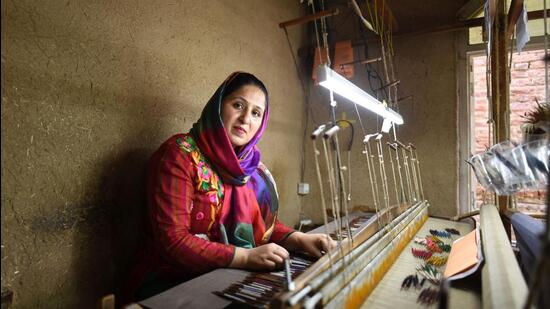
Shaheena Akhtar, 34, an award-winning Kani shawl entrepreneur based in Srinagar’s Old City, believes in doing the same, as she not only weaves trends into tradition but also helps weavers in distress, most of them women.
Of the six siblings born in a modest family, Akhtar is the only one with some college education in arts, but she had to drop out due to the family’s economic condition in 2004.
“I started learning shawl weaving from my elder brother, while our father, Ghulam Ahmad Rather, used to tin coat (kalai) copper utensils,” she recalls. Four of her siblings, including two brothers, became shawl weavers but her penchant for innovation began getting her business and recognition.
In 2014, she received Jammu and Kashmir’s exemplary entrepreneur award for her Kani shawls. In 2017, she was felicitated by Hindustan Times at its sixth edition of 30 young achievers from the region.
All was well until her marriage in 2017 to an abusive husband, who forced her to quit weaving. After 15 difficult months, she divorced but was not welcomed back by her brothers. She started from scratch, this time with some personal savings. “I wouldn’t have been here in the first place had my brothers not supported me. But then, things change. After the divorce, I became a stranger in my own house,” she says.
“I had started from zero and was back to zero. I took it as a challenge, and with the help of neighbours have succeeded again,” she says.
Akhtar started living with her mother in a part of their ancestral house and travelled to Amritsar in 2019 to participate in a handicraft exhibition. She took a loan to put her business back on track. Today it’s flourishing despite the Covid-19 restrictions.
After registering with the J&K handicrafts department in 2008, she participated in an exhibition the next year that was a turning point. “Few educated women join the shawl sector. That exposure gave me the confidence and insight into the demand,” she says. “People abroad prefer tone to tone shawls instead of colourful ones,” she says.
Akhtar recalls how one of her uncles was on the brink of bankruptcy. “He had woven shawls on traditional patterns, but there were no takers. He didn’t know the trend. Weavers hardly do, but with a little help, he started getting good returns,” she says.
Today, Akhtar is invited by the handicrafts department to give motivational speeches to women artisans. “More women are joining the handicrafts business. They realise that a woman is not insecure when she leaves home to do something in life,” she says.
At present, she provides employment to about 1,000 people, including Pashmina spinners, weavers, dyers and washers. Every year, she produces about 100 shawls, including plain Pashmina, Kani and Sozni. “I keep innovating. I’ve started a ready made garment business of pherans and stoles in addition to the shawls,” she adds.
She follows her heart to offer hope, serve a cause
While Akhtar finds strength in entrepreneurial pursuits, Qurat Ul Ain Masoodi, 35, found her calling in social work, particularly for orphans and women. “I studied at Mallinson Girls School in Srinagar, where we were taught to help the less fortunate, so I used to visit orphanages and the leper’s colony,” says Masoodi.
Originally from south Kashmir’s Khrew, her family shifted to Srinagar two decades ago. Her mother, Dilshada Banday, is a retired government teacher and father Saqlain Masoodi is a retired law professor. It was her parents, particularly her mother, who encouraged her to help people in distress.
She was pursuing engineering at the local SSM College in early 2000 when she decided to correct her course. “I had taken the eighth semester exam, but I wasn’t comfortable. My heart lay elsewhere,” she says.
Instead, she went to look after children in orphanages. Initially, she would take along small gifts for the inmates, but the pain in their eyes moved her to do something substantial.
During her visits, Masoodi found children of some orphanages were facing abuse, and she started highlighting their plight. “I was threatened with dire consequences and warned that being a young woman, this could become dangerous. But I continued raising the concern till the government closed all orphanages where children were being exploited,” she says.
The focus of her work in orphanages has been the mental health of the children. “I started a scholarship programme for orphaned students in January 2018. My organisation, Aash (Hope), offers free education, meals, books and uniforms to 50 needy students,” she says.
Gradually, Masoodi found herself travelling to remote areas of Kashmir, where people, particularly women, needed a helping hand out of poverty. “I’ve been working to improve the lot of women of underprivileged sections,” she says.
From obesity to powerlifting, she shoulders Olympic hopes
Thirty-three-year-old Upasana Mahajan’s journey was more inward, as she went from being an obese woman who contemplated suicide to a powerlifter representing India.
The year 2017 was the turning point. “I was working in Delhi with a multinational company as a human resource manager. Financially I was stable, but emotionally I was bogged down by the weight I was gaining day by day. I weighed 160kg. I needed a formal dress for an event the office had chosen me and to my shock I couldn’t even fit into size 8 XL,” says Mahajan.
Dejected, she returned home to Jammu. “I shut myself up in my room and cried for days. I just wanted to die. So, one day, I took out my scooty and rode to Hari Niwas Palace to find a suitable place to commit suicide,” she says.
Sitting beside the road, she decided to delete her social media accounts. “Someone on Facebook had mistakenly added me in the Institute of Nutrition and Fitness Sciences (INFS) page run by fitness expert Jitendra Choksi. That moment changed my life. I called them a scam and Choksi got into a conversation. My journey towards fitness had started,” she says.
She lost 9kg and a few inches in a month, but was yet to find her calling. In 2018, she came across a gym goer who used to do powerlifting. She again chanced upon a powerlifting event at Maulana Azad Stadium in Jammu. There was no looking back since then.
Since 2018, Mahajan has won three gold and two silver medals in state powerlifting championships, besides two bronze medals at the national level. She finished eighth in the 84+ kg category at the World Bench Press Championships organised by the International Powerlifting Federation at Narita in Japan in 2019.
Today, Mahajan is an official of the J&K Power Lifting Association and has been felicitated by Jammu and Kashmir lieutenant governor Manoj Sinha and additional director general of police Mukesh Singh for her achievements.
She is considered a Dogra icon, and the J&K tourism department and her alma mater, Lovely Professional University, Jalandhar, have honoured her. A BTech and MBA from LPU, she has studied B.Ed, done postgraduation in English and holds a diploma in advanced exercises.
“I’m enjoying life to the fullest. My family members are my biggest fans,” she says as she doubles up as a teacher on an education app.
Mahajan is training hard to improve her ranking in the international circuit. “It’s my dream to win a medal for India at the Olympics.”


