
 E-Paper



HT This Day: June 6, 1947 -- Cripps and Eden receive envelope-bombs
Three more envelope-bombs, addressed to “prominent Britons” and believed to have been sent by Jewish terrorists operating from Italy, were handed over to Scotland Yard today.


Three more envelope-bombs, addressed to “prominent Britons” and believed to have been sent by Jewish terrorists operating from Italy, were handed over to Scotland Yard today.
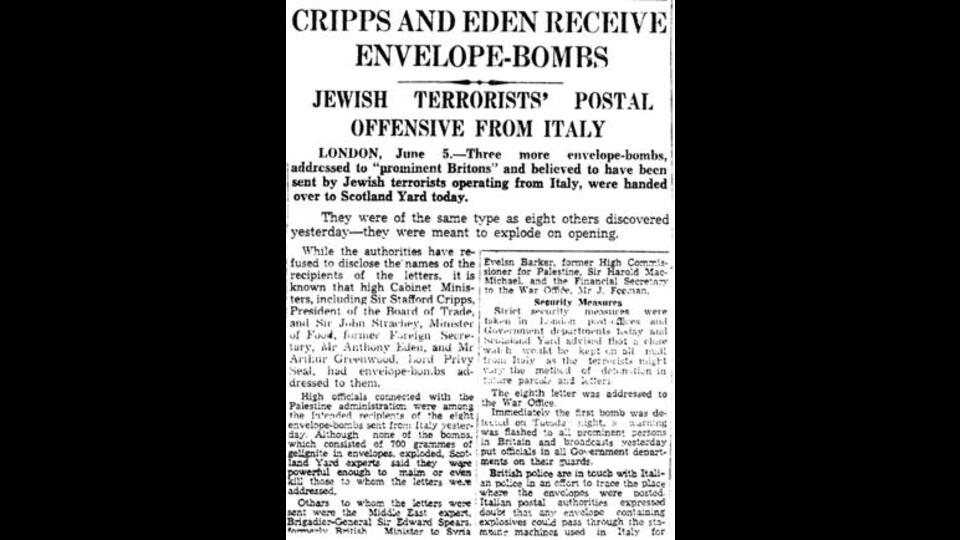
They were of the same type as eight others discovered yesterday-they were meant to explode on opening.
While the authorities have refused to disclose the names of the recipients of the letters, it is known that high Cabinet Ministers, including Sir Stafford Cripps, President of the Board of Trade and Sir John Strachey, Minister of Food, former Foreign Secretary, Mr Anthony Eden, and Mr Arthur Greenwood, Lord Privy Seal, had envelope-bombs addressed to them.
High officials connected with the Palestine administration were among the intended recipients of the eight envelope-bombs sent from Italy yesterday. Although none of the bombs, which consisted of 700 grams of gelignite in envelopes, exploded, Scotland Yard experts said they were powerful enough to maim or even kill those to whom the letters were addressed.
Others to whom the letters we a sent were the Middle East expert, Brigadier-General Sir Edward Spears, formerly British Minister to Syria Evelyn Barker, former High Commissioner for Palestine, Sir Harold Mac Michael, and the Financial Secretary to the War Office, Mr J. Feeman.
Security Measures
Strict security measures were taken in London post offices and Government departments today and Scotland Yard advised that a close watch would be kept on on all mail from Italy as the terrorists might vary the method of detonation in future parcels and letters.
The eighth letter was addressed to the War Office.
Immediately the first bomb was defused on Tuesday night, a warning was flashed to all prominent persons in Britain and broadcasts yesterday put officials in all Government departments on their guards.
British police are in touch with Italian police in an effort to trace the place where the envelopes were posted. Italian postal authorities expressed doubt that any envelope containing explosives could pass through the stamping machines used in Italy for marking mail.


