The Bharatiya Janata Party (BJP) is set to retain power in India’s most populous and politically crucial state of Uttar Pradesh, and the Aam Aadmi Party (AAP) is likely to get its first full state to rule in Punjab, a clutch of exit polls predicted on Monday.
The polls also said that the BJP would win Manipur, and threw up a mixed forecast for Uttarakhand and Goa.
The month-long five-state assembly elections round, the largest till the 2024 general election, ended on Monday. The results will be announced on Thursday.
In UP, the BJP was seen comfortably crossing the halfway mark of 202 by most exit polls. Some surveys, prominently the Axis My India-India Today, predicted that the party was on course to repeating its unprecedented victory in the 2017 elections, when it won 312 seats and garnered around 40% of the votes.
If the BJP returns to power in UP – no exit poll gave the advantage to the Samajwadi Party (SP)-led Opposition alliance – it will be the first party in a generation to complete a full term and retain government in the state. The party has comprehensively won the past three elections – the 2014 and 2019 general elections and the 2017 assembly elections – on the back of the popularity of Prime Minister Narendra Modi, outreach among small Dalit and backward groups, targeted welfare delivery, and its Hindutva agenda.
If the exit polls hold, chief minister Yogi Adityanath will also emerge as a popular leader in the state, and among the most prominent in the BJP stable across the country.
{{/usCountry}}If the exit polls hold, chief minister Yogi Adityanath will also emerge as a popular leader in the state, and among the most prominent in the BJP stable across the country.
{{/usCountry}}Rahul Verma, fellow at Centre for Policy Research, said that exit polls in Uttar Pradesh — and Punjab — were unanimous about the direction and victor. “If exit polls are right, then we are only looking at the magnitude of victory; it is less likely that the trends that have been predicted will get overturned on counting day.”
For UP, this means, Verma said, that the BJP and chief minister Yogi Adityanath have defied the weight of history. “It also means that the party has retained the social coalition it created in 2017 and 2019. Like the Rashtriya Janata Dal in Bihar, the SP in UP too seems to have faltered in creating a broad-based social coalition.”
For Punjab, Verma said, AAP’s arrival had “serious ramifications for the Congress”. “The AAP is likely to build on these gains in Punjab and Goa, and will attempt to cannibalise Congress in Gujarat and Himachal Pradesh, two states polling later this year.”
The UP exit polls were united in predicting a complete collapse of the Bahujan Samaj Party (BSP), which has lost four consecutive polls in the last decade, and the Congress, which ran a women-centric campaign but may have suffered due to non-existent cadre presence on the ground.
The polls suggested that the SP-led alliance could improve from their performance in the 2017 polls, and even better its vote share from the 2012 polls, when it won a simple majority, but added that the BJP might significantly outdo the Opposition bloc by breaching its already impressive 40% vote share – by eating into the BSP base. Two surveys also suggested that women voters may have backed the BJP in larger numbers than previously predicted.
BJP’s Amit Malviya said that if the party is re-elected in UP, it would be the first to do so in 37 years. “BJP is winning UP (per exit polls). It would be for the first time since independence a CM would complete a full term and get re-elected. Also for the first time in 37 years, since 1985, BJP would be the only party to get re-elected. Irrespective of seats, it would be phenomenal,” Malviya said.
Samajwadi Party spokesperson Ghanshyam Tiwari said, “Exit polls may show a contest (between parties), but on ground, we have not seen a contest. We will have a thumping majority on March 10.”
To be sure, exit polls are not always accurate and have often got the verdict wrong in earlier elections, especially in states with diverse populations, castes and communities. But they are useful in identifying trends.
Two exit polls predicted AAP will sweep Punjab, a state where the party’s disciplined and cohesive campaign struck a chord among voters who traditionally swung between the Congress and the Akali Dal administrations. Other surveys predicted a narrow majority for the AAP, or even a hung assembly, with the incumbent Congress in a distant second place. The Akalis and the BJP, which fought the election in alliance with ousted chief minister Amarinder Singh, were seen to be doing poorly.
If the AAP wins Punjab – the party was poised to do well in the 2017 assembly elections as well but ended up with only 22 seats in the 117-member assembly– it will get the first full state to rule, and expand its base outside the national capital, which is a Union Territory with crucial powers vested in the lieutenant governor (LG), after many disappointing campaigns. If these results hold, it will also prompt a churning in the national Opposition space as the Congress will lose one of only three states it rules on its own.
The Aam Aadmi Party has emerged as the fastest growing party in the country, the party’s Punjab co-incharge and MLA from Delhi’s Rajendra Nagar, Raghav Chadha said after the exit polls were announced.
“If these are the results on March 10, then it tells us that the Aam Aadmi Party is the fastest growing political party in the history of independent India. When BJP was incorporated with the backing of the Jan Sangh, it took the BJP a decade to win its first state and AAP has already won Delhi thrice and now is going to form the government in the state of Punjab. The AAP is going to be the national and the natural replacement of the Congress. Arvind Kejriwal is going to be the principal challenger of the BJP in 2024,” he said.
In the hill state of Uttarakhand, the exit polls predicted a close fight between the incumbent BJP and the challenger Congress, with little space for any third player such as AAP. All exit polls predicted that the difference in vote share between the two parties might be slim, and that the elections might be decided in a handful of close contests. The BJP went into the elections after changing its chief minister twice last year in a bid to beat anti-incumbency. The Congress will be hoping to continue the state’s political trend of alternating power every five years.
In Goa, too, exit polls predicted a hung House, but indicated that the key to forming a government may be the high-profile newcomers AAP and Trinamool Congress (TMC). Both the BJP and the Congress were seen in a neck-and-neck fight but falling some distance short of the majority mark of 21. Goa was a state where the Congress emerged as the single largest party in 2017 but saw its chances evaporate as the BJP quickly managed to cobble together a coalition. This time around, the Congress rejected a proposal to form a joint Opposition platform with the TMC and other parties.
But in another state where the Congress emerged as the single largest party in 2017 only to lose out, Manipur, the party’s support base appeared to have shrunk, according to the surveys. Most polls gave the edge to the BJP, which was the incumbent, and one survey (Axis My India-India Today) said that the party will cross the majority mark of 31 in the assembly.
Following the announcement of the exit polls, a tweet from Youth Congress’s official handle said, “Exit polls may or may not predict, but the exit of BJP is for sure this time.”
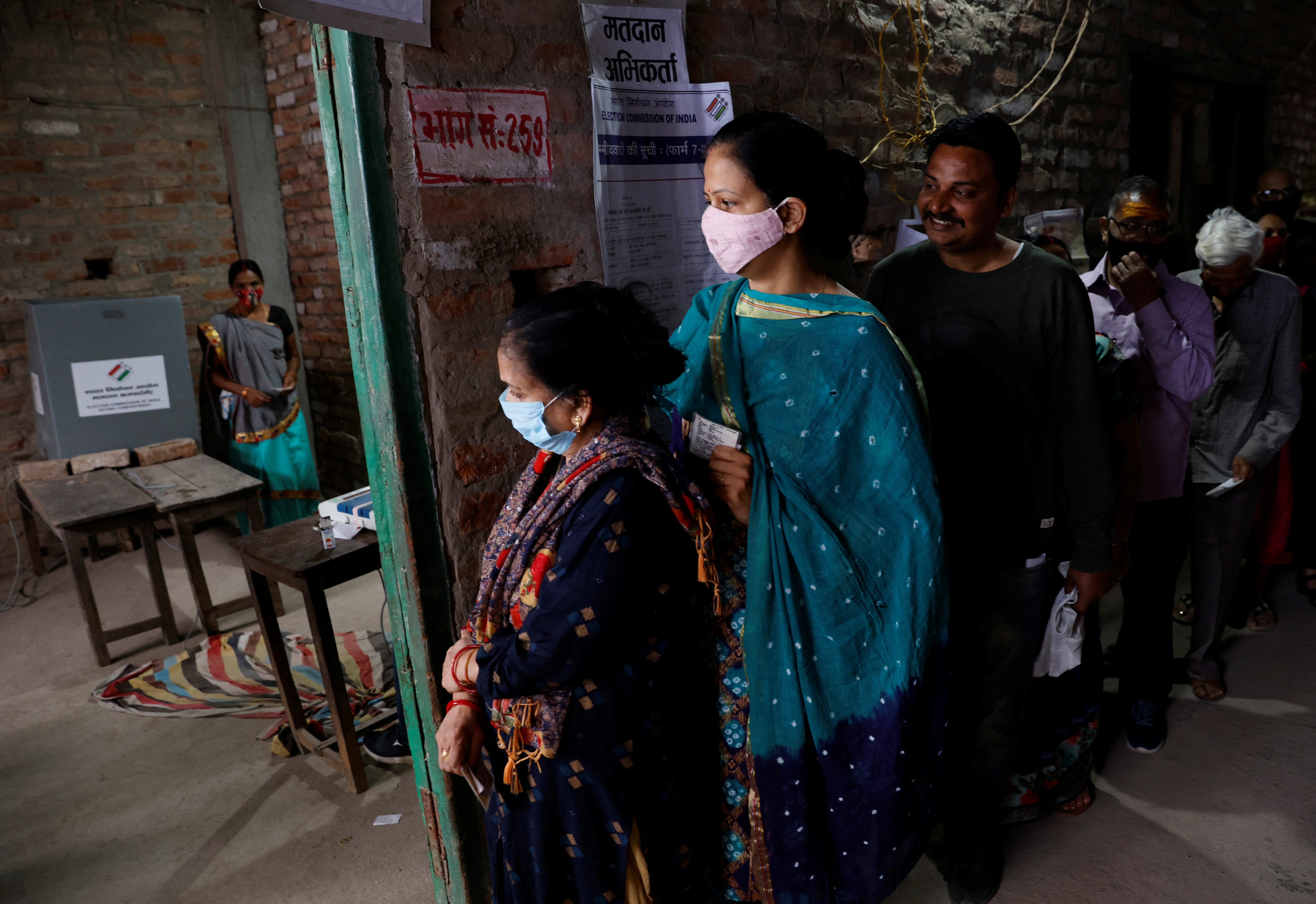
The elections were held in the shadow of the third wave of the pandemic, which forced the Election Commission to impose unprecedented curbs on physical campaigning at first, and relax it progressively over the next month.
A total of 690 constituencies went to the polls across five states.