
 E-Paper



Explained: Lightning, its effects and precautions to be taken
Lightning is a sudden electrostatic discharge during an electrical storm with a frequency of around 40-50 times a second on Earth, some of which may be seen even before the thunder is heard.


One person died and three others sustained injuries on Friday when a tree under which they were taking shelter from the rain was struck by lightning in Sector 82 of Haryana’s Gurugram. All four of them, the staff of the horticulture department, were rushed to the hospital where 38-year-old Ram Prasad later succumbed to his injuries. Officials later said Shiv Dutt, 43, Lali, 32, and Anil Kumar, 32, were stable and recovering after the accident in the residential township Vatika India Next.
On camera: Lightning hits tree in Gurugram, injures 4 who took shelter
Here’s a look at what is lightning and how does it take place:
What is lightning?
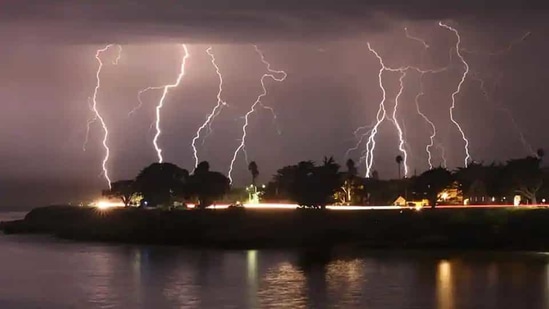
Lightning is a sudden electrostatic discharge during an electrical storm with a frequency of around 40-50 times a second on Earth, some of which may be seen even before the thunder is heard. But sometimes, distant lightning can be seen but maybe too far away for thunder to be heard. Lightning is of three forms: intra-cloud lightning, cloud to cloud lightning and cloud-to-ground lightning. Cloud-to-ground lightning is the most common form of lightning and accounts for about 25 per cent of cases in the world.
How does lightning take place?
During a thunderstorm due to separation of charge, the air currents start to move upwards while the water droplets simultaneously move downwards. Positive charges, therefore, start collecting near the upper edge of the cloud and the negative charges gather near the lower edge as well as close to the ground. When the magnitude of the charges becomes huge, the water droplets which are in the air start acting as the conductor of the charges and thus, the charges flow to meet, resulting in lightning and thunder.
What are the precautions which should be taken against lightning?
During lightning, taking shelter under a tree or lying on the ground can be very dangerous. Staying indoors is safer but touching electrical fittings, wires, metal and water must be avoided.


