E-Paper



Eye on US, Jaishankar says India, Russia need to be creative to overcome challenges
Jaishankar also sought urgent steps to address the sharp imbalance in India-Russia trade and to diversify trade and investment between the two sides

 Prefer HTon Google


NEW DELHI: India and Russia should adopt a “more creative and innovative approach” to tackle challenges posed by a complex geopolitical situation, external affairs minister S Jaishankar said on Wednesday while co-chairing a meeting of a bilateral economic panel amid US threats of punitive action against energy trade between New Delhi and Moscow.
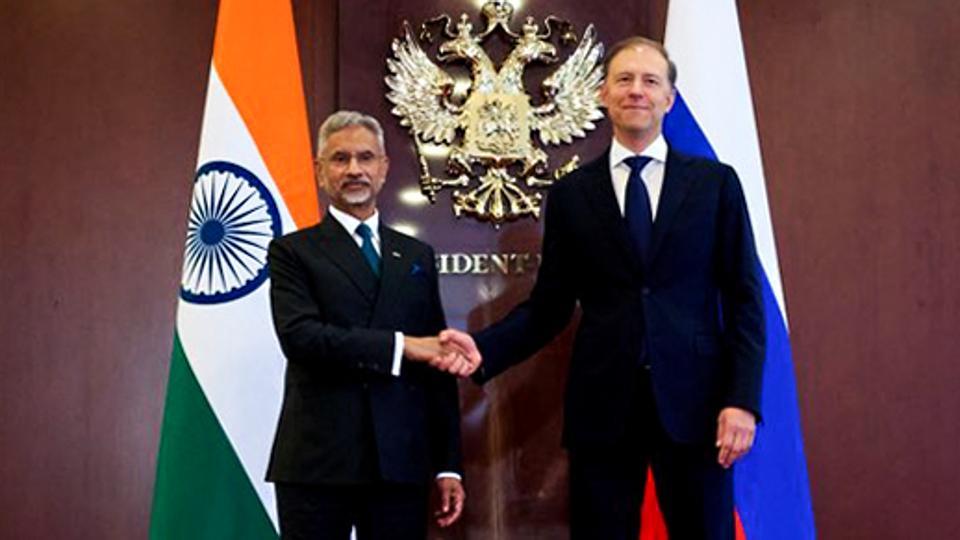
Jaishankar also sought urgent steps to address the sharp imbalance in India-Russia trade and to diversify trade and investment between the two sides, while addressing the meeting of the India-Russia Inter-Governmental Commission for Trade, Economic, Scientific, Technological, and Cultural Cooperation (IRIGC-TEC) in Moscow.
The meeting, part of preparations for Russian President Vladimir Putin’s planned visit to India later this year for a summit with Prime Minister Narendra Modi, was held against the backdrop of the Donald Trump administration in the US railing energy trade between India and Russia. The US is set to impose a 25% punitive tariff on Indian exports from August 28 over Russian oil purchases, which will be in addition to a 25% reciprocal tariff.
“We are all acutely aware that we are meeting in the backdrop of a complex geopolitical situation,” Jaishankar said without referring to the trade and tariff policies of the US. The different working groups under the IRIGC-TEC, he suggested, should adopt a “more creative and innovative approach” to face the challenges posed by the geopolitical landscape.
Russian deputy prime minister Denis Manturov, who co-chaired the meeting, emphasised Moscow’s commitment to continuing to meet New Delhi’s energy needs. “We continue to ship fuel, including crude oil and oil products, thermal and coking coal. We see potential for the export of Russian LNG,” he said.
The Indian side reiterated its concerns about the imbalance in two-way trade, driven largely by purchases of Russian energy, while Indian exports have remained stagnant. Bilateral trade reached a record of $68.7 billion in 2024-25, although India’s exports were valued at only $4.88 billion.
Jaishankar noted that two-way trade in goods has increased more than fivefold in the past four years, whereas the imbalance has risen ninefold from $6.6 billion to $58.9 billion. “So we need to address that urgently,” he said.
He suggested that addressing tariff and non-tariff trade barriers, removing bottlenecks in logistics, promoting connectivity through the International North-South Transport Corridor, Northern Sea Route and Chennai-Vladivostok Corridor, and implementing payment mechanisms smoothly could help tackle the imbalance and allow the two sides to achieve the target of growing trade to $100 billion by 2030.
Jaishankar also called for the early conclusion of the India-Eurasian Economic Union free trade agreement, whose terms of reference were finalised on Wednesday. Economic cooperation can be deepened by the smoothness of trade settlements, diversification of the trade basket, creating more joint ventures and collaborating on the mobility of professionals, he suggested.
“We should not get stuck on a beaten track. Doing more and doing differently should be our mantras,” he said, while calling for the setting of quantifiable targets and specific timelines for trade and investment and for tackling barriers.
India and Russia have two inter-governmental commissions, one for trade and technology-related issues and another for defence and military cooperation, and these are among the highest bilateral decision-making bodies. The India-Russia Inter-Governmental Commission on Military Technical Cooperation is set to meet in New Delhi in the coming weeks.
Manturov said that in addition to direct supplies of crude oil, the two sides are jointly implementing projects to extract and process hydrocarbons in Russia and India. “We plan to expand comprehensive cooperation in the peaceful nuclear sector, including on the basis of the successful experience of the Kudankulam NPP construction project,” he said.
Putin and Modi have spoken on the phone twice in recent weeks to discuss the situation in Ukraine and the overall bilateral relationship. The fallout from the actions of the US administration is also understood to have been discussed in their phone conversations.
The external affairs ministry has defended India’s purchases of Russian energy and bilateral defence ties on the grounds that they are linked to the country’s energy and national security interests.