
 E-Paper



Fear, uncertainty grip Assam ahead of NRC list
Final NRC will be published at 10am on Saturday. HT interviewed 40-odd people across four districts and found varying degrees of apprehension about what future holds, but no widespread panic about deportation or drastic measures to axe citizenship benefits.


Nur Islam Ali used to be a busy mechanic in lower Assam’s Dwarkuchi, a small hamlet in Baksa district, but since March this year, he has had no time on his hands for business. The 23-year-old has attended six hearings between March 12 and May 22 in order to get his name on the National Register of Citizens (NRC) – borrowing Rs 20,000 to attend the events held across three districts.
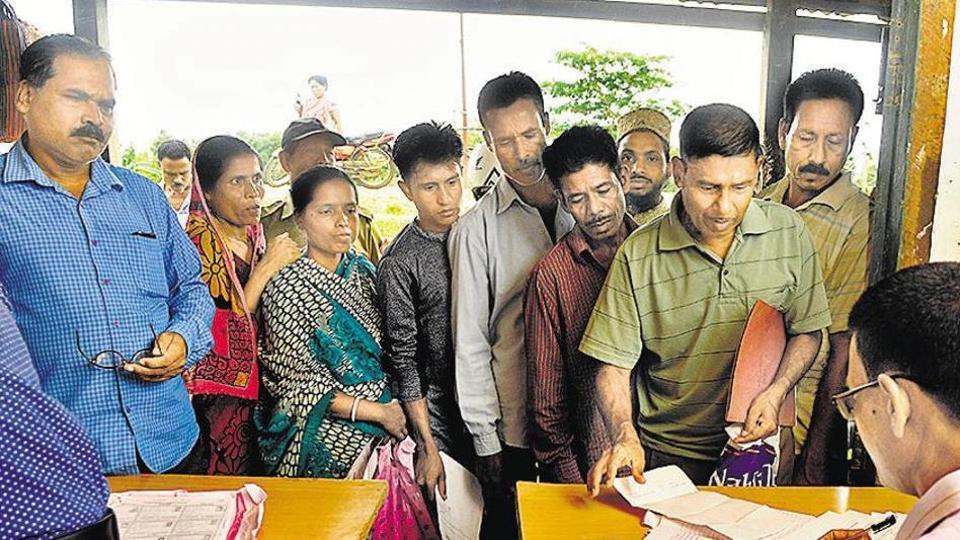
He thought he had a good shot – his grandfather Hussain Ali’s name was on the 1971 electoral rolls, and his grandmother, Tahira Khatun, figured in the 1966 voters list – but he didn’t find his or his mother’s name on the draft NRC released in July 2018. And, with a day to go for the final NRC publication, he is not hopeful of making it to what is one of the world’s largest citizenship enumeration exercises.
“We are quite tense. We don’t know what will happen if we don’t make it – we have heard that they make take away our ration card,” he says, even though the government has repeatedly assured citizens that an appeals process is in place, and no immediate action will be taken against those who don’t make it to the NRC.
His neighbor Muzammil Hussain echoes his feeling. His name was on the draft NRC but an objection was raised to his inclusion. When he went to the hearing – a process instituted to adjudicate claims against both inclusion and exclusion from the July 2018 list – he found that the objector, who was identified by a single name, Deepak, was not present. “Now I am worried whether I will make it again. The NRC has made us value these torn papers more dearly than gold or silver,” he says.
The final NRC will be published at 10am on Saturday. HT interviewed 40-odd people across four districts and found varying degrees of apprehension about what the future holds, but no widespread panic about deportation or drastic measures to axe citizenship benefits.
The NRC has left some of its ardent backers disappointed.
Abhijit Sarma of Assam Public Works, one of the original petitioners to the Supreme Court, said the authorities have allowed “illegal elements” to seep into the list. “We are going to approach the Supreme Court and the president, asking for 100% reverification. In the current list, we fear that genuine Indians may be struck off and aliens accommodated because of corruption and fabricated legacy data.”
Another initial backer of the process, Supreme Court lawyer Upmanyu Hazarika, says the NRC process is riddled with errors. “It was subverted by the foreigners’ lobby and it is evident from the fact that the border districts, which have the highest rates of influx of outsiders, have the lowest rate of exclusion.”
Living On Edge
In the Hindu Bengali village-dominated Salmara-Dumuria village in Assam’s Baksa district, residents are quite edgy and waiting to see if the hamlet’s 190 families will figure in NRC.
In a provisional citizens’ list published last year, claims of 180 households to citizenship in the village were found invalid. Millions left out of the draft list released last year are pinning their hopes on what is set to be a final roll of valid citizens.
The exercise is deemed critical to people’s political status in a state where locals have long resented the presence of illegal settlers from neighbouring Bangladesh, who are said to have entered Assam in several waves of illegal mass migration.
The process of updating the NRC, which started in 2015, has been quite elaborate, well-structured and multi-stage process monitored by the Supreme Court.
By very design, citizens were required to show that they or their ancestors were present in Assam before March 25, 1971 through so-called “legacy data” comprising two sets of documents. One set would establish their ancestors’ presence before the cut-off date. They then need to provide a second set of documents to trace lineage to their ancestors.
However, it’s easy for people to be struck of the list in a country where record-keeping is poor and doesn’t conform to a single standard.
Sanjay Sammanit’s family are among the 180 households in Salmara-Dimuria whose claims were rejected for what appears to be a typo. Sammanit’s father, Satyendra, had migrated from Bangladesh in 1964 and possessed a so-called citizenship card given at the time to refugees fleeing Bangladesh, then East Pakistan.
The “citizenship card” would have been enough for his family to be included in the NRC. However, Sammanit’s father name is spelt slightly differently – without the “y” -- in his school certificate. That was it.
His elderly aunt Jyotsna Sammanit, a widow, is out of the list too. “You tell me, what should we do?” she asks, desperately.
The only person in the family to have made it is Sanjay’s wife Jhuma – because she proved her ancestry through her father’s documents, but her two brothers did not figure in the July 2018 provisional list.
Their neighbour Jagganath Kumar Dey, whose family was out of the draft list too, doesn’t see much hope of figuring in the final list. “We don’t think we will get justice even from the Foreigners’ Tribunal because the Assamese are biased against us,” he says.
Despite some resentment towards the local NRC officials, nobody appears panicky and everybody are determined to establish their claims to citizenship through Foreigners’ Tribunals which are quasi-judicial bodies. A strong beacon of hope for them is the Bharatiya Janata Party (BJP)’s assurance that it would protect Hindu Bengalis. According to the BJP, Hindu Bengalis have a natural claim to residing in India since they fled religious persecution in East Pakistan.
‘As Indian As Anyone’
Situated on the northern banks of the Puthimari river, Dokkhin Borni village in Kamrup Rural district is dominated by Bengali-speaking Muslims, known colloquially as Miyas. The village of roughly 2000 people is out on its muddy roads at sunset to enjoy a cup of tea, catch up on local gossip or play a game of carrom as the evening breeze blows over them. There is a sister village, also populated by Miyas, called Number 1 Velkar, on the opposite bank of the river.
On Friday evening, with a few hours to go for the NRC publication, the mood in the village is relaxed. Roughly 80% of its citizens have made it to the draft NRC, courtesy an elaborate system of storage of legacy documents that many local families say they have perfected.
When the NRC process was announced in 2015, Yusuf Ali, 27, rushed to his grandfather Basher Ali who had in his possession all family legacy documents, including the 1951 NRC and the 1966 voter list – which the four Ali brothers used to trace their lineage and enter the NRC.
“Our families were always fearful that we would be asked to prove we are Indian, so we carefully saved all document,” said Ali. His district of Kamrup Rural has one of the lowest exclusion rates in the state – 5.18% compared to the state average of 12.15.%
Villagers said the hostility and scorn heaped on them because of their dialect and faith – they are often called aliens and Bangals and various slurs – steeled their determination to make it to the NRC. “We wanted to show everyone that we are not outsiders, we came here before most people, and as Indian as anyone,” said Saddam Hussein, a local resident.


