
 E-Paper



Fires, dust, weather plunge Delhi into air emergency
Delhi breathed its filthiest air of the season on Tuesday, when the air quality index (AQI) jumped to the “severe” zone for the first time this season, as a lethal combination of farm fires in northern states, still local winds, dust from construction sites, and cool temperatures pushed the Capital headlong into a pollution emergency.


Delhi breathed its filthiest air of the season on Tuesday, when the air quality index (AQI) jumped to the “severe” zone for the first time this season, as a lethal combination of farm fires in northern states, still local winds, dust from construction sites, and cool temperatures pushed the Capital headlong into a pollution emergency.
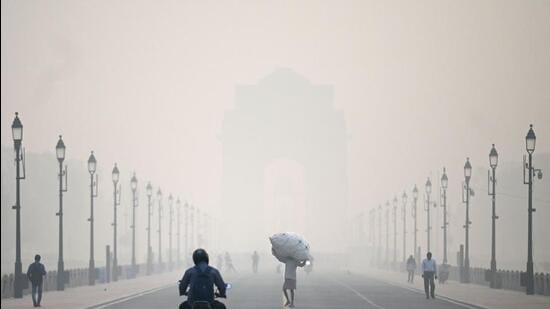
The city clocked an AQI of 424, according to the Central Pollution Control Board’s (CPCB) 4pm bulletin, higher than 392 (“very poor”) a day ago. The trailing 24 hour average AQI at 4 pm is taken as the day’s reading and this is the first time the Capital’s air is breaching the 400 level.
Tuesday was Delhi’s most polluted day this year, with the city’s air last more noxious on December 26, 2021, when AQI spiralled to 459.
Of the 38 air stations in Delhi, on Tuesday, 28 had readings in the “severe” zone (401-500) at 4pm, according to CPCB’s Sameer app. The rest were all “very poor” (301-400). To be sure, CPCB’s air quality monitors max out at 500 and don’t capture pollution levels beyond that mark.
The direction of winds is likely to change from Wednesday, under the influence of a western disturbance, keeping smoke from burning paddy fields in Punjab away from Delhi for a few days, apart from clearing up some pollutants trapped in the air, predicted experts.
An official of the India Meteorological Department (IMD) said that while the western disturbance will not bring Delhi any rain, it will bring in winds from the south-east.
Also read: Delhi govt bans construction work, blames UP diesel buses for pollution
“Winds will completely change to southeasterly by Thursday evening. Wind speeds will also pick up to 10-15 km/hr,” said an official.
But this relief will, in all likelihood, be marginal and temporary, warned forecasters, stressing that the hazardous pollution levels are here to stay for much of this month at least. In two of the last four years, November was the most polluted month (in the other two, it was December).
Even as experts held farm fires in Punjab culpable for the sepia haze that has tinted Delhi, they added that local factors have started to play a key role in the mounting pollution.
The northern state on Tuesday logged 1,842 stubble burning incidents, according to the state government. This contributed to 14% of Delhi’s PM2.5 levels (a dip from 22% a day ago), according to data from the System of Air Quality and Weather Forecasting And Research (Safar), under the aegis of the Union earth sciences ministry.
However, farm fires are still to peak, with the daily count hitting a high of 5,866 last year on November 5. At their worst, smoke from stubble fires can contribute to nearly half of Delhi’s pollution, a proportion yet to be reached since a significant section of farmland is still to be cleared in the upwind state.
Punjab has seen 17,846 farm fires between September 15 and November 1 this year, as against 15,065 during this period last year and 37,078 in 2020. The state clocked more than 71,000 fires all of last year, and has recorded an average of over 63,000 blazes over the past six years.
However, in Delhi, local emissions, together with lethargic winds and an unhelpful mixing height have kept pollutants trapped firmly in the city’s air, with low night-time temperatures compounding the problem.
The mixing height is an invisible layer within which particulate matter gets trapped. The lower it is, the worse the air gets, as pollutants are closer to the surface and are unable to disperse.
The mixing height has been between 500 to 1,000 metres over the last 48 hours, dropping lowest at night time, when the temperature dips. In the summers, this mixing height is 3,000 to 4,000 metres from the ground, allowing considerable room for dispersion to take place.
Further, widespread violations of the ban on private constructions have worsened air quality generally, with residents across the city throwing caution to the wind and adding to the dusty conditions.
The Centre for Air Quality Management (CAQM), the body tasked with keeping pollution levels in the National Capital Region (NCR) in check, on Saturday imposed a ban on constructions and demolitions (except those for Metro stations, railways and others of national importance), as part of Stage 3 of the Graded Response Action Plan (Grap).
However, much like the ban on firecrackers, the law seems to have been heeded sparingly.
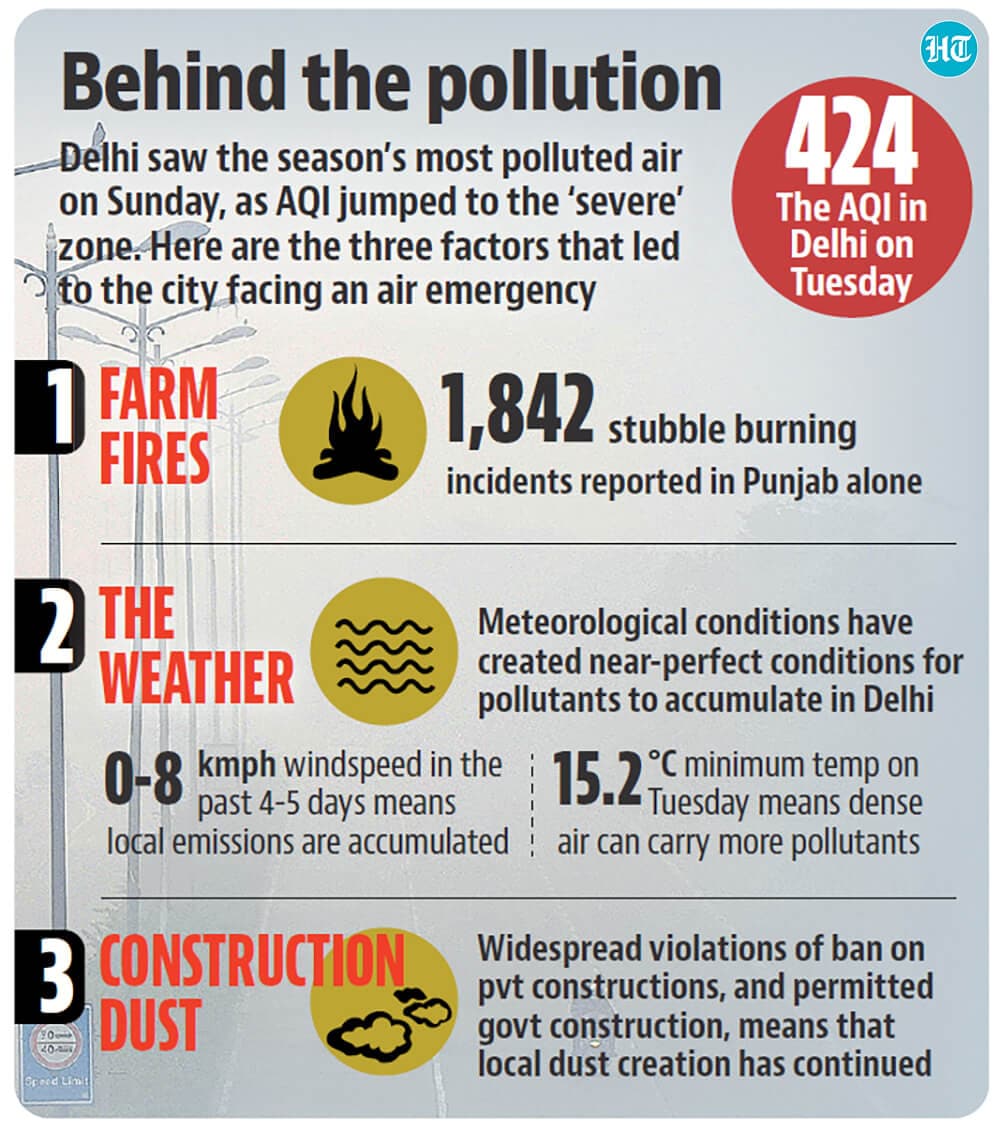
During a spot-check on Tuesday, HT spotted violations of dust norms in places like Sarojini Nagar, Kilokari-Maharani Bagh, Sarai Kale Khan and Anand Vihar. These localities host some of the major public infrastructure construction sites in the city. While such sites are exempted from construction ban under Stage 3 restrictions, they need to follow the 14 mandatory regulations, varying from simple measures like building tin walls around the construction sites, covering the construction material, spraying water in non-cemented areas, and anti-smog guns at larger sites, among others. The violations spotted at these sites included uncovered construction material, lack of windbreakers in some sections, unpaved road leading to construction area.
An environment department official said 586 teams had been formed by the Delhi government to enforce the ban on construction and demolition activities, with sites not following the 14-point guidelines to be fined on the spot. “If there are numerous violations or if corrective action is not taken, the site can be shut down too. The norms are also being checked at sites currently not operational due to the ban,” the official said, asking not to be named.
Delhi’s descent into an air quality disaster began two days after Diwali (last Monday), even though pollution levels before, on and during the festival itself were far lower than usual, thanks to strong winds that swept under the carpet the crippling impact of unimpeded violations of the ban on firecrackers.
But the hospitable weather conditions reversed rapidly from Friday, when the AQI jumped to 354 from 271 a day ago. This happened as long-range winds blew in from the northwest, bringing in smoke from stubble fires, which also picked up after Diwali.
Also read: DMRC trials new high-tech entertainment content service
VK Soni, scientist at IMD and a CAQM member, said Delhi was bearing the ill-effects of stable meteorological conditions.
“These have not changed for the last three days. While Stage 3 measures were imposed on Saturday, there was a slight dip on account of these control measures, but the AQI has once again risen as winds are not strong enough to disperse pollutants.”
According to the Early Warning System (EWS) for Delhi, which CAQM uses to decide Grap measures, Delhi’s AQI may improve to “very poor” by Thursday. It will however, remain, “severe” on Wednesday.
Cool nights have added to Delhi’s noxious pollution cocktail
While Delhi recorded a maximum temperature of 33 degrees Celsius (°C) on Tuesday — two degrees above normal, the minimum was 15.2°C, one below normal.
The IMD forecast said the day-time mercury will remain around 32°C degrees for the next two days and nights will stay between 15°C and 16°C.


