
 E-Paper



Five years later, BJP gamble on Yogi earns rich dividends
When Prime Minister Narendra Modi picked Yogi Adityanath as the chief minister of Uttar Pradesh in 2017, it was a surprise not just for those outside the party fold but also to a majority inside the party

 Prefer HTon Google


When Prime Minister Narendra Modi picked Yogi Adityanath as the chief minister of Uttar Pradesh in 2017, it was a surprise not just for those outside the party fold but also to a majority inside the party. The Bharatiya Janata Party (BJP) had won the election solely on the basis of PM Modi’s appeal. When asked about the selection, a senior BJP leader said at the time, “This is the PM’s pick. And he is keeping an eye on 2019 and 2022; you need a strong leader who can stamp his authority, appeal to the base, and say no in a hyper-politicised state like UP to be able to run an effective administration, to be able to win the state again. Among all our leaders, only Yogi can do that.”
When Prime Minister Narendra Modi picked Yogi Adityanath as the chief minister of Uttar Pradesh in 2017, it was a surprise not just for those outside the party fold but also to a majority inside the party. The Bharatiya Janata Party (BJP) had won the election solely on the basis of PM Modi’s appeal. When asked about the selection, a senior BJP leader said at the time, “This is the PM’s pick. And he is keeping an eye on 2019 and 2022; you need a strong leader who can stamp his authority, appeal to the base, and say no in a hyper-politicised state like UP to be able to run an effective administration, to be able to win the state again. Among all our leaders, only Yogi can do that.”
|#+|
Five years later, that gamble has paid off – and how.
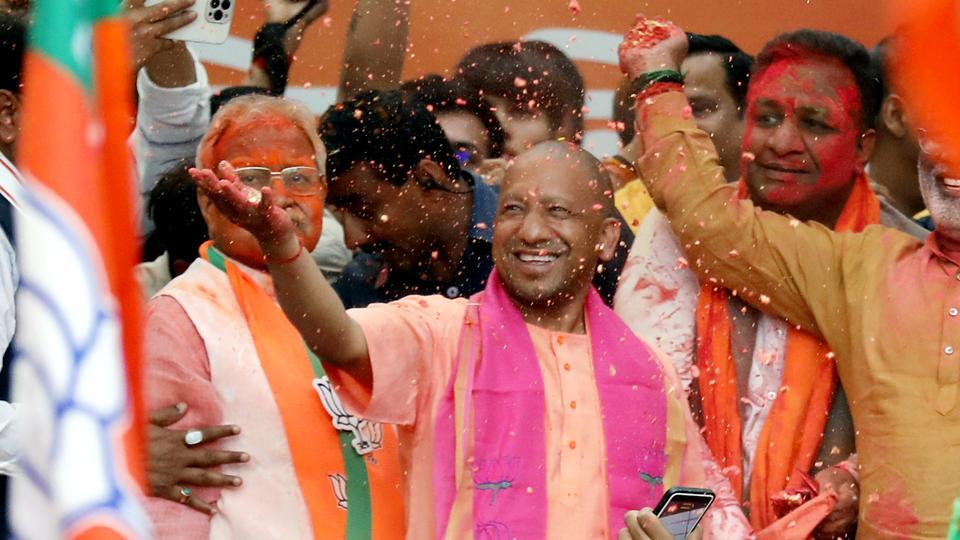
Adityanath has become the only leader in post-Independence India to have served as the UP CM for five years, and then got re-elected for another five-year term. For the first time since 1985, a party has returned to power in the state, with an electoral majority, for a second term. In a mark of the increasing fusion of political and religious power, he is also the first religious leader – Yogi remained the mahant of the Gorakhnath math after becoming CM – to have assumed and successfully retained a top political executive position.
And indeed, the precise reasons why the PM is understood to have picked Yogi in 2017 appear to have helped him in 2022 – with a high degree of support from home minister Amit Shah, party president JP Nadda, and state-in-charge Dharmendra Pradhan, and state organisational general secretary Sunil Bansal.
A senior party leader closely involved in the election said, “This was different from 2017 in four ways. One, back then, we won due to Modiji’s appeal and the anger against the Samajwadi Party (SP). In 2022, we had Modiji, but, for voters, the election was also about whether you wanted Yogi or you wanted to remove him. Two, we had a record. And Yogi’s emphasis on law-and-order was the single biggest factor that appealed across castes and communities, urban and rural areas, and among men and women.”
Critics have alleged that the improvement in public order came at the expense of the rule of law, with reports of extrajudicial executions, but that does not seem to have affected the calculus of the electorate. Party leaders say this factor added to the appeal. “The CM was not interested in the background of the criminal, did not listen to his political patrons, and empowered the police and the bureaucracy to do whatever was necessary; this was a big plus and this is what we meant when we spoke about a strong leader,” said the second leader quoted above. This was coupled with the effective delivery of welfare schemes, and a razor-like focus on projects in each district.
The third way the election was different, according to the leader, was the strength of the organisation.
“In 2017, we had just about created the organisation based on the work done by Amit Shah in 2014. By 2022, this machine has expanded even more. We have workers everywhere, and we have the ability to reach out to voters, particularly beneficiaries of schemes, to an unprecedented degree.”
And finally, the reason the BJP won was the often deliberate, often unstated factor, of religious polarisation. “It is not about the party saying it. If Hindu voters in a particular constituency see Muslims are voting in bulk for a particular party, then they automatically consolidate in another direction. And with Yogi as the face, we are then the natural alternative,” said a third leader.
But, most significantly for the future, this victory arguably marks Adityanath’s 2007 moment. It was his second electoral win in 2007 in Gujarat that had made Narendra Modi a serious contender for national leadership in the BJP; and it is the onset of his second term in office that catapults Yogi as a serious contender for leadership in the future.
Modi had to wait for another six years, see LK Advani lead the party (to a debacle) in 2009, and win another term in 2012 before he became the party’s pick as the PM candidate in 2014. Just like Modi, Yogi will have to wait, as Modi leads the party in 2024. Modi’s absolute control over the party, and his likely success in 2024, also means that, unlike Advani in 2013, Modi will have a decisive say in the selection of the next leader. And like Modi, Yogi will have to invest now in an image-transformation exercise to appeal to a broader electorate.
A lot can indeed change in political theatre by then, but the continued salience of the politics of religion, the centrality of geography (UP is more of a springboard for national politics than Gujarat), the persistent appeal of a “strong leader” among India’s voters, and the fusion of a pro-corporate and pro-welfare identity will, at the very least, catapult Yogi as a contender.
The significance of what happened on March 10, 2022 may well be in what we see on the national stage later this decade.


