
 E-Paper



Flip side of cracker ban: 40% drop in fireworks business at Sivakasi
This is due to the ban on using barium nitrate, and lower demand because of restrictions across the country on the use of crackers, according to manufacturers.

 Prefer HTon Google


There is a 40% dip in manufacturing of fireworks in Sivakasi in Tamil Nadu due to the ban on using barium nitrate – some states and Union territories have mandated green fireworks which do not use this chemical – and lower demand because of restrictions across the country on their use (there is an outright ban in Delhi, for instance), according to manufacturers.
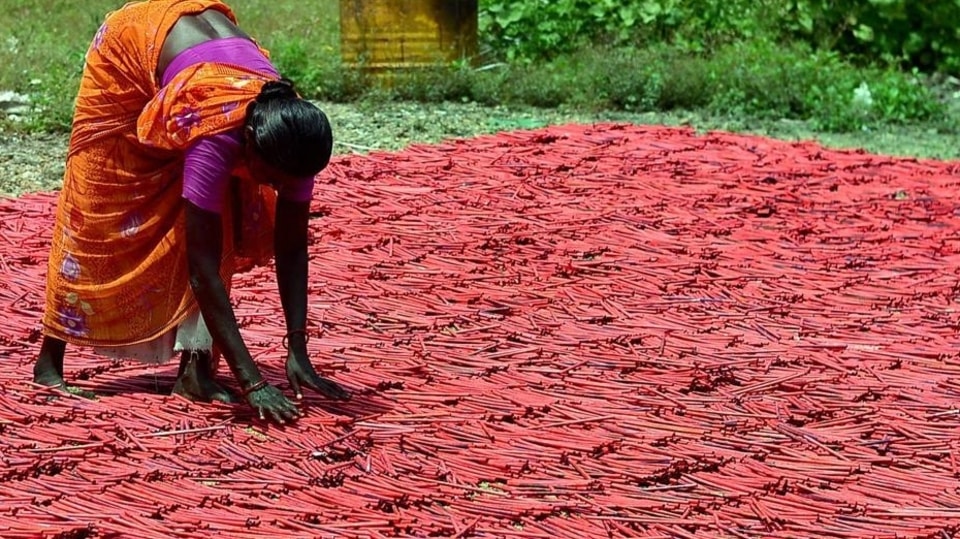
“We have been running our business in fear,” said N Kartheeswaran, the owner of Velavan Fireworks, established in 1983 in Sivakasi. “Our production has been less than 70% of the normal. Only in the coming days will we know how the sales were. Indications are not good,” he said.
R Selvaraj, president of a small fireworks distributor in Sivakasi echoes that sentiment and says that his business has fallen from the time he used to do annual revenue of ₹75 lakh. “This year, my sales have plummeted to around ₹15 lakh. He said that one of the reasons for business going down is that the cost of making a green firework is almost three times what it takes to produce a conventional one using barium nitrate.
The 100-year-old firework industry in Sivakasi in Tamil Nadu accounts for about 90% of fireworks made in India. Industry representatives say their business has gone down from around ₹6,000 crore a few years ago to ₹3,500 crore now. And, the biggest blow, they add, was the ban on barium nitrate. Fireworks made with the chemical can last up to ten years; green fireworks have a much shorter life.
In September 2017, the Supreme Court banned the use of antimony, lithium, mercury, arsenic, lead and strontium nitrate in firecrackers, hearing a case filed in 2015 by the legal guardians of three Delhi based children who argued for a complete ban to protect their right to a pollution free environment. In 2018, the top court held that only green fireworks would be allowed. Last year, the Supreme Court reiterated that only “green firecrackers” were allowed and that those containing barium salts and so-called string crackers – both a staple of the industry – are prohibited.
Although these chemicals are banned, people aware of the developments in Sivakasi said that the ban has led to workers manufacturing the banned fireworks illegally within their homes in and around Virudhunagar. In recent years, most of the firecracker accidents have happened in these home industries, government officials said.
Sivakasi-based manufacturers say that instead of a ban, barium salt sales should be regulated.
Virudhunagar district collector, J Meghanathan Reddy, has been cracking down on illegal factories. Currently, 1.009 factories are operational in and around Sivakasi – out of which 268 are licensed by the district revenue office and 741 by Petroleum and Explosives Safety Organization(PESO).
“This year we have issued a show cause notice to 491 factories and suspended 181 factories (for various procedural lapses) which were later revoked,” said Reddy. “Inspections are happening continuously. We are simultaneously monitoring those manufacturing illegally in their homes and we have made several arrests this year.”
After the Supreme Court’s mandate on green fireworks, several manufacturers made the switch to a formula prescribed by CSIR-NEERI (National Environmental Engineering Research Institute).
On October 13, Tamil Nadu chief minister M K Stalin wrote to his Delhi counterpart Arvind Kejriwal, requesting that sale of fireworks be allowed , as long as norms set by the Supreme Court on bursting of firecrackers are followed. On Wednesday, Delhi’s environment minister Gopal Rai said that purchasing, bursting of firecrackers will be punishable with ₹200 fine and six-month imprisonment.
In Tamil Nadu, as in the past four years, the government has said fireworks can be set off for two hours on Diwali . The Punjab government has also done the same. In West Bengal, the Calcutta high court has allowed only green fireworks. The Haryana State Pollution Control Board (HSPCB) on Monday prohibited the manufacture, sale and use of conventional fireworks (which are not green).
Stalin said in his letter that green crackers have been scientifically developed and that the Supreme Court has permitted the sale of green crackers through licensed traders. “I sincerely urge you to permit the sale of firecrackers that fall within the permissible norms. When no other state has imposed a total ban on firecrackers, your kind act will light up the lives of lakhs of people around Sivakasi, especially rural women who depend on this industry for livelihood as Diwali accounts for 70% of their annual business,” he added in the letter.


