
 E-Paper



Foodgrain output set to drop due to uneven monsoon rains
Acreage under key food crops has been mostly average so far, while the area under rice, the summer staple, has shrunk 12.4% compared to last year’s levels, according to official sowing data reviewed by HT.


Farmers are racing against the clock to plant key summer crops, which account for nearly half of the country’s annual food output, due to a highly uneven monsoon, with the sowing of rice well behind its usual pace.
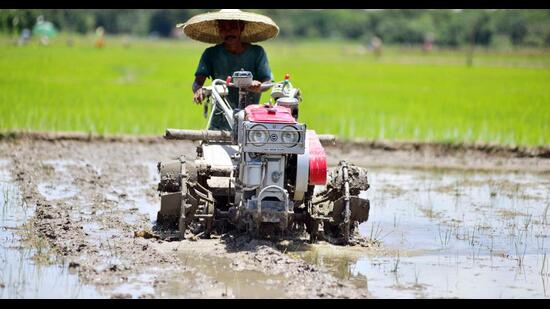
Acreage under key food crops has been mostly average so far, while the area under rice, the summer staple, has shrunk 12.4% compared to last year’s levels, according to official sowing data reviewed by HT.
India’s foodgrain output is set to dip for the first time after six straight years of record production. A smaller area under rice could cut into harvests amid high cereal prices.
Overall, the area under major kharif crops tracked by the agriculture ministry lags behind last year’s levels by 3.7% so far. The area under seven key summer crops stands at 96.3 million hectares, compared to last year’s 100.1 million hectares.
Robust harvests are critical this year because of a global food crisis. Plentiful summer harvests help keep a lid on inflation and drive-up rural spending, boosting the wider economy.
The area under pulses showed a decline of 4%, while the acreage under oilseeds was marginally lower than last year so far. The country imports up to two-thirds of its edible oil requirement, while 16% of domestic demand for pulses is met through imports.
In rain-soaked states, such as Madhya Pradesh and Karnakata, farmers had to go for resowing. Heavy rains in Karnataka, Maharashtra and Madhya Pradesh have hampered the sowing of tur, a key pulses variety, whose total area, at 4.2 million hectares, is lagging by 10%. Farmers have planted 3% more coarse cereal and millets compared to last year for this time of the year, the data showed.
In the country as a whole, the June-September monsoon, which waters nearly 60% of the country’s net-sown area, has been cumulatively 8% surplus. However, the rains have been highly skewed in distribution during July, the most critical month for the planting of crops, the main reason for sluggish sowing. Eastern states have seen rainfall deficits of up to 16%, while southern states have seen 37% excess falls.
Poor rains in rice-growing states such as Uttar Pradesh (minus 43%), West Bengal (minus 22%) and Bihar (minus 37%) have dragged down paddy sowing. The agriculture ministry’s data showed nearly 4.3 million hectares have gone unplanted with paddy compared to last year.
“Traders are worried that the government could impose curbs on rice exports depending on the shortfall of output,” said Rahul Chauhan, an analyst with IGrain Pvt Ltd, a commodity trading firm.
India banned private wheat exports in May after an estimated 3% fall in output due to an unseasonal heatwave. A patchy monsoon is expected to crimp rice output as well.
Currently, the government has enough stocks of rice. On July 1, stocks held by the Union government stood at 31.5 million tonne, about 133% more than the buffer requirement of 13.5 million tonne.
Unlike wheat, India is a major exporter of rice. In 2021-22, India exported nearly 21 million tonnes of rice, about a sixth of its total output. A lower output could affect exports.


