
 E-Paper



From HT Archives: United Front picks IK Gujral to lead the nation as PM
United Front chooses Inder Kumar Gujral as leader, replacing HD Deve Gowda, paving the way for a new government with support from Congress.

 Prefer HTon Google


The United Front (UF) arrived at a consensus on April 19, 1997, to elect external affairs minister Inder Kumar Gujral as its leader in place of HD Deve Gowda, on whose removal was contingent the Congress’s renewed support to the multi-party combine.
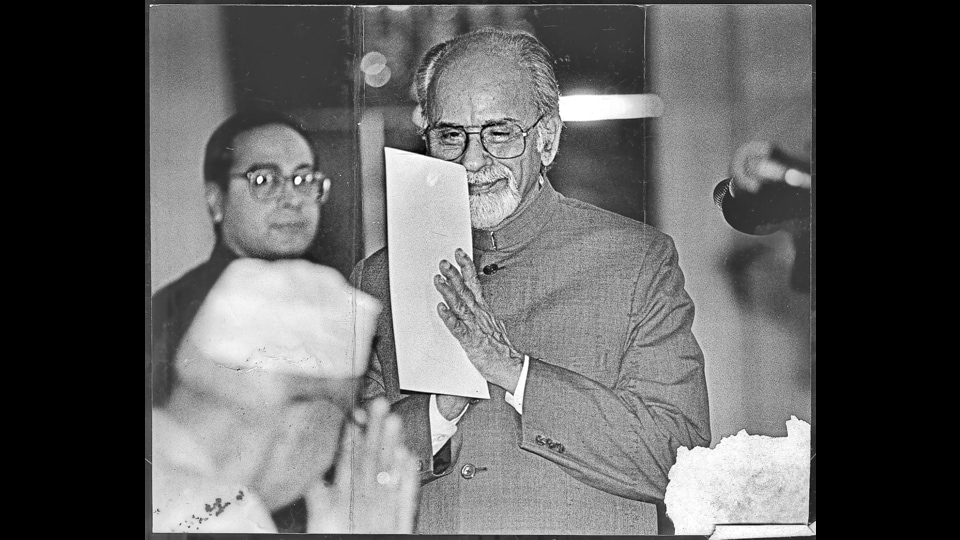
On a day marked by tension and high drama, the endorsement of Gujral’s candidature by the Front’s steering committee set the stage for the formation of a new UF government. Andhra chief minister N Chandrababu Naidu was at the centre of the hectic parleys and back-room consultations — spread over two excruciating days — that saw all the 13 Front partners agreeing finally on a common candidate.
In the overly crowded race for power, Gujral emerged the winner as the “agreed” nominee of the Left parties as also the Janata Dal and the Telugu Desam. “It’s a call to serve the nation,” he told Hindustan Times. His first public appearance upon being elected the leader was at Andhra Bhavan in the company of Naidu.
Earlier, the steering committee’s decision was announced by Gowda in the presence of Naidu, and Jammu & Kashmir chief minister Farooq Abdullah. The Front’s decision, he said, would be conveyed formally to the President early the next day.
In an otherwise smooth election of the new leader, the only discordant note was the Tamil Maanila Congress’s (TMC) decision to support the government from outside. A participant in the outgoing Gowda regime, the TMC is believed to be peeved about the manner in which GK Moopanar’s candidature for the Front’s leadership was rejected by other partners in the combine, especially the Left and the regional parties.
In fact, efforts were made at the steering committee meeting, which witnessed tense moments between the DMK’s M Karunanidhi and P Chidambaram to dissuade the TMC leaders from opting out. Their role as founder members of the UF was lauded by West Bengal chief minister Jyoti Basu, the CPl’s AB Bardhan and Mulayam Singh Yadav of the Samajwadi Party.
These leaders also praised Chidambaram’s performance as finance minister while imploring Moopanar to reconsider the decision. The TMC chief was told that it was not correct for his party to go the CPI(M) way; the latter having stayed out of the earlier government on account of its reservations about being part of a Congress-supported set-up.
Moopanar responded to the UF leaders’ request by promising to have the matter placed before the TMC parliamentary party. However, the TMC parliamentary party, which met shortly after the steering panel’s parleys, did not change the decision taken earlier in the day. This prompted a late-night call on Moopanar by Gujral. The premier-to-be failed, however, in his bid to placate the TMC.
Another significant aspect of the steering committee meeting, lasting over 90 minutes, was Gowda’s last-ditch effort to delay the election of the new leader. He said the Janata Dal required some more time to settle internal “differences” on its consensus candidate for the UF leadership.
As other leaders in the combine, specifically Naidu, already had a whiff of Gowda’s personal agenda to get the Lok Sabha dissolved on April 22, after it passed the Finance Bill, the move was promptly checkmated by Lalu Prasad Yadav.
The Bihar chief minister told the meeting that Gujral’s election was a matter of happiness, and not regret, for the Janata Dal. Moreover, he had the JD PAC’s authorisation to decide on the matter.
In fact, a consensus on the external affairs minister’s candidature was managed by Lalu Yadav, in tandem with JD working president Sharad Yadav, earlier in the day. The other strong Dal contender for the top slot, SR Bommai, volunteered to make room for Gujral after Naidu and Karunanidhi conveyed to him that it wasn’t possible for them to back a Karnataka leader on account of that state’s water disputes with Tamil Nadu and Andhra Pradesh.
A seasoned politician, Bommai set an example of “supreme political sacrifice” by withdrawing from the field. According to sources in the JD, had he not demonstrated the sort of maturity that he did, the JD would have had problems maintaining its unity and that of the UF. The HRD minister gave up his claim despite being the preferred candidate of Lalu Yadav (after he realised his own limitations as a prime ministerial aspirant) and Karnataka chief master JH Patel.
Bommai surged ahead in the scramble for the PM’s office after Lalu Yadav managed to nullify Mulayam Singh’s candidature, backed by the CPI(M), by making it known that he wouldn’t withdraw from the contest unless the Samajwadi Party chief decided to relent.
In the unfolding scenario, the fight eventually narrowed down to the Gujral-Bommai duo. Once it became obvious that Mulayam Singh would have to bow out, the Left parties, among whom the CPI, the RSP and the Forward Bloc were already inclined towards Gujral, tilted in favour of the external affairs minister.
A formal decision to project Gujral as the JD nominee was taken at a meeting at the residence of Sharad Yadav. The Dal’s “choice” for the leadership was conveyed a few hours later to Naidu, who promptly called on Jyoti Basu at the Banga Bhawan to clinch the issue.
No UF leader was willing to confirm or deny the developments. But Mulayam Singh is understood to have been offered deputy premiership in the new arrangement, a proposal which did not immediately materialise.


