
 E-Paper



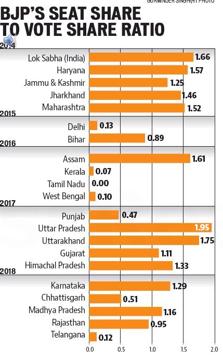
From invincible to vulnerable: BJP’s seat share to vote share ratio
The year 2018 has completely changed the state of play for the party. The BJP could not come to power in even one large state out of the five – Karnataka, Madhya Pradesh, Chhattisgarh, Rajasthan and Telangana – which went to polls during this year.


2017 was perhaps the best year for the Bharatiya Janata Party (BJP) since its stellar victory in the 2014 Lok Sabha elections.

It won the key state of Uttar Pradesh with a huge majority. The impact of this victory also gifted Bihar to the BJP when Nitish Kumar’s Janata Dal (United) broke ranks with the Congress and the Rashtriya Janata Dal (RJD) and rejoined the National Democratic Alliance (NDA). Even in Gujarat, the BJP managed to overcome anti-incumbency and recapture power. Heading into its last year in government, the BJP looked like the new invincible hegemon of Indian politics.
The year 2018 has completely changed the state of play for the party. The BJP could not come to power in even one large state out of the five – Karnataka, Madhya Pradesh, Chhattisgarh, Rajasthan and Telangana – which went to polls during this year. It had won a majority of seats in all these states except Telangana in the 2014 Lok Sabha elections. In the three Hindi belt states, it lost power to the Congress, which managed to win just three out of 65 Lok Sabha seats in these states in the 2014 elections. Heading into 2019, the BJP’s political strategy will have to shift from consolidating its gains to cutting its losses.
To be sure, the BJP still enjoys a significant lead over its political competitors in terms of popular support. Some of its losses in the recent assembly elections in the Hindi heartland will probably be compensated by gains in the eastern and north-eastern regions of the country. However, the BJP’s electoral reverses will also encourage its opponents, both parties and voters, to come together in the forthcoming elections. In a first-past-the-post system, this can drastically reduce the BJP’s seat share even if it retains its popular support in regions.
The signs of this happening were already visible in 2018. The BJP’s seat share to vote share ratio – a useful indicator of a party’s ability to convert votes into seats in elections– appears to be caught in a downward trajectory.


