E-Paper



From Kyiv to Kashmir: Jaishankar delivers 2 blunt messages to Poland at meeting
Jaishankar pointedly raised the “selective targeting” of India by European states in context of the Ukraine war, describing the trend as unfair and unjustified

 Prefer HTon Google


NEW DELHI: Poland should show zero tolerance for terrorism and not help fuel terrorist infrastructure in India’s neighbourhood, external affairs minister S Jaishankar told his Polish counterpart Radosław Sikorski on Monday, an apparent response to a mention of Kashmir and terrorism in a joint statement issued by Poland and Pakistan last year.
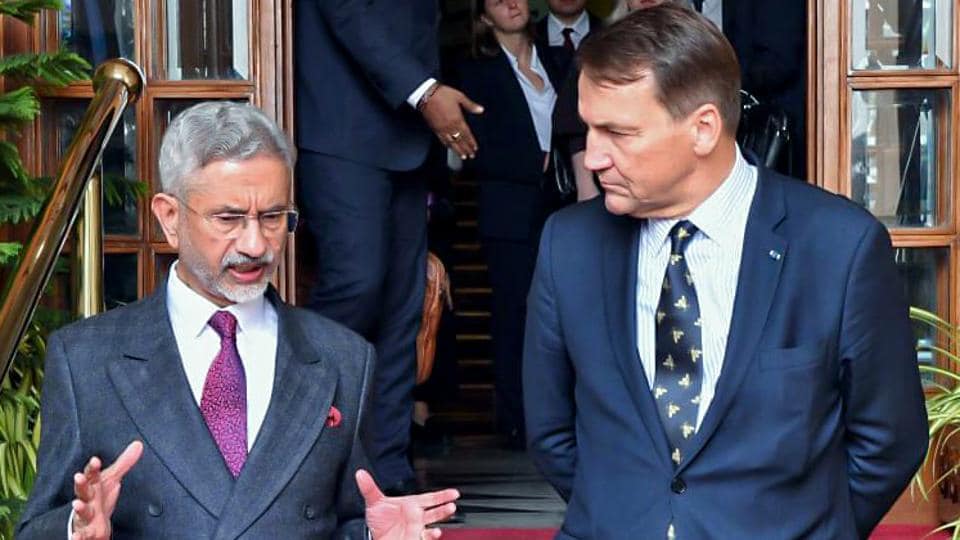
Jaishankar also pointedly raised the “selective targeting” of India by European states in the context of the war in Ukraine, describing the trend as unfair and unjustified. The comments were part of Jaishankar’s televised remarks at the start of his meeting with Sikorski.
References to the Kashmir issue and state support for terrorism in a Pakistan-Poland joint statement issued after Sikorski’s visit to Islamabad last October had not gone down well in New Delhi. During a meeting of the Weimar Triangle Plus format in Paris earlier this month that was joined by Jaishankar, Sikorski had expressed satisfaction at India’s reduction of Russian oil imports “because this is financing the war machine of [Russian President Vladimir] Putin”.
Also Read: UAE President Al Nahyan arrives in Delhi amid Middle East tensions, to hold talks with PM Modi
Jaishankar, in his televised remarks, pointed to the long-standing challenge of cross-border terrorism and said, “I hope at this meeting to discuss some of your recent travels to the region. Poland should display zero tolerance for terrorism and not help fuel the terrorist infrastructure in our neighbourhood.”
He pointed to his recent meetings with Sikorski in New York last September and in Paris this month and said he had candidly shared India’s views on the Ukraine conflict and its implications. “While doing so, I have repeatedly underlined that the selective targeting of India is both unfair and unjustified,” he said.
Sikorski said he agreed with Jaishankar on countering trans-border terrorism and noted that Poland too has been a “victim of arson and attempted state terrorism”, including the recent blowing up of the Polish railway line under a moving train. “I also completely agree with you on the unfairness of selective targeting by tariffs, and we in Europe have known something about that,” he said.
Following Sikorski’s remarks, Jaishankar clarified that “selective targeting is not limited to tariffs” and that there were other forms of this.
The Pakistan-Poland joint statement of October 2025 referred to the “Kashmir dispute” and called for peaceful solutions to conflicts in line with the principles of international law and the UN Charter. It also “emphasised the importance of dialogue and cooperation to address regional security challenges in South Asia”. While condemning all forms of terrorism, the joint statement said “no State should provide a safe haven to those who finance, plan, support, or commit terrorist acts”.
Such references in joint statements involving Pakistan are usually a red flag for India, which has repeatedly accused the neighbouring country of using terrorism as an instrument of state policy and asserted that the Kashmir issue can only be handled by New Delhi and Islamabad as a bilateral matter.
At the meeting between Jaishankar and Sikorski, the two sides reviewed the bilateral action plan for 2024-28 and discussed ways to advance cooperation in trade, investment, defence, security, clean technologies and digital innovation.
Poland is one of India’s largest trading partners in Central Europe, and the two countries elevated their ties to a strategic partnership in 2024. Two-way trade is currently worth $7 billionand has grown by almost 200% over the past decade. Indian investments in Poland have crossed $3 billion, and Jaishankar said India’s economic growth, market size and pro-investment policies provide key opportunities for Polish businesses.
Poland has also backed a proposed India-European Union (EU) free trade agreement, negotiations for which are expected to be concluded during the India-EU Summit in New Delhi on January 27.
Sikorski, who also met National Security Adviser Ajit Doval, acknowledged at a media briefing that the Indian side had raised terrorism-related concerns about Pakistan, while the Polish side discussed India’s participation in the Zapad military exercise hosted by Russia last year. “On terrorism, we are of one mind…I was very glad that we were able to discuss frankly what's on our minds,” he said.
“Both of our countries condemn the crossing of international borders, either by tanks or by terrorists. Both India and Poland are victims of transnational terrorists, and therefore we condemn it in the strongest terms,” he said.
Sikorski also said he was confident India “will be among those countries that urge the perpetrator” of aggression towards Ukraine to settle the issue without further bloodshed.