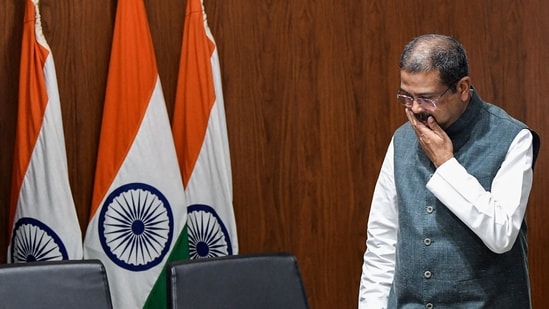
Union education minister Dharmendra Pradhan on Saturday sent his resignation letter to Prime Minister Narendra Modi after more than a month of student protests that spread from Delhi’s Jantar Mantar to cities across the country.
The demonstrations, led by the Cockroach Janta Party (CJP) and boosted by activist Sonam Wangchuk's hunger strike, had made Pradhan’s exit their central demand over the government’s handling of the NEET-UG paper leak this year.
Posting his letter on X, Pradhan said he wanted to protect the future of students, keep “anti-national forces” from exploiting the situation at Jantar Mantar, and preserve national unity. The Prime Minister is yet to formally accept the resignation.
Pradhan’s four-and-a-half years at the helm of the education ministry — spanning the rollout of the National Education Policy (NEP), exam-related crises, and recurring friction with opposition-ruled states — were rarely free of controversy.
Here is a look at 10 flashpoints during his tenure:
1. Heckled at oath-taking (June 2024)
Pradhan's return to the Union Cabinet got off to a rocky start. As he rose to take his oath as an MP and minister in the newly constituted 18th Lok Sabha in June 2024, INDIA bloc members heckled him with chants of “NEET” and “Shame, Shame”. The protest reflected mounting anger over alleged irregularities in that year’s NEET-UG medical entrance exam, with Opposition MPs demanding a discussion on the paper leak scandal and pressing Pradhan on accountability.
2. NEET-UG paper leaks, twice over (2024 and 2026)
{{/usCountry}}Pradhan's return to the Union Cabinet got off to a rocky start. As he rose to take his oath as an MP and minister in the newly constituted 18th Lok Sabha in June 2024, INDIA bloc members heckled him with chants of “NEET” and “Shame, Shame”. The protest reflected mounting anger over alleged irregularities in that year’s NEET-UG medical entrance exam, with Opposition MPs demanding a discussion on the paper leak scandal and pressing Pradhan on accountability.
2. NEET-UG paper leaks, twice over (2024 and 2026)
{{/usCountry}}No issue dogged Pradhan more than the National Eligibility cum Entrance Test paper leaks. In 2024, allegations of paper leaks and grace-marks anomalies — with irregularities reported in Bihar and elsewhere — triggered nationwide protests, Supreme Court intervention and a CBI probe, and cost the National Testing Agency (NTA) its chief.
The crisis resurfaced this year. The NEET-UG exam held on May 3 was cancelled on May 12 after leaks were traced to guess papers circulating out of Rajasthan coaching centres. A re-test was subsequently held on June 21 under heavy security.
The episode disrupted millions of aspirants and prompted the CJP’s sit-in at Jantar Mantar.
Live updates: Dipke hails resignation as ‘big win’, celebrations across cities
3. UGC-NET cancelled a day after (June 2024)
The ministry cancelled the UGC-NET exam on June 19, 2024 — just a day after it was conducted — following intelligence that question papers had leaked and were circulating on the dark net via Telegram and other platforms. Pradhan confirmed the breach and ordered a CBI probe. Coming in the middle of the NEET row, the episode further eroded confidence in the NTA.
4. A testing agency under constant strain
The NTA – which conducts NEET, JEE, CUET and NET among other major exams – faced sustained scrutiny through Pradhan’s tenure over technical glitches, faulty grade marking, data security and reliance on outsourcing. Critics blamed bureaucratic mismanagement and staff shortages. Multiple reforms panels were set up, including one led by former Indian Space Research Organisation (Isro) chief K Radhakrishnan, but the controversies persisted into 2026, prompting leadership changes, terminations, and a renewed debate on shifting exams to computer-based testing.
5. CBSE’s on-screen marking crisis (2026)
The rollout of On-Screen Marking (OSM) for CBSE Class 12 board exams this year triggered a fresh row over alleged evaluation errors, poor scan quality, technical glitches and marking discrepancies.
An internal trial in January 2026 had flagged more than 36 issues that were allegedly overlooked before the rollout. Students and teachers protested, and senior CBSE officials were transferred. Pradhan took responsibility and promised action against those found guilty, though the opposition dismissed it as a superficial fix for deeper ministerial and board-level shortcomings. A committee has since been formed to examine alleged violations in OSM procurement.
6. States push back on PM SHRI schools
The PM Schools for Rising India (PM SHRI) scheme, launched in 2022, ran into resistance from several non-BJP-led states. Tamil Nadu, Kerala, and initially West Bengal and Punjab, delayed or refused to sign the required memorandum of understanding (MoUs), accusing the Centre of tying crucial funds – including under Samagra Shiksha — to ideological compliance with the National Education Policy (NEP) 2020.
Some states eventually signed on under fiscal pressure, though Tamil Nadu and Kerala held out the longest.
7. Three-language formula & Hindi ‘imposition’ row
Implementation of the NEP’s three-language formula has been a persistent flashpoint, particularly in Tamil Nadu, where the row intensified through 2025 and 2026. Then chief minister MK Stalin repeatedly accused the Centre of using CBSE policy and the PM SHRI scheme to impose Hindi through the back door.
Pradhan rejected the charge, defending the formula as a vehicle for “linguistic liberation” and multilingualism that allowed flexibility for mother-tongue instruction. The dispute spilled over into funding disputes and heightened Centre-state tensions in the south.
8. NCERT’s textbook rationalisation (2022-2023)
NCERT’s “rationalisation” exercise removed chapters and references on Mughal history and courts, the 2002 Gujarat riots, the Cold War and aspects of India”s democratic struggles from school textbooks, notably in Class 12 Political Science and History. The ministry defended the exercise as an effort to reduce pandemic-era academic burden, but historians, intellectuals and opposition leaders accused it of “saffronising” the curriculum and politically sanitising history.
9. A draft rulebook for choosing vice-chancellors (January 2025)
Draft UGC regulations circulated in January 2025 proposed widening eligibility for vice-chancellor posts to include non-academics and industry professionals, while expanding the role of governors and visitors in search committees. Non-BJP-ruled states and academic bodies opposed the move as an encroachment on federalism, state rights and university autonomy, with several states passing resolutions against the draft rules and reviving debate over central overreach in higher education.
10. Caste-equity rules and a Supreme Court stay (2026)
In early 2026, the UGC notified the Promotion of Equity in Higher Education Institutions Regulations, intended to tackle caste-based discrimination through campus equity committees and definitions centred on SC/ST/OBC categories. The regulations drew criticism over the potential for misuse, concerns of reverse discrimination, and fears of social division, prompting legal challenges. The Supreme Court stayed their implementation in January 2026, directing that the 2012 regulations continue to apply while it sought the Centre’s response.