
 E-Paper



Stiffer jail terms, task forces, faster trials: The changes paper-leak bill would introduce & existing state laws
The 2026 bill would compress investigation and trial timelines, raise penalties, and create a new task force route, besides similar laws in over a dozen states.

 Prefer HTon Google


The Union Cabinet on Friday approved a draft bill that proposes faster trials and harsher punishments, including jail terms of up to 10 years and fines of up to ₹10 crore, for those convicted of leaking examination papers, HT reported.
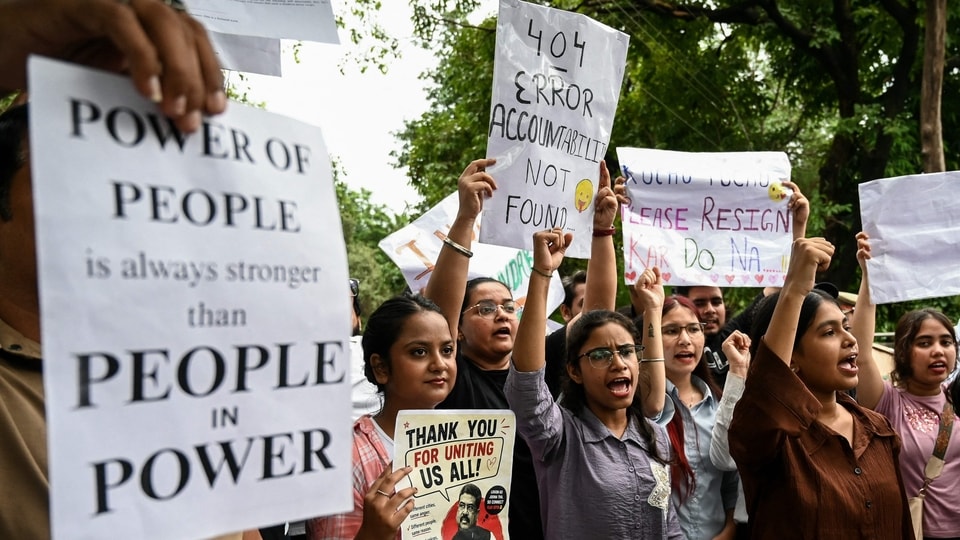
The draft, a copy of which has been seen by HT, would cap investigations at two months and place special fast track courts to complete trials in three months.
The bill lands as student and youth demonstrators mobilised by the Cockroach Janta Party (CJP) protested over competitive exam leaks, and prompted the resignation of Union education minister Dharmendra Pradhan on Saturday.
The draft proposes an amendment to the Public Examinations (Prevention of Unfair Means) Act, 2024, and is expected to be introduced in the Lok Sabha on Monday.
Follow Live updates: Education minister Dharmendra Pradhan resigns amid nationwide protests
The existing 2024 law
The dedicated law against unfair means in public examinations, the Public Examinations (Prevention of Unfair Means) Act, was passed by Parliament in February 2024 and enacted later that year, after a series of paper leaks.
The law lists 15 acts that qualify as “unfair means” when carried out for monetary or wrongful gain. These range from the leaking of question papers and answer keys to sharing solutions with candidates mid-examination, tampering with OMR sheets or the computer systems that host tests, and manipulating seating arrangements or shift allocations.
The list also covers unauthorised possession of question papers, altering assessments outside of bona fide corrections, threatening exam authority personnel, setting up counterfeit exam websites, and running bogus tests or issuing fraudulent admit cards to cheat candidates.
Conspiring to enable any of these acts is itself an offence under the law. So is entering an exam centre with the intent of disrupting proceedings, or opening or divulging a question paper before the official time.
A distinct head of offence — “organised crime” — targets coordinated efforts by individuals, groups or institutions that act in concert to game a public examination for wrongful gain.
Service providers hired to run examinations carry their own layer of liability: anyone acting on their behalf who assists a candidate without authorisation is treated as having committed an offence, and the provider itself is on the hook if it does not report incidents of malpractice.
Senior functionaries — directors, managers and other officers — of such providers face prosecution where an offence is shown to have been carried out with their consent or connivance. But the Act carves out a defence for those who can demonstrate that the offence occurred without their knowledge, and that they had taken reasonable steps to prevent it.
Every offence under the Act is classified as cognisable, non-bailable and non-compoundable, which means it allows arrest without a warrant, leaves the question of bail entirely to courts, and rules out any private settlement between the parties.
Individuals convicted of resorting to unfair means face a jail term of three to five years and a fine that can go up to ₹10 lakh. For service providers, the financial penalty is set at up to ₹1 crore, along with recovery of a share of the examination’s cost proportionate to their role, and a four-year disqualification from taking on public examination work.
The penalty is hiked when it is found that a director, senior manager or a person of a service provider consented to or connived at the offence: a prison term of three to 10 years, with a ₹1 crore fine.
For those convicted of organised crime under the Act — whether individuals, groups, or entities including examination authorities and service providers — the punishment moves up to a jail term of between five and 10 years, and a fine that cannot fall below ₹1 crore.
Institutions caught in an organised crime case additionally face attachment and forfeiture of their property, and are liable to reimburse a proportionate share of the examination’s cost.
The Act’s schedule covers the UPSC, the Staff Selection Commission, Railway Recruitment Boards, the Institute of Banking Personnel Selection, central government ministries and their subordinate offices for staff recruitment, and the National Testing Agency, which conducts NEET-UG, JEE (Main), UGC-NET and CUET.
Candidates are not under its purview.
Also read: 47 NTA officials sacked amid nationwide student protests, more cleanup to follow
What changes in the draft bill
The Cabinet-approved draft, if implemented, would raise the minimum jail term for an individual convicted of unfair means from three years to five, while lifting the top end of the same offence from five years to 10.
The maximum fine, HT reported, would go up to ₹10 crore.
Beyond the numbers, the amendment is aimed at compressing the timeline of the entire process, from investigation to verdict.
The draft, a copy of which has been seen by HT, proposes that every probe under the Act be wrapped up within two months, regardless of whether it is being run by the local police, a central investigating agency, or a special task force — a new investigative route that would be available under the amended law.
The draft also seeks to place special fast track courts on a statutory footing.
Each state and Union territory would designate a court of session, in consultation with the concerned high court, to try offences under the Act. Proceedings before such courts would run on a day-to-day basis, and the trial “shall” be completed within three months from the date of the chargesheet, the draft says.
States and UTs would also appoint special public prosecutors for these cases.
The amendment continues to leave candidates outside its scope.
Also read: 'Have a heart': Sonam Wangchuk's wife urges people to not judge him for breaking 26-day fast
The state laws
Several states have enacted their own anti-leak legislation, some predating the central law and others adopted since, with penalties that vary widely.
Andhra Pradesh was among the earliest, enacting its Public Examinations (Prevention of Malpractices and Unfair Means) Act in August 1997, which prescribes three to seven years in jail and fines between ₹5,000 and ₹1 lakh for both leaks and unfair means. Haryana followed in September 2021 with a law setting seven to 10 years' imprisonment and a minimum ₹10 lakh fine for leaks.
Rajasthan’s 2022 law provides for five to 10 years in jail and fines between ₹10 lakh and ₹10 crore for leaks and syndicates. Uttarakhand’s 2023 Act goes further, prescribing life imprisonment and fines of up to ₹10 crore for leaks, alongside a three-year term, fines up to ₹5 lakh and a two-to-five-year exam bar for unfair means; Gujarat's 2023 law sets seven to 10 years in jail with a minimum ₹1 crore fine for leaks, and up to 10 years with a ₹1 crore fine for unfair means. Jharkhand’s 2023 Act likewise allows life imprisonment and fines up to ₹10 crore for leaks.
Odisha’s Public Examinations (Prevention of Unfair Means) Act, 2024, enacted in February 2025, prescribes three to 10 years in jail and a ₹1 crore fine for leaks, and three to 10 years in jail with a ₹10 lakh fine for unfair means.
Among the laws enacted in 2024, Assam's Act sets five to 10 years' imprisonment and fines between ₹10 lakh and ₹10 crore for leaks; Arunachal Pradesh’s allows up to five years and a ₹1 crore fine; Bihar's law permits up to 10 years in jail and a fine of up to ₹1 crore, while Uttar Pradesh's provides for a life term, property seizure and a fine of up to ₹1 crore; and Maharashtra, through its 1982 malpractices Act and 2024 competitive examination Act, allows up to five years in jail and a ₹1 crore fine for leaks.
Himachal Pradesh’s Public Examination (Prevention of Unfair Means) Bill was enacted in November 2025, providing for three to 10 years in jail and fines of up to ₹1 crore. Chhattisgarh's law — the Lok Bharti evam Vyavasayik Parikshao me Anuchit Sadhano ki Roktham Vidheyak — is the most recent, enacted in March 2026, allowing up to 10 years in jail, a ₹1 crore fine and property seizure for leaks, and three years with up to ₹1 crore in fines for unfair means.


