
 E-Paper



Furore in Tamil Nadu assembly as Guv refuses to read govt speech
He skipped his entire customary speech of budget session of the state assembly saying he disagrees with numerous passages on “moral and factual” grounds and walked out


Chennai: Tamil Nadu governor RN Ravi on Monday skipped his entire customary speech at the start of budget session of state assembly saying he disagrees with numerous passages on “moral and factual” grounds and walked out even as speaker was reading out the Tamil version of his speech.
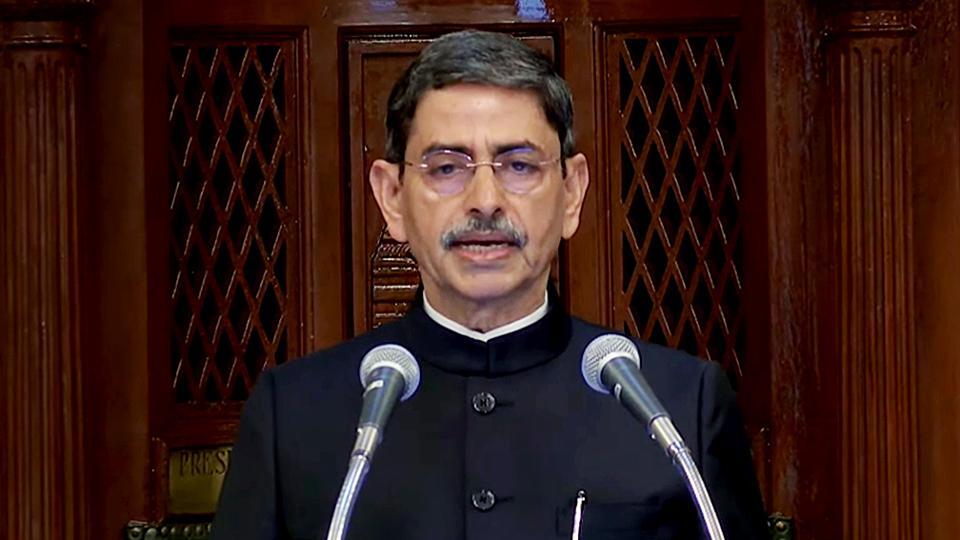
The Governor’s address on the first day when the House convenes for the year is customarily prepared by the state government. While Ravi was walking out, the DMK-led government passed a resolution to record the approved speech. In 2022, Govenor Ravi has read the first and the last para of the speech.
The session began at 10am with the state’s anthem (Tamil thai vazhthu) following which the Governor began his speech quoting Tamil philosopher Thirvalluvar and complained that his repeated request to “show due respect to the national anthem” by playing play it at the beginning and end of the address has been ignored.
“This address has numerous passages with which I convincingly disagree on factual and moral grounds,” Ravi said. “I lending my voice to them would constitute a constitutional travesty. Hence, with respect to the house, I conclude my address. I wish this house a productive and healthy discussion for the good of the people.”
This led to a mild and brief commotion in the House but Tamil Nadu’s Speaker M Appavu immediately took over to read the Tamil version of the prepared speech. Ravi continued to be seated next to the Speaker.
Former secretary general of the Lok Sabha, PDT Acharya said that the Constitution requires the Governor–the head of the state– to be physically present and inform the members of the House about the activities of the government.
“The Governor is not responsible for what is in the speech which is prepared by the state government,” Acharya said. “There is a sanctity to this procedure where the Constitution has given this task to the governor. When the governor refuses to read the speech, he is violating Article 176 of the Constitution and though he was present, he did not perform his constitutional duty.”
The speech running 48-pages, which the governor refused to read, was critical of the BJP-led Union government’s policies such as the Goods and Services Tax (GST) that was impacting the state’s fiscal autonomy, central funds not being released for projects such as the Metro Rail’s phase 2 in Chennai, flooding and the state’s stance to never allow the Citizenship Amendment Act (CAA). The speech also highlighted Tamil Nadu’s achievements, welfare schemes and its economic growth.
The Speaker concluded that the speech was sent to the Raj Bhavan for approval. He added that the issue over the national anthem has already been resolved given the practice in Tamil Nadu to play the state anthem in the beginning of a program and the national anthem in the end. The Speaker noted that though they are ideologically different, the Tamil Nadu government led by chief minister M K Stalin has been treating the office of the Governor with respect and there would be no change in it.
The Speaker said that Tamil Nadu had sought aid due to the cyclone Michaung in Chennai and unprecedented flooding in southern regions last December but “not a paisa” had come from the BJP-led Union government. “Several lakhs are in the PM Cares funds which is unaccountable. I could ask you (Governor) that if you had asked for ₹50,000 crore from that, it would have been good (for the state),” the Speaker said. Adding to the existing charge by the DMK that the Governor is an agent of the BJP and the RSS, the Speaker said that they follow the way of V D Savarkar and Nathuram Godse.
The Governor and minister Durai Murugan were on their feet. The Governor walked even as the Speaker said that the national anthem would be played. Durai Murugan began reading a resolution that the assembly takes on record the English and Tamil versions of the prepared customary speech.
Hours later, the Raj Bhavan said that they received the draft address on February 9 and they found “numerous passages with misleading claims far from truth.” The governor returned the file saying that the address should reflect government’s achievements, policies and programmes and to inform the house of the “causes of its summons” and should not be a forum for peddling misleading statements and venting blatantly partisan political views.
The Governor’s office explained that he rose for the national anthem but he left because of the Speaker targeting him. “...Speaker instead of following the schedule launched a tirade against the Governor and called him a follower of Nathuram Godse and more,” the Raj Bhavan said in a statement. “The Hon’ble Speaker with his unbecoming conduct lowered the dignity of his chair and grace of the House…The Hon’ble Governor with due regard to the dignity of his office and the House left the House.”
Tamil Nadu’s law minister S Regupathy told reporters that the governor could have boycotted the session if he was unsatisfied and his actions would only strengthen the INDIA bloc. “The address was approved by the governor himself. If he had doubts, we would have clarified,” Reghupathy said. Comparing Ravi to his Kerala counterpart, Arif Mohammed Khan, he added, “At least the Kerala governor read the last paragraph of the address but he (Ravi) did not read a single word.”
AIADMK general secretary and leader of opposition Edappadi Palaniswami said that this was an issue between the governor and the state. BJP’s floor leader Nainar Nagendran backed the governor for walking out saying that the Speaker used inappropriate words.


