
 E-Paper



Govt apathy to migrants unpardonable, says Supreme Court
The bench of justices Ashok Bhushan and MR Shah also ordered all states and Union territories to implement the “One Nation One Ration Card” scheme by July 31 to help beneficiaries, especially migrant workers, to avail of subsidised food commodities from anywhere in the country.


Citing the tribulations of the migrant workers during the Covid-19 pandemic, the Supreme Court on Tuesday held that “the apathy and lackadaisical attitude by the ministry of labour and employment is unpardonable”, and directed the Centre to make the national portal for registration of unrecognised workers operational by July 31 so that various benefits could flow to the marginalised section.
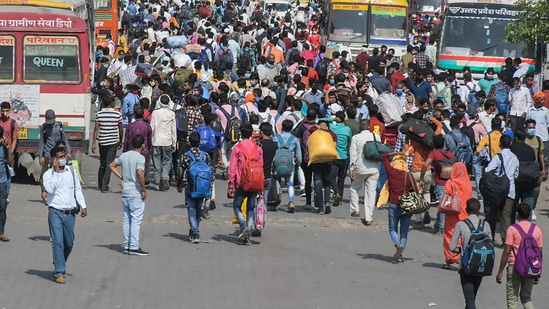
The bench of justices Ashok Bhushan and MR Shah also ordered all states and Union territories to implement the “One Nation One Ration Card” scheme by July 31 to help beneficiaries, especially migrant workers, to avail of subsidised food commodities from anywhere in the country.
The court, which passed a slew of directives in the matter registered suo motu (on its own motion) to ameliorate the miseries of the migrant workers affected by the pandemic, took a stern view that the national portal for the registration of unorganised workers remained in limbo even after 30 months of the central government’s assurance to the Supreme Court on making the facility fully functional by the end of 2018.
Relying on a survey by the National Statistics Office (NSO) in 2017-2018 that reckoned the number of persons in the unorganised sector as 380 million and 94% of the total workforce, the bench bemoaned the fact that unrecognised workers might have failed to avail of the benefits available to them under the laws during the pandemic because of the laxity by the Union labour ministry in operationalising the portal for registration under the National Database for Unorganised Workers project.
“When the unorganised workers are waiting for registration, and are waiting to reap the benefit of various welfare schemes of the states and the Centre, the apathy and lackadaisical attitude by the ministry of labour and employment is unpardonable. There was urgency in the portal to be finalised and implemented looking at the pandemic and dire need of unorganised workers to receive the benefit,” regretted the bench, adding that registration was the first step to grant benefits to migrant workers.
“The attitude of the ministry of labour and employment in not completing the module even though directed as early as on August 21, 2018 shows that ministry is not alive to the concern of the migrant workers and the non-action of the ministry is strongly disapproved,” maintained the court as it rejected a request by the ministry to give it at least three months more to operationalise the portal.
It directed the secretary, ministry of labour, to ensure that the national portal commences by July 31, and called for a compliance report by the end of August. The court also asked states and Union territories to cooperate with the Centre and upload the data of the workers on the portal “at the earliest, but not later than December 31, 2021”. It further directed states and Union territories to register all establishments and license all contractors who must furnish particulars of the migrant workers employed with them.
Shortly after the nationwide lockdown was imposed last year, hundreds of thousands of migrant workers spilled out on the to the highways, walking and cycling hundreds of kilometres back to their homes in the hinterlands. Many went without food for days, boarded packed trains back to their homes, faced hostility and bias as ‘outsiders’ and perished on the way. Their plight prompted the Union and state governments to set up relief measures. On the implementation of One Nation One Ration Card scheme, the court called it “an important citizen centric reform” to extend food security to migrants who were covered under the National Food Security Act Scheme as it emphasised that providing food security to impoverished persons was the bounden duty of all states and governments.
“When migrant workers are spread throughout the country, each state has to implement the scheme, which is a necessary welfare measure towards food security to this class of persons. The states are duty-bound to implement this scheme, which is a welfare scheme in the interest of poor and marginal sections of the society,” said the court, directing all states to implement the scheme by July 31 so that nobody is denied ration for not being in his native state.
According to the Centre’s submissions in the apex court, three states -- West Bengal, Assam and Chhatisgarh -- were yet to implement the scheme, while Delhi had not implemented it fully. The scheme is currently functional in 32 states and Union territories and allows eligible beneficiaries to get food grain under the National Food Security Act from fair price shops across India without securing a new ration card.
In other directives, the bench told the states to frame proper schemes for distributing dry ration to migrant workers who may not have ration cards while obligating the Union government to allocate additional foodgrains in terms of demands made by the states. Community kitchens, the court said, must also continue till the pandemic prolongs. The court noted as many as 2.8 crore were identified as migrant workers by the states during the first Covid-19 wave and that dry ration should be made available to them.
About the coverage of rural and urban population under National Food Security Act, 2013, the court noted that state-wise coverage was determined by the then Planning Commission (now Niti Aayog) by using the household consumption survey data for 2011-2012 and if a fresh survey were to be carried out now, number of beneficiaries would go up drastically benefitting the large number of eligible persons.
The bench urged the central government to carry out a fresh survey to redetermine the total number of people to be covered under the rural and urban areas of the states so that more persons eligible for the benefits under the act could also be covered.
At the same time, the court refused to issue any directive to the Union or the state governments to implement direct bank transfer to the migrant workers. “The direct bank transfer, being matter of policy and being in domain of the state, no direction can be issued by this court. We only observe that in event any person is entitled for direct bank transfer as per the existing scheme in any state, he can avail the said benefit by the mechanism as provided in the policy decision,” it held.
With these directions, the bench drew the curtains on the public interest case that it had registered last year and passed orders from time to time.
Meanwhile HT also reached out to the labour ministry for a comment over the current status of this registration portal. DPS Negi, Director General of labor bureau, the data arm of the ministry, said that the issue of registration portal pertains to the Labour Welfare Department. Director General Labor Welfare Department, Ajay Tiwari did not respond to the repeated calls from HT.
HT also talked to Union Labour and Employment Minister Santosh Gangwar over the issue.
Gangwar said that he does not have the immediate knowledge of the directions that Supreme Court has given, however, he assured that the ministry will abide by all these directions. He added that he would review the status of the registration portal tomorrow and update HT with the details on it. The story will be updated after a response from the minister.
“We had floated tenders to implement the scheme twice, but no bidder could be selected due to technical issues. That’s why the scheme got delayed in Assam. We have finally zeroed in on one bidder after the third tender. Negotiations are underway with the latest bidder, and we are confident of launching the scheme soon,” said a senior government officer on condition of anonymity.
West Bengal food and supplies minister, Rathin Ghosh could not be contacted but a senior officer of the department said on condition of anonymity that the government has started the paperwork for implementing the “One Nation One Ration Card” scheme. “Chief minister Mamata Banerjee announced on June 14 at the state secretariat that the Bengal government will implement it,” he said.


