E-Paper



Gujarat Budget 2026-27: No new taxes, regional focus in ₹4.08 lakh crore budget
The Gujarat finance minister also announced a major push for tourism and sports in the state

 Prefer HTon Google


Gujarat Finance Minister Kanubhai Desai on Wednesday presented the state budget for 2026–27 with an outlay of ₹4.08 lakh crore, without proposing any new taxes. The budget projects a revenue surplus of ₹25,586 crore and an overall surplus of ₹1,184 crore after accounting for capital expenditure and public account transactions.
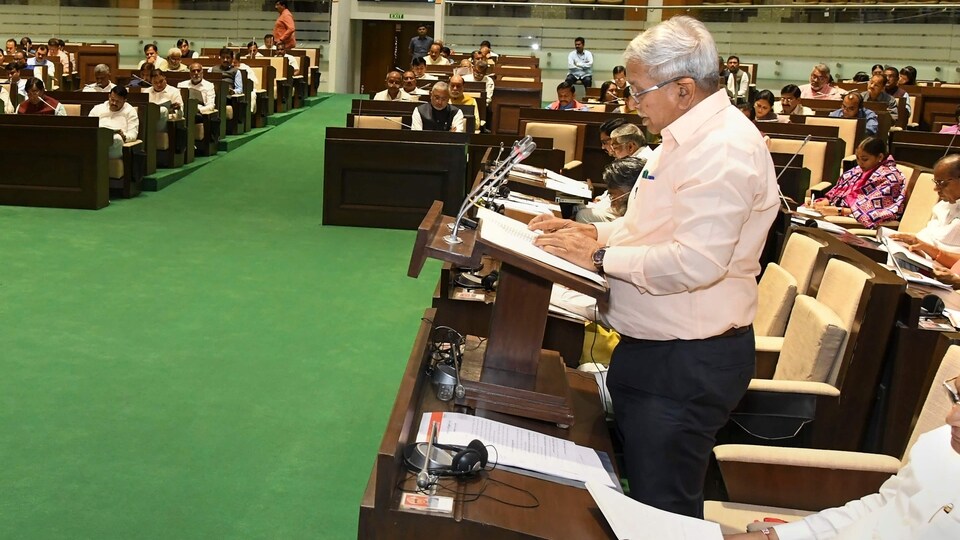
Presenting the budget in the Gujarat Legislative Assembly in Gandhinagar, Desai said the Budget Estimate of ₹4,08,053 crore for 2026–27 represents an increase of ₹37,803 crore, or 10.2%, over the previous year. The revenue surplus shows that the state’s regular income exceeds its day-to-day expenditure, while higher capital spending on infrastructure has resulted in a capital account deficit of ₹34,358 crore, which is offset by net public account transactions.
The finance minister said the surplus on the revenue account reflects higher receipts compared to day-to-day expenditure, while the capital account shows a deficit of ₹34,358 crore due to higher spending on infrastructure. After adjusting capital expenditure with net public account transactions, the overall surplus has been estimated at ₹1,184 crore.
The finance minister said 65% of the total expenditure has been earmarked for development. Revenue expenditure has been estimated at ₹2.46 lakh crore, while capital expenditure has been pegged at ₹1.57 lakh crore, an increase of 17.5%.
The budget is aligned with the vision of “Viksit Bharat@2047” and “Viksit Gujarat@2047” and is centred on GYAN — Garib (poor), Yuva (youth), Annadata (farmers) and Nari (women), Desai told the House, adding that the government’s approach rests on five pillars: social security, human resource development, infrastructure, economic development and green growth.
On taxation, Desai said no new taxes have been proposed. He announced tax relief of ₹210 crore, primarily through the extension of concessional motor vehicle tax for electric vehicles for one more year. After factoring in this relief, the estimated net surplus stands at ₹974 crore.
Referring to GST reforms, the finance minister said the Next-Gen GST reforms and GST 2.0 decisions have strengthened ease of living and ease of doing business.
“As a result of reduced tax rates, people of the state will benefit from GST tax savings of approximately ₹11,000 crore in a single year,” he said. Gujarat has recorded over 12% growth in GST collections during the current financial year, he added.
Tourism received a major push, with the government declaring 2026 as ‘Gujarat Tourism Year’. More than ₹6,700 crore has been allocated for tourism, pilgrimage centres and civil aviation. The government announced the development of Somnath as a global destination, projects at Ambaji, Dwarka, Shivrajpur beach and Lothal, and the launch of the ‘Wed in Gujarat’ campaign to promote the state as a wedding destination.
The budget places emphasis on balanced regional development through six Regional Economic Master Plans covering North Gujarat, Central Gujarat, South Gujarat, Saurashtra, Coastal Saurashtra and Kutch. Around 80 projects involving an outlay of more than ₹6,600 crore have been proposed under these plans during the year to strengthen industry, tourism, roads and urban infrastructure, with the stated objective of spreading economic activity beyond major urban centres and generating local employment.
Sports and games received a significant push in view of Gujarat hosting the Commonwealth Games 2030. A total provision of ₹2,006 crore has been made for the Sports, Youth and Cultural Activities Department, of which ₹1,331 crore has been earmarked for sports infrastructure. Ahmedabad will be developed as an Olympic-ready city with an allocation of ₹1,278 crore for international-standard stadiums, sports complexes and allied public transport facilities, including projects at the SVP Sports Enclave, according to the finance minister. The budget also provides ₹90 crore for the construction of a world-class hockey stadium, the establishment of a Para High Performance Centre at Gandhinagar, the development of Olympic-level sports infrastructure at Karai and the strengthening of district-level sports complexes across the state.
Desai said the infrastructure is being planned in line with preparations for the 2030 Games and India’s bid to host the Olympic Games 2036.
The budget makes significant provisions for tribal welfare, with over ₹35,000 crore allocated for the current year as part of a long-term plan to integrate tribal regions into mainstream development. New lift irrigation schemes covering more than 51,000 hectares, five new GIDCs in tribal areas and transport support for workers and students have been announced.
The budget signals a push towards future technologies, with over ₹850 crore allocated for artificial intelligence and digital governance initiatives. A data fusion centre and a centre of excellence for AI in policing have been proposed to strengthen citizen-centric governance and internal security.
Urban development has been allocated ₹16,116 crore under the Swarnim Jayanti Mukhyamantri Shaheri Vikas Yojana, with provisions for metro expansion in Ahmedabad and Surat, development of satellite towns with regional rapid transit connectivity, smart parking and integrated traffic management systems.
For rural areas, ₹5,600 crore has been allocated under the Mukhyamantri Gram Sadak Yojana for village roads and bridges. The VB–G RAM G scheme has been provided ₹1,500 crore, increasing guaranteed wage employment from 100 to 125 days per rural household annually. Agriculture and allied sectors received ₹24,022 crore, including ₹1,565 crore for farm mechanisation and ₹3,043 crore for irrigation projects under the Sujalam Sufalam pipeline scheme, SAUNI and Kutch projects. An agriculture relief package of over ₹11,000 crore has been provided for more than 3.3 million farmers affected by floods and unseasonal rains, the finance minister said.
Education has been allocated ₹63,184 crore, including scholarships for over 9.7 million students, 926 new PM Shri schools, composite schools and a Namo Central Library in Gandhinagar. Health expenditure has been pegged at ₹25,403 crore, including ₹3,472 crore for the PMJAY–Mukhyamantri Amrutam scheme, providing cashless treatment of up to ₹10 lakh to 27.2 million beneficiaries.