
 E-Paper



Hardeep Singh Nijjar: The terrorist who was mourned by Justin Trudeau and Gurpatwant Pannun
Justin Trudeau, whose government depends on support from pro-Khalistani MP Jagmeet Singh's NDP, alleged the role of Indian agents behind the killing of Nijjar.

 Prefer HTon Google


Canada's House of Commons observed a ‘moment of silence’ for Khalistani terrorist Hardeep Singh Nijjar on Tuesday, who was killed in a gangwar on the same day a year ago in Surrey, British Columbia.
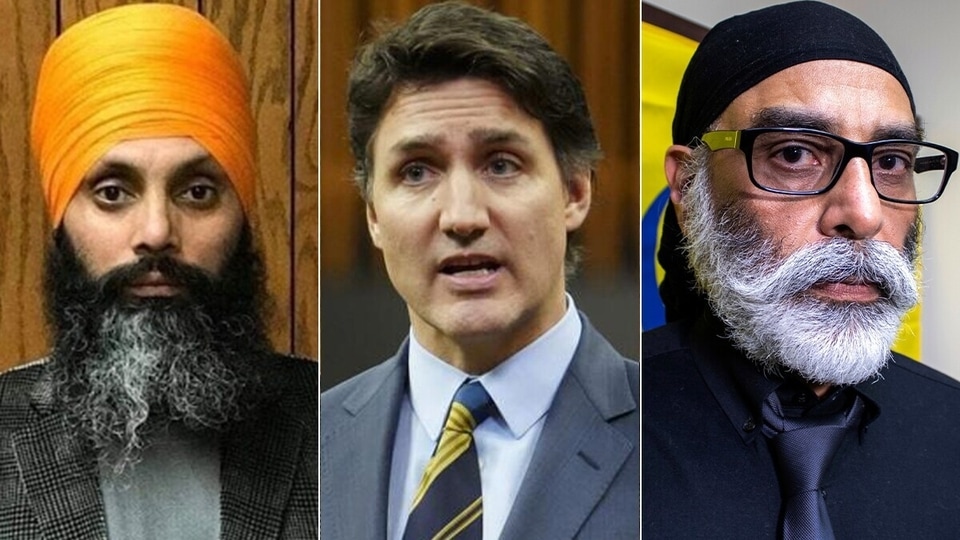
The brazen act by Ottawa is not new as the ruling Justin Trudeau government continues to harbour radical Khalistani extremists on its soil, who burn effigy of Prime Minister Narendra Modi and even take out a tableau of Indira Gandhi's assassination.
Last September, Justin Trudeau, whose government depends on the support from pro-Khalistani MP Jagmeet Singh's New Democratic Party, alleged the role of Indian agents behind the killing of Hardeep Singh Nijjar. However, Trudeau has not provided a proof to support his charges.
Nijjar, who became the head of a Sikh gurdwara in Surrey by threatening his own cousin, was portrayed as an innocent and religious-minded head by the Canadian intelligence.
But who is Hardeep Singh Nijjar, the terrorist whose death was mourned by Trudeau and Sikhs for Justice founder Gurpatwant Singh Pannun, a designated terrorist by the Indian government?
Nijjar, hailing from Jalandhar in Punjab, migrated to Canada in 1996 and was a Babbar Khalsa International (BKI) operative before joining the Khalistan Tiger Force.
According to a dossier, Nijjar travelled to Pakistan between 2013 and 2014 to hold meetings with self-styled KTF chief Tara and officials of Islamabad's spy agency Inter Services Intelligence (ISI).
Nijjar is also accused of organising an arms training camp in Mission Hills in Canada's British Columbia, wherein he trained Mandeep Singh Dhaliwal and other youths to fire AK-47 rifles, sniper rifles and pistols. He sent Dhaliwal in 2016 to Punjab to target Shiv Sena leaders and VIPs.
In 2020, an FIR was registered by NIA against Nijjar, UK-based Paramjit Singh Pamma and Sikhs for Justice (SFJ) founder Gurpatwant Singh Pannu under Section 124A (sedition), 120B (criminal conspiracy), 153A (Promoting enmity between different groups on grounds of religion, race, place of birth, residence) and 153B (Imputations, assertions prejudicial to national-integration) of the Indian Penal Code. The trio was also booked under various sections of stringent anti-terror law Unlawful Activities (Prevention) Act or UAPA.
The intelligence dossier accused Nijjar and his mentee Arsh Dala's involvement in the killing of Dera Sacha Sauda follower Manohar Lal in Bathinda in 2020, murderous attack on Hindu priest Pragya Gyan Muni in Phillaur (2021), attempted abduction and killing of Shakti Singh in Faridkot and more. Nijjar was designated as a terrorist by the MHA under UAPA in 2020. The NIA had even declared a reward of ₹10 lakh against Nijjar.


