Haryana has thrown up a big surprise in this round of assembly polls. The Bharatiya Janata Party (BJP) won all 10 Lok Sabha seats in the 2019 Lok Sabha elections. All major exit polls, with the exception of the India Today-Axis one, gave more than 70 out of the 90 assembly constituencies (ACs) to the BJP. After counting of around 40% of the votes, the BJP and the Congress seem to be locked in a close contest; the BJP led in 38 ACs, the Congress in 32. With the Jannayak Janata Party (JJP) leading in another 12 ACs, Haryana appears to be heading towards a hung assembly.
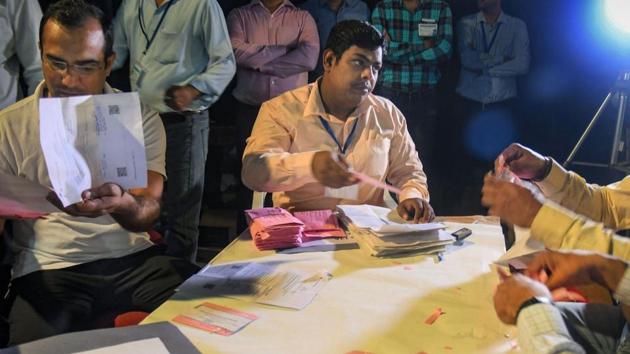
Why did everyone get Haryana wrong? Because everyone might have taken the 2019 Lok Sabha results as the new benchmark.
For full coverage of Haryana, Maharashtra assembly elections 2019, Click here.
Vote shares are the biggest indicator. The BJP had a 58% vote share in Haryana in the 2019 Lok Sabha elections. This has come down to 36% in the assembly elections. If these trends hold, the BJP has actually gained 2-3 percentage points in terms of vote share compared to the 2014 assembly elections, but lost a massive 20 percentage points compared to the 2019 Lok Sabha.
This is not very different from what happened in assembly elections such as Gujarat, Madhya Pradesh, Chhattisgarh and Rajasthan before the 2019 Lok Sabha elections, where the BJP was in power in the states and its performance did not match its 2014 Lok Sabha election levels. However, it once again achieved total dominance in the 2019 Lok Sabha polls.
This also suggests that even though Narendra Modi is not vulnerable to anti-incumbency, at the all-India level, BJP state governments cannot take pro-incumbency for granted.
{{/usCountry}}This also suggests that even though Narendra Modi is not vulnerable to anti-incumbency, at the all-India level, BJP state governments cannot take pro-incumbency for granted.
{{/usCountry}}The Congress, on the other hand, has increased its 2014 assembly vote share by around 9 percentage points to 29%, while the combined vote share of the JJP and Indian National Lok Dal (INLD) has come down by around 7 percentage points. The JJP was formed out of a split in the INLD in 2018.
This has led to a better consolidation of anti-BJP votes, leading to a decline in the BJP’s assembly tally even though it has increased its vote share (compared to the 2014 assembly elections). The consolidation of opposition votes in Haryana cannot be understood without the role of the Jat vote, which might have consolidated behind the Congress in a much bigger way than in the 2014 Lok Sabha and assembly elections and the 2019 Lok Sabha elections. That the BJP made a non-Jat leader, Manohar Lal Khattar, the chief minister and denied the traditional dominance of the Jats in the state, is bound to have played a role in a Jat consolidation against the BJP.