E-Paper



Heat, encroachment, illegal shows fuel lion-human conflict in Gujarat
A five-year-old boy was killed by a lioness in Gujarat, marking one of several recent human deaths from lion attacks amid rising man-lion conflicts.

 Prefer HTon Google


On the night of June 24, a five-year-old boy who was going with his grandfather to deliver milk was killed in a lioness attack in Chaturi village of Khambha taluka. The boy was holding on to his grandfather’s finger and walking when suddenly a lioness pounced and dragged the child away. Villagers heard their cries and rushed to the scene with sticks. Search efforts led to the recovery of the child’s remains around one kilometre away from the village.
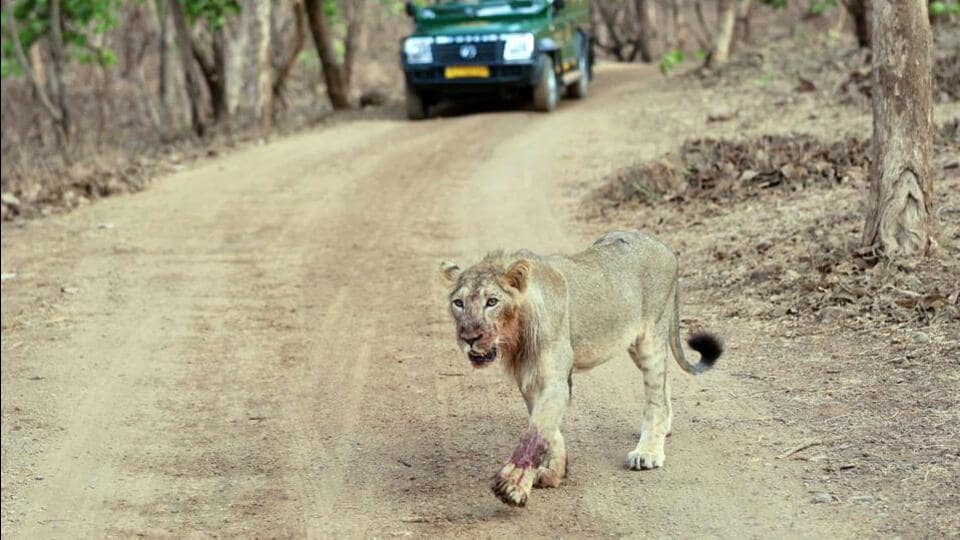
Caught in lion territory
The death is the latest in a series of five human deaths linked to man-lion conflict reported this month. To be sure, two of the deaths are only suspected lion attacks and remain under investigation, Gujarat PCCF (Wildlife) Jaipal Singh told HT. Investigations into the confirmed fatal attacks found that the victims’ bodies were partially eaten by the lions.
The other incidents include the June 16 killing near Kovaya village in Rajula taluka of a 25-year-old migrant hotel worker from Uttarakhand, whose severed head and some body parts were all that was found the next day. The other deaths were reported from Bagasara in Amreli district, Savarkundla in Amreli district and Mahuva in Bhavnagar district.
“The department has so far captured 10 lions in connection with the five deaths, and three of these big cats are likely to remain in captivity and won’t be released back into the wild,” said Singh.
As a precautionary measure, lions found to have preyed on humans are generally not released back into the wild.
A senior forest department official attributed the spike in attacks partly to weather conditions. The official, who spoke on condition of anonymity, said that for many years, the Gir landscape, particularly Junagadh and adjoining areas, has received pre-monsoon showers. This year, however, the monsoon has been delayed, resulting in a prolonged and harsh summer. According to the official, lions are most comfortable at temperatures of around 35 degrees Celsius, but the extended heat spell has made them more irritable. When disturbed by humans or brought into contact with them under such conditions, lions are more likely to attack, he said.
Illegal shows, encroachment
A second forest official said on condition of anonymity that the sharp increase in human deaths in Amreli points to illegal lion shows and harassment as key factors, with such activities far more common in that district than in Junagadh or Bhavnagar. He also noted that illegal encroachments around Gir and other protected areas across the lion landscape are shrinking the buffer between lions and human settlements. According to the officer, annual human deaths from lions and leopards in the broader region average 20-30, with lions accounting for roughly 40% of the cases.
Last May, one incident shook the Maldhari community living within Gir National Park and Sanctuary. A 21-year-old man died in what police and forest officials suspect was a lion attack in Lathi taluka of Amreli district. Forest officials linked the case to repeated illegal lion shows allegedly organised by the victim and his group in reserved forest areas.
In a separate case, forest officials on June 25 caught a person in connection with the death of a male Asiatic lion cub aged 7-8 months. The cub was found dead in the Rabari Nes area near Junagadh with head injuries suggesting human involvement.
Experts note that many unreported lion attacks occur where victims survive but people avoid reporting them due to fear of legal repercussions.
Wildlife experts have also raised concerns about illegal tourism activities on private land, where lions are sometimes baited for shows, and the expansion of hospitality projects near lion corridors. According to government figures, there were 12 illegal lion shows in Gujarat in 2022-23.
A population under pressure
The core Gir landscape has an estimated carrying capacity of 350 lions. According to the 2025 census, Gujarat’s overall Asiatic lion population stands at 891, resulting in a large number of lions dispersing beyond the core habitat into surrounding human-dominated landscapes. Amreli district is home to around 350 Asiatic lions, many of which have dispersed across hillocks, corridors and coastal stretches from Una to Mahuva. This eastern expansion contrasts with patterns in western areas, where reserve forests function as habitat islands linking Gir toward Bhavnagar. The movement has brought lions into closer contact with human settlements and farmland.
The spread of these incidents across distant sites indicates the involvement of multiple animals. Experts speaking on condition of anonymity cite behavioural changes linked to habitat pressure, including proposed mining activities in high-density zones, and rising human harassment through illegal lion shows and provocative videos.
Wildlife photographer and former State Wildlife Board Committee member Bhushan Pandya said, “Many deaths due to lions or leopards in Gujarat involve migrant field labourers during cultivation season in open areas. Illegal resorts and hotels in Gir are blocking lion corridors. Incidents like a recent attack near Pipavav occurred when people disturbed lions sheltering in Prosopis juliflora thickets.” He called for a rapid response team and an emergency helpline.
Dr Jalpan Rupapara, a lion researcher and radiologist, added: “In summer the incidents of lion attacks are high as there is some impact on the lion’s behaviour due to the heat. Humans are not on their food menu. Their rising population could have also led to a change in their behaviour.”
Y V Jhala, a leading expert and co-author of the 2024 study Deciphering the Enigma of Human-Lion Coexistence in India, published in Conservation Biology, has noted that lions generally avoid areas of high human activity. “Lions avoid periods of high human activity and use hedgerows between farmlands and small patches of vegetation as daytime refuges to rest in close proximity to settlements, working farmers, and their livestock for several hours without detection or aggression...Rarely do lions consider humans as prey, and those that do are removed from the population,” according to the research paper.
The paper also pointed to lower attack rates compared to African lions. “More than four attacks per month (double the frequency in India) on humans by lions have been reported in similar human-dominated landscapes of Tanzania.”
Forest officials provide compensation for livestock losses and issue safety advisories urging villagers to avoid venturing out alone after dark. Barda has a lion population of 24 at present and forest officials said it has a carrying capacity of up to 100 lions. The Barda Wildlife Sanctuary, located 15km from Porbandar and 100km from Gir National Park in Gujarat, is a key component of Project Lion, a 2021 central government initiative to conserve and expand the Asiatic lion population. Identified by the Wildlife Institute of India (WII) as a suitable habitat for translocating Asiatic lions, Barda historically sheltered lions until their local extinction in 1879.