...
...
Next Story

How a dry August turned monsoon surplus to deficit

The rain this August has been far from being the rainiest monsoon month. This has turned the surplus rain India was enjoying at the end of July into a deficit

Published on: Aug 28, 2023 12:32 AM IST
Advertisement

The official monsoon season runs from June 1 to September 30. This means that there will be just a month of India’s peak rainy season left after August ends. The end of August also usually marks the end of the rainiest part of the monsoon. However, an HT analysis shows that the rain this August has been far from being the rainiest monsoon month. This has turned the surplus rain India was enjoying this monsoon at the end of July

PREMIUMVendors on a hot summer day at Kartavya path in Delhi on Tuesday. (Vipin Kumar)
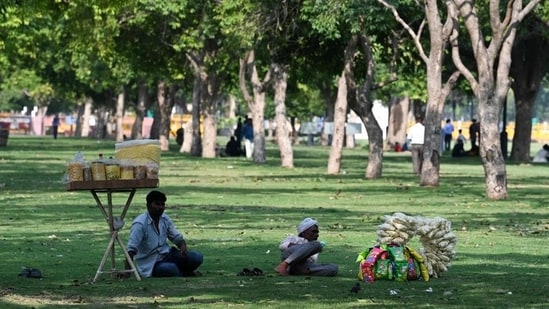
Vendors on a hot summer day at Kartavya path in Delhi on Tuesday. (Vipin Kumar)
The charts that matter
  • The rain this monsoon rain is now among the bottom 25%
    According to the gridded dataset of the India Meteorological Department (IMD), India has received 618mm rain from June 1 to August 26, the 28th lowest rain since 1901, the earliest year for which this data is available. This puts it in the driest 25% of the monsoon seasons so far. However, ranks don’t always tell how far the rain is from expected levels. This can be checked from the departure of rain from the 1961-2010 average, a benchmark for rainfall. Currently, the 2023 monsoon has a 5.7% deficit compared to the 1961-2010 average, which puts it in the “below normal” range, but not in the “deficient” range. The latter begins at a 10% deficit at all-India level if one is looking at season-long rain. To be sure, the monsoon was not in this dry a state throughout. In fact, at the end of July, the season’s performance was the polar opposite of its current status. July rain was 13% more than the 1961-2010 average (22nd highest since 1901) and created a 6.3% cumulative surplus for the monsoon. This surplus has now turned to a 5.7% deficit because the August so far is second driest since 1901 and has a 30% deficit compared to the 1961-2010 average.
  • This is because August is the second driest since 1901
    To be sure, the monsoon was not in this dry a state throughout. In fact, at the end of July, the season’s performance was the polar opposite of its current status. July rain was 13% more than the 1961-2010 average (22nd highest since 1901) and created a 6.3% cumulative surplus for the monsoon. This surplus has now turned to a 5.7% deficit because the August so far is second driest since 1901 and has a 30% deficit compared to the 1961-2010 average.
  • But some parts of the country were drowning even in August
    If the statistics above suggest that August monsoon performance is bad, that is because they show the all-India average, which hides some extreme regional variations this month. At the state level, August rain so far is the driest ever in Karnataka and Kerala and has a deficit of 60% or more in 10 states in western, northwestern, and peninsular India. On the other hand, there is a 9% and 23% surplus in Himachal Pradesh and Uttarakhand respectively, which are battling the worst floods in a decade. The area under “deficient” rain is back to early July levels. As the state-level figures above suggest, the August rain has brought the regional disparity back to early July levels. This can be seen in the area under different categories of departure from the 1961-2010 average. On July 9, there was a cumulative deficit of 20% or more – classified as “deficient”, or “large deficient” if the deficit is 60% or more – over 38% of India’s total area. This area decreased to 28% on August 3. With a dry August over most of India, this number is back to early July levels: 37% of India is now either “deficient” or “large deficient”. To be sure, August has also been dry in some regions that were running a surplus of 20% or more. The area under such surplus changed from 36% on July 9 to 37% on August 3 to just 21% on August 26.
  • The area under “deficient” rain is back to early July levels
    As the state-level figures above suggest, the August rain has brought the regional disparity back to early July levels. This can be seen in the area under different categories of departure from the 1961-2010 average. On July 9, there was a cumulative deficit of 20% or more – classified as “deficient”, or “large deficient” if the deficit is 60% or more – over 38% of India’s total area. This area decreased to 28% on August 3. With a dry August over most of India, this number is back to early July levels: 37% of India is now either “deficient” or “large deficient”. To be sure, August has also been dry in some regions that were running a surplus of 20% or more. The area under such surplus changed from 36% on July 9 to 37% on August 3 to just 21% on August 26.
  • This trend has affected reservoir levels as well
    How has the poor rain in August affected agriculture? It did not derail kharif sowing drastically because 85% of the season’s normal sowing of foodgrains (86% of cereals and 81% of pulses) was complete by August 11, when India was just a week into dry weather. By August 18, these numbers inched up further to 92.4% for cereals and 82% for pulses. The latter is lagging last year’s levels by eight percentage points while the former is three percentage points ahead. But the underwhelming sowing of pulses is not the only point of concern. Reservoirs in 12 of 20 states for which the Central Water Commission (CWC) gives data have a deficit compared to last 10 years’ average, up from eight states on August 3. Therefore, rainfall in the remaining period of the season will be important. “Monsoon rainfall continues to be deficient, with uneven distribution on a cumulative basis. With completion of kharif sowing, adequate rainfall in the remaining monsoon period will be critical for crop maturity,” Rahul Bajoria, Shreya Sodhani and Amruta Ghare, economists at Barclays India, said in an August 25 research note.
All Access.
One Subscription.

Get 360° coverage—from daily headlines
to 100 year archives.

E-Paper
Full
Archives
Full Access to
HT App & Website
Games
 
Check India news real-time updates, latest news on Hindustan Times and more across India.
SHARE THIS ARTICLE ON
Hindustantimes wants to start sending you push notifications. Click allow to subscribe