E-Paper



I-Day Special: How India’s demographic profile changed over last 8 decades
India has a population of about 1.46 billion compared to just 346 million in 1950 but it is not just the number of people that has changed

 Prefer HTon Google


Independent India turns 78 today with an estimated 1.46 billion population compared to just 346 million in 1950. To be sure, it’s not just the number of Indians which has changed in the last almost eight decades. The demographic profile of Indians has also changed significantly. Here is how.
The median age of an Indian is nine years higher than in 1950
The median age of India’s population is estimated at 20 years in 1950 (the earliest estimate from UN’s World Population Prospects report) and is 29 years in 2025.
Also Read: How Partition reshaped Delhi – and its soul
In fact, there’s more to the change in India’s demographics than just ageing. In 1950, each five-year age group had a lower share in population than the preceding five-year group. In other words, children under the age of five were the most populous five-year age group. In 2025, the 20-24 age group is the most populous.
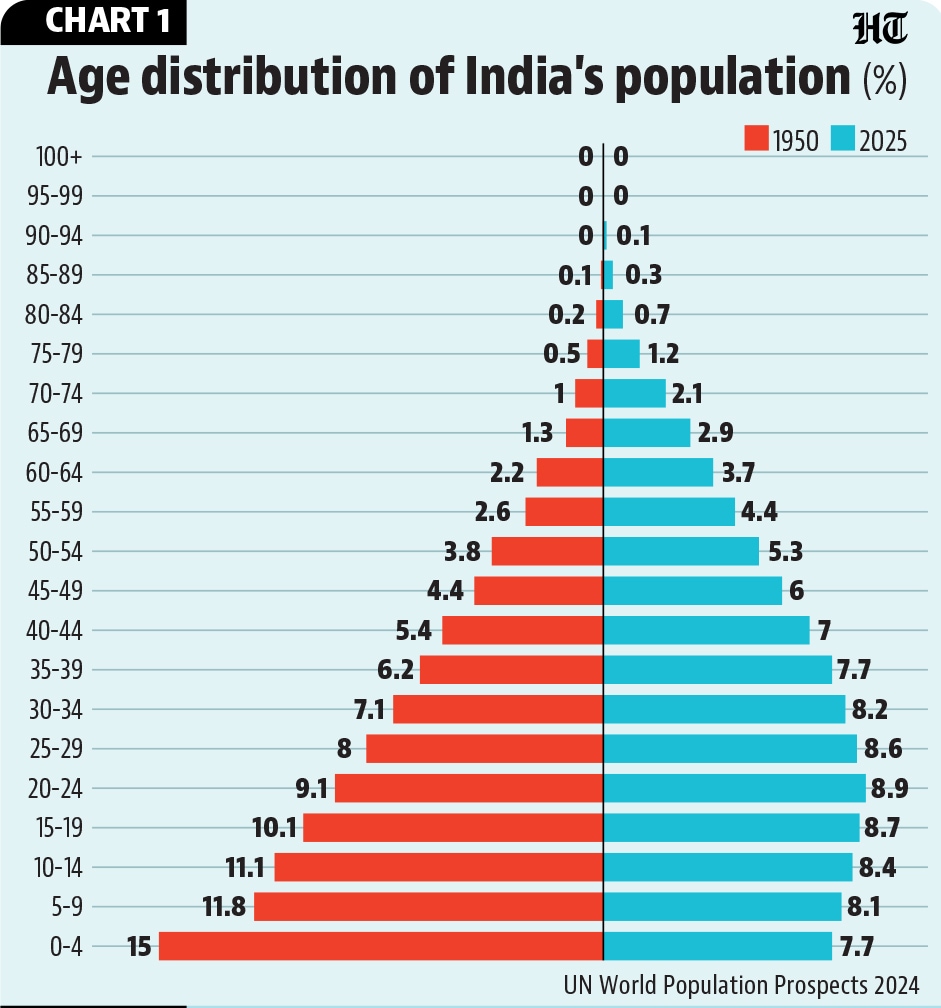
It is because of this shift towards the middle that India is said to possess a demographic dividend, where the share of the working-age population is much higher than the children and elderly, both of whom need care. But there are certain dynamics at play here.
India’s dependency ratio has fallen despite a rising population share of elderly
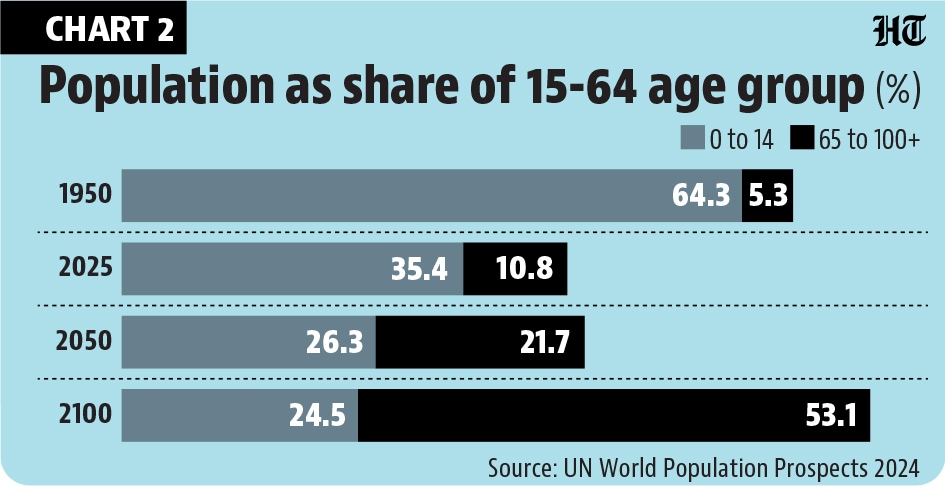
The dependency ratio, which is defined as the population outside the 15-64 age group as a percentage of the 15-64 population, has decreased from 70% in 1950 to 46% in 2025. However, this decline is completely on account of children. The 65 years and older population is now 11% of the 15-64 age group compared to 5% in 1950.
How will these trends change in the future?
With declining fertility, the ageing of the population is expected to continue. The largest age-group in 2050, for example, is expected to be the 45-49 age group. As expected from this ageing, the dependent population will shift further towards the 65 and older group.
Also Read: Foot soldiers who won India freedom
This is expected to increase the dependency ratio from 46% in 2025 to 48% in 2050, with slightly less than half of that dependent population coming from the 65 and older group.
This is what makes the period from now till 101st Independence Day in 2047 crucial for India’s economic fortunes. This demographic sweet spot will not come back. To be sure, despite peaking in absolute terms in 2049, India’s working age population will fall below the 2025 number only in 2082.