
 E-Paper



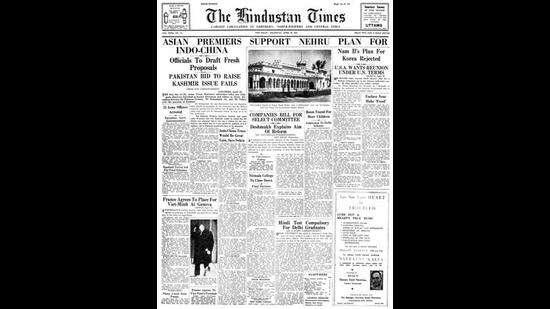
HT This Day: April 29, 1954 -- Asian premiers support Nehru plan for Indo-China
The first day of the Asian Prime Ministers’ conference today saw what some observers described as heated discussion and others as lively discussion between the Pakistan Premier, Mr Mohammed Ali, and Mr Nehru over the question of Kashmir.


The first day of the Asian Prime Ministers’ conference today saw what some observers described as heated discussion and others as lively discussion between the Pakistan Premier, Mr Mohammed Ali, and Mr Nehru over the question of Kashmir.
Mr Mohammed Ali was determined that the Kashmir issue should be discussed by the Premiers, but Mr Nehru objected, saying that the matter had dragged on for seven years and could not be discussed within an hour or so at the conference.
The Pakistan Premier, however, insisted and some other Premiers also felt, Kashmir might be raised but Mr Nehru was adamant that it was not a subject for the conference and added that if it was raised the question of U.S. military aid to Pakistan would also have to be discussed.
The conference then decided that Kashmir could not be discussed on the principle that no question to which any country objects should be discussed. The conference also debated for two hours at its afternoon session, Mr Nehru’s six-point plan for peace in Indo-China.
The Premiers agreed that there should be peace in Indo-China immediately, that the country should be free, that no colonial or communist Power should be allowed to interfere there and that nothing should be done to impede the Geneva conference.
The Prime Ministers, however, were not disposed to accept Mr Nehru’s plan without amendments and most of them proposed some alterations.
PAKISTAN VIEW
The Pakistan Premier is reported to have stated that what was needed was something “ concrete “ and if they desired only to state the objectives, they might do so by saying that they wanted cease-fire and that Indo-China should be free.
In the light of these comments, officials of the participating countries will draft an amended plan for peace in Indo-China and the Premiers will discuss it tomorrow when they continue their discussions.
The general tone of the conference is friendly despite disagreements, and the hope of success is being entertained by all.
A communique at the end of the session said the conference was held in an atmosphere of cordiality and informality, says P.T.I.
The Prime Minister of Ceylon, in his speech welcoming the other Prime Ministers, briefly referred to the questions that he considered should be discussed at the conference.
Other Prime Ministers made their replies. Thereafter, the conference discussed the procedure that should be followed in subsequent meetings. It was agreed that the conference should meet each day from 10 a.m. to 12-30 p.m. and from 3 p.m. to 4-30 p.m.
In the afternoon the Prime Ministers discussed Indo-China. A communique issued after the afternoon session said “ Indo-China was discussed. Discussions will be resumed tomorrow.”
The session, which began at 2-30 p.m. ended at 4 p.m. Sir John Kotelawala proposed that the conference should discuss the problems of Indo-China, threat to democracy, internal or external, and the question of an appeal against the use of violence. He said it was his earnest hope that the nations now conferring in Geneva would find it possible to approach the problem of Indo-China in a “ spirit of realism.”
ATOMIC WEAPONS
The Ceylon Premier urged for a check on atomic weapons. “We in Asia cannot afford to stand by in the idle hope that although these weapons are being made neither side will take the risk of resorting to their use in fear of retaliation.”
For the preservation of world peace, he said, there should be closer association of the five countries. * Such association,” he said, “ will not presuppose more than mutual understanding and trust among ourselves with pledges to shun war and aggression and oppose intervention in any form in the affairs of other States and to conduct ourselves in our relations with one another and with other States strictly in accord with the principles of international propriety.”
INDO-CHINA WAR
“I have been perturbed, as I am sure you all have been, with the way things have been going on in Indo-China recently,” he said.
“For seven years that country has been the grim battleground of what appeared to be a civil war. But today it has become an international issue with most explosive possibilities. It seems opportune indeed that the Geneva Conference is in session as we meet here. And it is my sincere hope that the nations participating in that conference will find it possible to approach these problems in a spirit of realism.
“We too, it and when we get town to the subject, must bring realism very much to bear on our discussions of the situation in Indo-China. What happens in Indo-China in the immediate future will have the most far-reaching consequences for every one of us and it is our urgent duty to consider what we must do to safeguard ourselves against dangers that loom ahead. Certain proposals save been made by certain people ad these also must be considered dispassionately and with care.”
THREAT TO FREEDOM
Sir John referred to the threat to democratic freedom by expansionist desires and policies of thers and said: “This comes from aggressive communism and retention of and attempt to perpetuate colonial rule. And I think it would greatly conduce to the preservation of peace if there could be closer association of our five countries as well as other like-minded countries that may wish to join us.
“Such an association would not presuppose much more than mutual understanding and trust amongst ourselves with pledges to shun war and aggression, to oppose intervention in any form in the affairs of other States and to conduct ourselves in our relations with one another and with other States strictly in accord with canons of international propriety. With all that we have in common in the way of our religious and cultural background and with the identity of our interests, I cannot see any real difficulty in our getting together in such m association. Time is running short and with the pressures that are developing all round us, we shall have to do something as a matter of urgency it we are not to be submerged in the world conflict that seems dangerously close.
RACE FOR WEAPONS
“Another matter which has been vividly before us in the last few weeks is the dreadful fate which awaits the world if the mad race in atomic weapons is allowed to go on unchecked. All attempts to control and regulate the manufacture 4 atomic weapons have so far been abortive and new and more deadly instruments of destruction are being produced both by Western nations and the Soviet Union which, I used, can only result in the annihilation of humanity. The argument that development of this deadly atomic power will be the best deterrent to a third world war :an hardly find acceptance with millions of human beings all the world over, who will have no say on how and when it may eventually be used.”
CULTURAL FIELD
Sir John said in the economic and cultural fields there was much opportunity for closer co-operation, poverty, under-nourishment, disease and ignorance were the common lot of the people in this region. There could be no guarantee of peace and stability until these things were got rid of. Foreign aid was not a remedy. The future lay “ in our own lands and depends on our willingness and readiness to help one another along.” Self-sufficiency in food, stabilization of the prices of valuable raw materials, development of agriculture and industry within a balanced economy, expansion of trade-these were some of the many fields in which, he said, there could be cooperation.
ALI’S SPEECH
Mr Mohammed All told the conference that continuance of the Kashmir dispute “constitutes in his area perhaps the biggest potential danger to international peace.”
He said Pakistan was pledged to policy of peace. They had throughout, Mr Ali added, endeavoured to follow in regard to international issues and disputes which concerned them the “same precept of international justice and propriety as we have preached to others.” He cited the example of Kashmir where, he said, Pakistan lad accepted every formula for peaceful solution so far put forward by the U.N. or its representatives but the dispute had remained unsolved for over six years.
“So long as this dispute is not resolved, so long as other causes of conflict and bitterness between some other countries represented here are not removed, it would be idle to hope that we will succeed in establishing mutual understanding and trust among ourselves and perhaps a little presumptuous for us to preach peace to others.”
UNREAL APPROACH
He was also of the view that any pledge among themselves to renounce war or aggression would be “somewhat unrealistic.” He did not know how it would help to promote the cause of peace or mutual understanding and trust even among themselves if “ Pakistan on the one hand and Ceylon. Burma and Indonesia on the other were to pledge themselves not to go to war or not to commit aggression against each other.” There was not the smallest danger of any of these countries going to war or committing aggression against each other now or at any time, Mr Ali declared.
He said Pakistan was pledged to a policy of peace. As a member of the U.N., it had throughout endeavoured its utmost in its own humble way to strengthen and promote the cause of peace. “ Our work in regard to Palestine, Libya, Eritrea, Morocco and Tunisia in particular is well known and has been universally acclaimed as a notable contribution to the cause of peace through promotion of international justice. * We have throughout thrown our weight unhesitatingly and unreservedly on the side of those pledged like us as members of the U.N. to seek a peaceful solution of all international disputes, to promote international justice and to fight international exploitation or discrimination in every form.
PAKISTAN’S PRINCIPLES
“We have endeavoured to follow ourselves in regard to international issues and disputes which concerned us, particularly the same precept of international justice and propriety as we have preached to others, the same canons of justice and same determination to resolve international disputes through peaceful means to which we, along with other countries represented here, are pledged as members of the U.N.
KASHMIR’S PLIGHT
“For nearly seven years, the four million people of Kashmir have remained deprived of their right of self-determination. So long as this dispute is not resolved, so long as other causes of conflict and bitterness between some other countries represented here are not removed, it would be idle to hope that we will succeed in establishing mutual understanding and trust among ourselves and perhaps a little presumptuous for us to preach peace to others.
“Similarly any pledge amongst ourselves to renounce war or aggression would be somewhat unrealistic. I do not know how it would help to promote the cause of peace or mutual understanding and trust even amongst ourselves if Pakistan on the one hand and Ceylon, Burma and Indonesia on the other were to pledge themselves not to go to war or not to commit aggression against each other. Our relations are of the friendliest character and there is not the smallest danger of any of these countries going to war or committing aggression against each other now or at any time.
NO-WAR DECLARATION
What would we, therefore, be pledging ourselves against? We cannot strengthen the cause of peace or even promote understanding and trust amongst ourselves by dealing with purely hypothetical possibilities such as these.
“As for a no-war declaration between India and ourselves, our policy is well known. Both India and ourselves as members of the U.N. are committed to seeking solution of our disputes through peaceful methods. It has been contended in the past that a no-war declaration between India and Pakistan might serve to reassure the people of both countries and might thus allay suspicion and mistrust. This purpose surely can only be achieved if the disputes that occasion bitterness and poison their relations are first settled.
“So long as these causes of bitterness and conflict continue, a more no-war declaration would carry no conviction with our people that the two countries will live in peace and harmony with each other or that there will be no cause in future for any apprehension of armed clash between them. Peace cannot be established by a mere declaration of the intention of not going to war. It can be established only by the removal of conflicts that may cause war.”
PRIORITY MATTER
If, therefore, we are to promote mutual understanding and trust amongst ourselves, if we are to co-operate in dealing with those urgent and vital economic tasks that face our countries if we are to make our contribution to the promotion of peace and to raise the standard of living of our people, we must address ourselves first and foremost to the solution of our differences and settling those disputes that at present cause bitterness, misunderstanding and mistrust amongst our various countries.
Dr Ali Sastromidjojo, Indonesian Prime Minister, said the people of Asia and Africa, who won independence and sovereignty recently, were in jeopardy because of inereasing tension and the threat of a world war.
U NU’S CALL
Burma’s Prime Minister, U Nu, expressed the hope today that “the results of our deliberations will lead to greater co-operation and mutual help, especially in the economic field.”
U Nu said the conference had a double significance: First, great events were taking place in the area and the five countries getting together ensured that whatever happened in the area, problems would have been closely and intimately considered by the countries most directly affected by those events; secondly, this was the first opportunity for them of considering common political and economic problems and the results of the deliberations should lead to greater co-operation.
“I am confident.” he said “that the outcome of our deliberations will mark a vital stage in the political stability and economic welfare of our region.
The Prime Ministers spent half-an-hour informally with journalists chatting and joking before they went into conference.
NEHRU’S ‘BUS’
While cameras were clicking, the Prime Ministers engaged themselves in cordial that. Mr Ali was heard talking to Mr Nehru about the Super-Constellation in which he came to Colombo. He then asked Mr Nehru: “How did you come?” Mr Nehru humorously remarked: “ I came in my bus.” They both burst into laughter.
As they were leaving the room, a photographer’s flash bulb burst. “It is a good omen,” Sir John said. “The conference is starting with a bang.” The Prime Ministers laughed.


