
 E-Paper



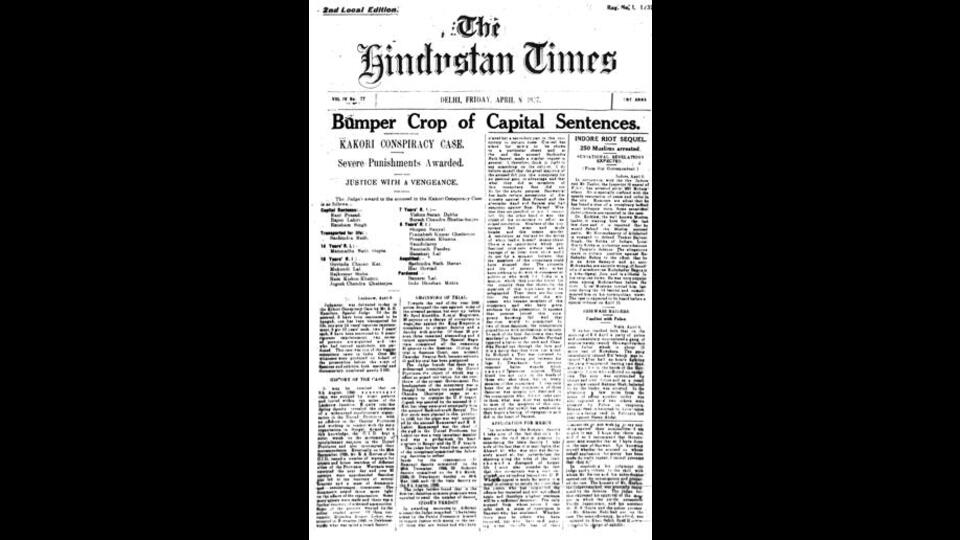
HT This Day: April 8, 1927 -- Kakori conspiracy case judgment delivered
It may be recalled that on 9th August, 1925 a раssenger train was stopped by some persons and looted within ten miles of the Lucknow Junction

 Prefer HTon Google


Lucknow: Judgment was delivered to-day in the Kakori Conspiracy case by Mr. A. Η. Hamilton, Special Judge. Of the 28 accused, 3 have been sentenced to be hanged, one has been transported for life, one gets 14 years’ rigorous imprisonment, 5 get 10 years’ each, two 7 years’ each, 6 have been sentenced to 6 years’ rigorous imprisonment. 2 persons are acquitted and two who had turned approvers, are pardoned. This case was one of the biggest conspiracy cases in India. Over 200 witnesses were produced on behalf of the prosecution before the court of Sessions and exhibits, both material and documentary, numbered pearly 1100.
History of the case
It may be recalled that on 9th August, 1925 a раssenger train was stopped by some persons and looted within ten miles of the Lucknow Junction. Enquiry into this daring dacoity revealed the existence of widespread revolutionary organisation in the United Provinces with an offshoot in the Central Provinces and working in concert with the main organisation in Bengal. Armed with this knowledge the C.I. D. kept a strict watch on the movements of revolutionary suspects in the United Provinces and also intercepted their correspondence. Eventually on the 25th September, 1925, Mr. B. A. Horton of the C.I.D. issued a number of warrants for arrests and house searches of different cities of the province. Warrants were executed the next day and over 80 persons were apprehended. Searches also led to the recovery of several firearms and a mass of documents and revolutionary literatures. The documents threw more light on the affairs of the organisation. Some more arrests were made and there was a further recovery of arms and ammunition. Some of the persons wanted by the police evaded arrest. Of them one, namely, Rajendra Kumar Lahiri, was arrested in November in Dakshineswar, in what was called a bomb factory.
Beginning of trial
Towards the end of the year 1925 police dropped the case against some of the arrested persons, but sent up before Mr. Syed Ainuddin, Special Magistrate, 26 persons on a charge of conspiracy to wage war against the King-Emperor, a conspiracy to commit dacoity and a dacoity with murder. Of these 26 persons, three remained absconding and 2 turned approvers. The Special Magistrate committed all the remaining 21 persons to the Sessions. During the trial in Sessions Court, one accused Damodar Swarup Seth, became seriously ill and his trial has been postponed.
The Judge found that there was & widespread conspiracy in the United Provinces, the object of which was to affect an armed revolution for the over-throw of the present Government. The headquarters of the conspiracy was in Bengal from where the accused Jogesh Chandra Chatterjee came as an emissary to organise the U. P. branch. Jogesh was assisted by the accused G C Kar, but ideas emanated principally from the accused Sachindranath Sanyal. The first seeds were planted in this province in 1923, but the plant was well nourished by the accused Ramparsad and R N Lahiri. Ramprasad was the chief of the staff in the United Provinces, but Lahiri too was a very important member and was a go-between the headquarters in Bengal and the U. P. branch.
The judge further found that members of the conspiracy committed the following dacoities to collect funds for the Organisation (1) Bamrauli dacoity committed on the 5th December. 1924, (8) Bichpuri dacoity committed on the Oh March, 1925 (3) Dwarkapur dacoity on 24th May 1925, and; (4) the train dacoity on the 9th August, 1925.
The judge further found that the first two dacoities common criminals were enrolled to swell the number of dacoits.
Judge’s verdict
In awarding sentences to different accused the Judge remarked “I have been asked by the Public Prosecutor himself to temper justice with mercy in the case of those who are young and who have played but a secondary part in this conspiracy in certain cases. Counsel has asked for mercy to be shown to a particular client and at the end the accused Sachindra Nath Sanyal made a similar request in general. I, therefore, think it right to say something on the subject. I do believe myself that the great majority of the accused did join this conspiracy for no personal gain or advantage and that what this they did conspiracy as members did they did not do for the above purpose. Banwarilal has made certain accusations of dishonesty against Ram Prasad and the absconder Azad and Banarsi also had suspicion against Ram Parsad.
Whether they are justified or not I cannot tell. On the other hand it was object of this conspiracy to effect an armed revolution. Members of the conspiracy had arms and made bombs and this means murder. A revolution as realized by the writer of white leaflet himself means chaos. Chaos is an opportunity which professional criminals always take advantage of as local riots show and I do not for a moment believe that the members of this conspiracy could have stopped this. The property and life of persons who have nothing to do with Government or politics or who work for India in a manner which they consider better for the country than that chosen by the members of this conspiracy must be safeguarded.
Then there are dacoities from the evidence of the witnesses who became members of this Conspiracy and who have given evidence for the prosecution. It appears that persons joined this conspiracy knowing full well that dacoities would be committed. In two of these dacoities, the conspirators joined forces with professional criminals. In each of the four dacoities a man was murdered in Bamrauli. Baldeo Pershad received a bullet in the neck and Chandika Parsad one through the face and it is a mercy that they were not killed. In Swarkapur four persons received bullet wounds which caused grievous injuries. Their blood lies not only on the heads of those who shot them, but on every member of this conspiracy. I can only hope that as the commission of these dacoities was usually not disclosed to the conspirators who did not take part in them, what was done was unknown to most of the members of this conspiracies and that now it has awakened in their hearts a feeling of repugnance as it did in the heart of Banarsi.
“In considering the Bichpuri dacoity I take note of the fact that only the men on the roof shot at persons. ln considering the train dacoity I take note of the fact that it is improbable that Ahmad Ali who was shot was definitely aimed at, but nevertheless the shooting along the sides of the train showed a disregard of human life. I must also consider the fact that this conspiracy was very important one extending beyond the U. P. When appeal is made for mercy, it is usual to attempt to satisfy the court that the person who has committed the offence has repented and will not offend again and therefore a lighter sentence will be a sufficient deterrent. The only accused from whose action I can infer such a sense of repentance is Banwari who has confessed. Whether there may be others who have repented, but who have said nothing either because fear of their companions, or not wishing to say anything against their companions. I am unable to say. I hope that there are, and if so I recommend that Government may consider that as I have done in the case of Banwari. Not knowing myself whether the accused on whose behalf application for mercy has been made do really repent, I cannot presume that they do.”
In concluding his judgment, the judge paid a tribute to the skill with which Mr Horton and his subordinates carried out the investigation and prepared the case. The honesty of Mr. Horton. The judge remarked, was generally recognised by the defence. The judge further expressed his approval of the manner in which the public prosecutor Pandit Jagatnarain, and his assistant Mr HS Gupta and the police prosecutor Mr. Khairat Nabi had put up the case. The same efficiency, he added, was displayed by Khan Sahib Syed Hussain, prosecutor in charge of exhibits


