
 E-Paper



HT This Day: January 15, 1948 -- Time Pakistan stopped outrages against Hindus and Sikhs
On the second day of his fast today, Gandhiji continued to observe his normal routine and before he retired for the night, he had participated in two important conferences with Ministers of the Indian Cabinet, received a large deputation of refugees from the N.W.F.P., addressed his usual evening prayer meeting, written articles for the next issue of the ‘Harijan’ and received a fair number of important visitors and friends.


On the second day of his fast today, Gandhiji continued to observe his normal routine and before he retired for the night, he had participated in two important conferences with Ministers of the Indian Cabinet, received a large deputation of refugees from the N.W.F.P., addressed his usual evening prayer meeting, written articles for the next issue of the ‘Harijan’ and received a fair number of important visitors and friends.
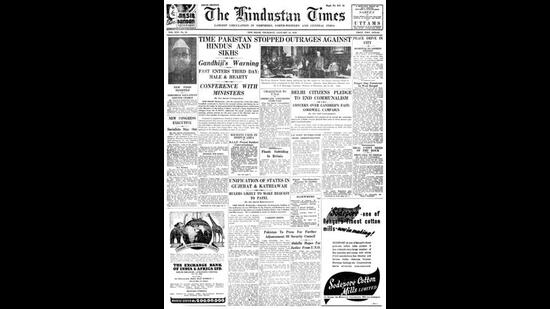
Contrary to expectations, Gandhiji walked as usual to the prayer meeting ground this evening and delivered his address in person. In his speech, Gandhiji referred at length to the recent attacks on Hindus and Sikhs in Karachi and Gujrat and asked: “How long can the Union put up with such things? How long can I bank upon the patience of the Hindus and Sikhs in spite of my fast?”
Pakistan, said Gandhiji, must put a stop to this state of affairs. They must purify their hearts and pledge themselves that they will not rest till the Hindus and the Sikhs can return and live in safety in Pakistan.
Referring to his fast, Gandhiji said he claimed God had inspired this fast and that it would only be broken when- He wished it.
Discussions With Leaders
In the morning at 10, Pandit Nehru, Sardar Patel, Mr Shanmukham Chetty and Dr John Matthai drove into Birla House and for over two hours held important discussions with Gandhiji. No visitor or any inmate of Gandhiji’s ashram was allowed near where the leaders conferred.
In the evening at 7-20, Gandhiji again conferred with Cabinet Ministers. The conference lasted for about 90 minutes and was attended by Pandit Nehru, Sardar Patel and Maulana Azad.
Gandhiji’s visitors today included the Maharaja of Patiala, Mr Jairamdas Daulatram, Rajkumari Amrit Kaur, Mr Krishna Menon, India’s High Commissioner in the United Kingdom, Mr Ghulam Mohd. Bakshi, Acting Head of Administration, Jammu and Kashmir, Mrs Sucheta Kripalani, Mr Shankarrao Deo, Mr G. D. Birla, Mr N. C. Mehta and local Nationalist Muslim leaders.
In his half-hour talk with Gandhiji, Mr Bakshi, on behalf of the people of Jammu and Kashmir, appealed to him that he should give up his fast as his life is too precious for the country. He further told Gandhiji that in these days of world-wide conflicts, humanity needs a man like him.
Mr Bakshi also pointed out to Gandhiji that Kashmiris had already given a lead to India and Pakistan in maintaining communal unity and every Kashmiri-man and woman was ready to lay his life to carry out a country-wide peace campaign for communal unity.
In reply, Gandhiji told Mr Bakshi that the fast was for restoring unity among all communities in India. The moment he felt that his purpose had been served, he would give up the fast.
Gandhiji got up as usual at 3-30 a.m. held his prayers after which he rested for some time. Later in the morning, Gandhiji looked through some important papers and dictated articles for the next issue of the Harijan. It was observed, however, that today Gandhiji did not talk much and even in his conferences with the Ministers of the Cabinet, Gandhiji spoke very little.
While the conference with the Ministers was in progress in the morning, a batch of volunteers of the “Peace Brigade” drove to Birla House and raised slogans of communal unity. They, however, dispersed after Dr Jivraj Mehta came out and told them that Gandhiji was being disturbed in his important discussions.
In the evening, when Pandit Nehru, Sardar Patel and Maulana Azad were driving out of Birla House after conferring with Gandhiji, a small batch of demonstrators who had arrived there on bicycles raised communal and anti-Gandhi slogans. At this, Pandit Nehru got out of his car and faced the demonstrators. To the demonstrators’ cries of ‘Let Gandhi die,’ Pandit Nehru replied, “How dare you say that. Come and kill me first.”
The demonstrators, however, dispersed at Pandit Nehru’s challenge but when he had gone, they reassembled. At this, Dr Mehta and other inmates of Gandhiji’s ashram tried to pacify the demonstrators who confessed that they were induced to raise anti-Gandhi slogans on account of the terrible plight of the refugees who had migrated from West Pakistan. What they asked for, the demonstrators said, was food, houses, clothing and employment. The demonstrators later dispersed peacefully.
N.W.F.P. Refugees Assurance
A deputation of refugees from the N.W.F.P., led by Mr Mehr Chand Khanna waited on Gandhiji in the evening. The deputation, consisting of over 200 people, assured Gandhiji that in spite of all the suffering undergone by the refugees from West Pakistan, they did not bear any ill will towards the Muslims and requested him to consider the early termination of his fast in the interest of both the Muslims and the refugees from Pakistan. The deputationists promised that they will actively work for the creation of a friendly atmosphere in Delhi so that Muslims may feel perfectly safe here. It is understood that Gandhiji told the deputationists to go ahead with their plans for creating goodwill among the various communities in the country.
Dr B. C. Roy who attended on Gandhiji during his previous fasts flew from Calcutta to Delhi this evening and held consultation with Dr J. Mehta and Dr Sushila Nayyar concerning Gandhiji’s health.
Medical Bulletin
Dr Mehta and Dr Sushila Nayyar who attended on Gandhiji, issued the following bulletin on his health in the afternoon today: “Mahatma Gandhi completed 24 hours of his fast at 11 a.m. today. He had fairly good sleep last night. He has been drinking hot water without the addition of salt or sour lime juice. The daily routine work has not been changed except for the fact that he did not have the usual morning and evening walk. Contrary to expectation he was able to walk to the prayer ground and back and address the audience without any difficulty for about 15 minutes. In spite of this, we would urge the people that everyday’s fast without food increases both immediate and future danger to life.”
The following is the authorized version of Gandhiji’s prayer speech today:
Gandhiji had dictated a message to be read out to the prayer audience this afternoon, but later on he decided to go to the meeting and address the gathering. He said he had come in spite of the doctor’s objections. But from tomorrow he would probably not be able to walk to the prayer ground. He had the strength today and he used it though the doctors had advised him to conserve it. He was in God’s hands. If He wanted him to live he would not die. He did not want his faith in God to weaken.
Continuing his speech without any reference to the dictated notes, Gandhiji said: “Cablegrams and telegrams are pouring in from far and near. Some, in my opinion, weighty and congratulating me on my resolve and entrusting me to God. Some others in friendliest terms appealing me to abandon the fast and assuring me that they would befriend their neighbours, irrespective of caste and creed, and try to carry out the spirit of my message that accompanied the fast.
“I am asking Pyarelalji to give a few selections from the abundance which is hourly increasing, to the Press. They are from Hindus, Muslims, Sikhs and others. If those who have given me assurances-some of the senders represent associations and groups-carry them out faithfully, they will certainly have contributed largely to the hastening of the stoppage of the fast.
“Mridulaben asks the following question from Lahore, where she is in touch with Pakistan authorities as also the common Muslims: ‘There are friends here who are very anxious about Gandhiji’s health and are eager to know what Gandhiji would like them to do on this side and what he expects from his Muslim friends in Pakistan, including those who are in political parties and in Government service.’
Process Of Self-Purification
“It is pleasing to think that there are Muslim friends who are anxious about my health and more so to know that they are eager for the information Mridulaben seeks. To all senders of the messages and to the seekers in Lahore, I wish to say that the fast is a process of self-purification and is intended to invite all who are in sympathy with the mission of the process of self-purification, whether they are in the service of Pakistan Government or whether they are members of political parties or others.
Gujrat Tragedy
“You have heard of the cowardly attack on the Sikhs in Karachi. Innocent men, women and children were butchered, looted and others have had to flee. Now comes the news of an attack on a refugee train at Gujrat. The train was carrying non-Muslim refugees from the Frontier Province. Large numbers are reported to have been killed and women abducted. It distresses me. How long can the Union put up with such things? How long can I bank upon the patience of the Hindus and Sikhs in spite of my fast?
“Pakistan has to put a stop to this state of affairs. They must purify their hearts and pledge themselves that they will not rest till the Hindus and Sikhs can return and live in safety in Pakistan.
“Supposing that there is a wave of self-purification throughout India, Pakistan will become Pak. It will be a State in which past wrongs will have been forgotten, past distinctions will have been buried, the least and the smallest in Pakistan will command the same respect and the same protection of life and property that the Quaid-e-Azam enjoys. Such Pakistan can never die. Then and not till then shall I repent that I ever called it a sin, as I am afraid I must hold today, it is.
“I want to live to see that Pakistan not on paper, not in the ovations of Pakistan orators, but in the daily life of every Pakistani Muslim. Then the inhabitants of the Union will forget that there ever was any enmity between them and, if I am not Mistaken, the Union will proudly copy Pakistan and if I am alive shall ask her to excel Pakistan in well-doing. The fast is a bid for nothing less. Be it said to the shame of those of us, who are in the Union that we had readily copied Pakistan’s bad manners.
“Before I ever knew anything of politics in my early youth, I dreamt the dream of communal unity of the heart. I shall jump in the evening of my life, like a child, to feel that the dream has been realized in this life. The wish for living the full span of life portrayed by the seers of old and which they permit us to set, on at 125 years, will then revive. Who would not risk sacrificing his life for realization of such a dream? Then we shall have real swaraj. Then though legally and geographically we may still be two States, in daily life no one will think that we were separate States. The vista before me seems to me to be, as it must be to you, too glorious to be true, and yet like a child in a famous picture, drawn by a famous painter, I shall not be happy till I have got it.
“I live and want to live for no lesser goal. Let the seekers from Pakistan help me to come as near the goal as it is humanly possible. A goal ceases to be one, when it is reached. The nearest approach is always possible. What I have said holds good irrespective of whether others do it or not. It is open to every individual to purify himself or herself so as to render him or her fit for that land of promise.
“I remember to have read, I forget whether in the Delhi Fort or the Agra Fort, when I visited them in 1896, a verse on one of the gates which, when translated, reads: ‘If there is paradise on earth, it is here, it is here, it is here.’ That Fort, with all its magnificence at its best, was no paradise in my estimation.
True Swaraj
“But I should love to see that verse with justice inscribed on the gates of Pakistan at all the entrances. In such paradise, whether it is in the Union or in Pakistan, there will be neither paupers nor beggars, nor high nor low, neither millionaire employers nor half-starved employees nor intoxicating drinks or drugs. There will be the same respect for women as is vouchsafed to men and the chastity and purity of men and women will be jealously guarded. Where every woman, except one’s wife, will be treated by men of all religions, as other sister or daughter, according to her age. Where there will be no untouchability and where there will be equal respect for all faiths. They will be all proudly, joyously and voluntarily bread labourers.
“I hope, everyone who listens to me or reads these lines will forgive me if stretched on my bed and basking in the sun, inhaling life-giving sunshine, I allow myself to indulge in this ecstasy. Let this assure the doubters and sceptics that I have not the slightest desire that the fast should be ended as quickly as possible. It matters little if the ecstatic wishes of a fool like me are never realized and the fast is never broken. I am content to wait as long as it may be necessary, but it will hurt me to think that people have acted merely in order to save me. I claim that God has inspired this fast and it will be broken only when and if He ever been known to thwart, nor will it ever thwart divine will.”


