
 E-Paper



HT This Day: January 3, 1956 -- Annual tax on total wealth
The Planning Commission, in its draft memorandum on the second Five-Year Plan, is understood to have suggested an annual tax on total wealth as a complement to income-tax and estate duties.


The Planning Commission, in its draft memorandum on the second Five-Year Plan, is understood to have suggested an annual tax on total wealth as a complement to income-tax and estate duties.
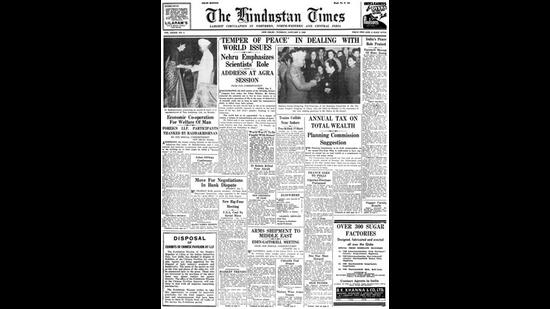
The Commission has pointed out that such an annual tax on wealth existed in Sweden, the Netherlands and Japan. It felt that ‘ prima facie ‘ there was no reason why practical proposals for such a tax could not be worked out for application in India.
The draft memorandum. due to be considered by the Cabinet this week. Will be discussed by the consultative committee of Parliament on January 13 and by the National Development Council on January 20. It is expected to be published for public comment either at the end of this month or in the first week of February.
The Commission has also pressed for early action by the Government on the recommendation of the Taxation Inquiry Commission that estate duties should be enhanced.
The Commission has also suggested that there should be some reasonable relationship between the national average income and the maximum income of an individual after making allowance for direct taxation, the size of the family and any special circumstances. Such a ratio between these two incomes, it is emphasized, should operate generally, but a beginning should be made with the public sector be. cause it sets the tone for the rest of the community and in a planned economy a great deal of leadership and direction rested with it.
After recalling the recommendations of the Taxation Inquiry Commission in this respect, the Commission is understood to have suggested that a gross income of about ₹25,000 per annum or a net income after tax of about Ra 20,000 per annum might be considered reasonable in the economic circumstances and social set-up of India. If public salaries could be adjusted on this basis, it is understood to have pointed out, active steps could also be initiated to bring about adjustments in wage differentials in other fields.
The Commission is understood to have stated that important fields for expanding the public sector were public utilities, mineral development, transport and communications, banking and insurance and foreign trade. It has emphasized that the co-operative sector had to be developed to the greatest extent possible.
The building up of co-operative activity as the dominant form of organization in agriculture, rural trade, village and small industries and in a great deal of construction work, had a high priority. The scope for developing the co-operative sector, therefore, set an important limit to the expansion of the public sector. A co-operative sector operating in fields that bear closely upon the welfare of large numbers of peasants, artisans and workers was an alternative both to the public sector and the private sector, and was to be regarded as a major element in a planned economic structure based upon democracy and social justice.
LABOUR POLICY
Dealing with the labour policy to be adopted during the Plan period, the memorandum is understood to lay emphasis on negotiations for settlement of disputes. It suggests that only in intractable cases may recourse be taken to governmental machinery for appropriate intervention.
As regards wages, the memorandum is understood to state that a progressive wage structure which provided rising real wages could only be based on increase in productivity accompanied by a firm assurance to labour that an equitable share would accrue to it. Wage disputes are sought to be settled through tripartite wage boards, As regards land policy, the memorandum is understood to have suggested certain ceilings on agricultural holdings and urged that all land in excess of the ceiling in the possession of any individual should be acquired by the State on payment of compensation at rates to be determined. While a ceiling on future acquisition of land already existed in several States, in those States where it did not exist the transfer of land should be subject to the ceiling being observed in respect of the transferee.
The memorandum lays emphasis on the rights of tenants and suggests that action should be taken to stay ejectment of tenants and subtenants except on grounds of nonpayment of rent and misuse of land. The Commission has suggested that all cultivators should be under an obligation to maintain reasonable standards of efficient production and to preserve and develop the fertility of the soil. Land management legislation should provide for standards of efficient cultivation and management which would permit objective and qualitative judgments.
SANCTIONS
It has suggested that sanctions should be provided in the legislation for fulfilment of certain obligations such as (1) in the case of a large and medium holding, bringing cultivable waste land under cultivation within a reasonable period, (2) measures relating to levelling, bunding and fencing, maintenance of irrigation channels, control of insects and diseases and eradication of weeds and terracing of fields and (3) use of improved seeds, and composting of farm refuse.
While the Commission feels that land management legislation must apply eventually to farms of all sizes and in all areas, it has suggested that in order to gain experience it may be applied in the first instance to selected areas. At the village level implementation of the legislation should be undertaken mainly through panchayats, but suitable arrangements for supervision should also be made.
As regards programmes in rural areas, the Commission is understood to have suggested that they should be worked with the aim of carrying the benefits to the greatest extent possible to those whose incomes were below the national average They should also ensure fuller and more continuous work opportunities for those whose employment was now casual and liable to frequent interruption and who were ill-paid.


