
 E-Paper



HT This Day: Nov 8, 1938-- World aviation record broken
The world aviation record for long-distance nonstop flight has been annexed by British flyers who piloted two R.A.F. bombers, Welesley no. I and no. III, from Ismailia (Egypt) to Darwin (Australia).


The world aviation record for long-distance nonstop flight has been annexed by British flyers who piloted two R.A.F. bombers, Welesley no. I and no. III, from Ismailia (Egypt) to Darwin (Australia).
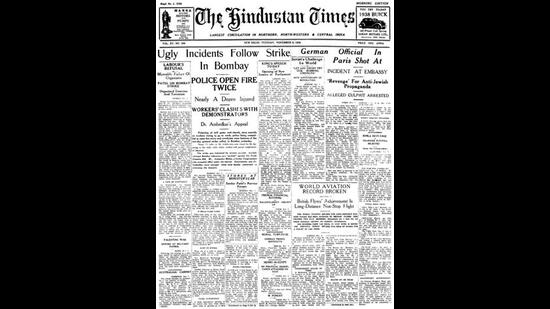
The bombers flew 7,162 miles in just over 48 hours. The previous world record was held by Russia for a flight of 6306 miles.
Darwin -Welesley bombers No. I and No. III landed at Darwin at 1-32 and 1-35 p.m. (Local time> respectively.
London advices state that an official message received from the R.A.F. flyers confirms that the world non-Stop record has been smashed.
The R.A.F bombers No. I and No III have broken the non-stop record of 6,036 miles by flying 7,162 -miles in just over 48 hours.
Bomber No. II left Koepang for Darwin immediately after refueling.
ACHIEVEMENT HAILED BY PRESS
A Melbourne message received in London at 02-48 a.m. (G.M.T.) states that all the three planes are off East Timor, but, No. II is landing at Koepang owing to petrol shortage. Others are continuing to Darwin, where they are expected at 2-30 p.m. (local time). In the Air Ministry’s latest report, the bombers’ progress had been given for the leading ‘plane, at 8-26 p.m. (G.M.T.), as passing the southern Lip of the Celebes Island with the others not far behind.
At this point, 6,400 miles from the starting point Ismailia the record of 6,306 miles was presumed to have been beaten and the achievement is hailed by the morning press.
Later news from Batavia says that No. II bomber refuelled at Koepang, resumed the flight for Darwin.
The British Air Ministry, announcing the record, states that high praise is due to Squadron Leader R. Kellett, leader of the flight, who was in No. I plane, Wing-Commander O. R. Gayford, officer commanding the unit for his organization, and the personnel for their piloting the navigation, also to the makers of the aircraft engines and equipment for their share in the achievement. It is added that the wire-, less personnel are qualified pilots and took turns in piloting during the flight.
BEATEN BY 300 MILES
The bomber, which landed at Keopang, broke the Russians’ record by approximately 300 miles. The planes are fitted with Bristol Pegasus engines.
“I never felt better,” said Squadron Leader, R. Kellett, to Reuter, as he stepped out of the ‘plane. “We had an excellent flight and, apart from storms ever India, we experienced no discomforts. My only regret is that one of the machines was forced to land at Koepang for Jack of fuel.” The planes made perfect landings at the Fannie Bay aerodrome here and will remain about four days before flying southward. The crews showed little signs of the journey, except that their eyes were red rimmed from sunshine. They superintended the overhauling and refuelling of tire machines, which are little worse, for the arduous test. The third bomber sent a radio message and will probably arrive at Darwin at 07-05 (G.M.T.).
INDIAN-BORN CREW
Messrs. Hogan and Burnett., included in the crew of the RAF long-distance planes, were born at Rawalpindi and Hyderabad (Deccan) respectively.
Flight-Lieut. Hogan, the first pilot of Bomber No. 2, who was born in Rawalpindi. interviewed by Reuter on arrival from Koepang said they had about 60 gallons of petrol when they descended at Koepang.
We might have done it. but, it was too risky to continue, and I thought it best to leave nothing to chance.”
The crew of the three machines will attend a cocktail party this evening and later a dance in the French sloop.
The R.A.F. cannot be such a feeble organization as some critics made out, states the Sydney Sun, commenting on the record. It adds that the flight has a significance for the security of Australia whose surrounding oceans are shrinking.
The R.A.F. flight was described as admirable by a high official of the Air Ministry. The flight attracted the greatest, attention here act, only as a feat of aviation, but, as a demonstration of the capabilities of the new type of the bomber.
MAGNIFICENT ACHIEVEMENT
Sir Charles Kingsley Wood -telegraphed to Squadron Leader Kellett: “Heartiest congratulations on the magnificent, achievement by the Royal. Air Force long-distance flight. The success of the flight is due t-o the excellence of the personnel, aircraft and engines and called for high Qualities of leadership and organization. Please convey the congratulations of the Air Council to all concerned.”


