
 E-Paper



HT THIS DAY: November 30, 1967 — West Bengal Assembly prorogued; Speaker adjourns House, holds Ghosh Government illegal
The Secretary of the West Bengal Legislative Assembly said the “Governor has directed that the Assembly do stand prorogued with effect from November 30

 Prefer HTon Google


Calcutta - The West Bengal Legislative Assembly was prorogued tonight. The Secretary of the Assembly, announcing this, said the “Governor has directed that the Assembly do stand prorogued with effect from Nov. 30.”
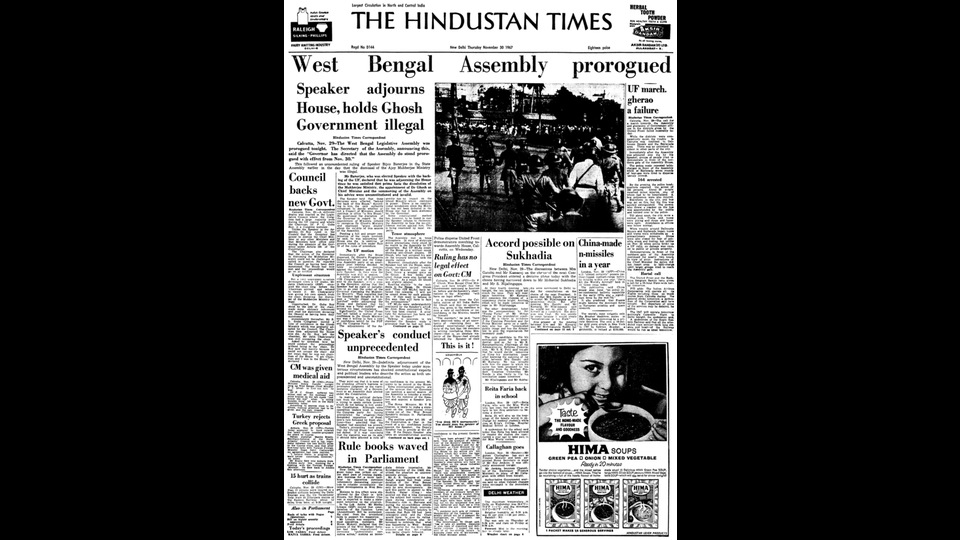
This followed an unprecedented ruling of Speaker Bijoy Banerjee in the State Assembly earlier in the day that the dismissal of the Ajoy Mukherjee Ministry was illegal.
Mr Banerjee, who was elected Speaker with the backing of the UF, declared that he was adjourning the House since he was satisfied that prima facie the dissolution of the Mukherjee Ministry, the appointment of Dr Ghosh as Chief Minister and the summoning of the Assembly on his advice were unconstitutional and invalid.
The Speaker held that these decisions were effected “behind the back of this House.” According to him, the only authority competent to decide whether or not a Council of Ministers should continue in office “is this House.” He questioned the discretion of the Governor in regard to the appointment of Ministers refused to recognize Dr Ghosh’s Ministry and expressed “grave doubts” about the validity of this session of the Assembly.
Pending a full and proper examination of the issues involved, he said, he was adjourning the House sine die in exercise of powers vested in him under Rule 15 of the rules of procedure.
No UF motion
Immediately after the House dispersed, Dr Ghosh’s Progressive Democratic Front and the Congress Assembly party at an emergency joint meeting decided to table no-confidence motions against the Speaker and the Deputy Speaker. In their view the Assembly was still in session.
A letter signed by 146 members (128 Congress and 18 PDF) was sent to the Speaker, with a copy to the Governor, stating that the Speaker had no right or jurisdiction to go over the order of the Governor dismissing the Mukherjee Ministry. They regretted that the Speaker had thought it fit to pass a “wholly illegal and unjustified” order adjourning the House and declared that his action was a “total nullity” and beyond his legal competence.
Significantly, the United Front had ‘ not tabled a motion of no-confidence in the Ghosh Ministry nor was it willing to face a vote of confidence tabled by the PDF and the Congress Party.
The adjournment of the Assembly has no impact on the Ghosh Ministry which continues in power. There is no constitutional breakdown since the Ministry has not been defeated in the House nor has it been dismissed by the Governor.
Some constitutional method has, however, to be found in case the Speaker refuses to reconvene the Assembly to face the no-confidence motion against him. This is being examined by legal experts.
Tense atmosphere
The Assembly met in tense atmosphere. In view of elaborate police precautions, there could be no march to the Assembly by UP supporters. But UF MLAs entered the House in a militant mood, shouting anti-Ghosh slogans. Dr Ghosh, who had occupied his seat on the treasury benches, took the insults calmly.
However, immediately after the Speaker had left the House, opposition members surged towards the Chief Minister and one of them threw a wooden piece on Dr Ghosh. A few books and other things were also hurled on Dr Ghosh. As a result, Dr Ghosh was slightly injured.
Reacting sharply to the incidents in the House, Dr Ghosh said: “They (UF MLAs) have behaved like cowards. I will not be cowed down by such goondaism. If they want to behave in this way, they will have to face the consequences.”
UF MLAs were understandably overjoyed by the Speaker’s action. Mr Jyoti Basu commented: “History has been created. A great fight for democracy has been put up by the Speaker.” Talking to newsmen in his chamber, the Speaker made a grievance that he had not been invited to the swearing-in ceremony of the Ghosh Ministry at Raj Bhavan. He came to know of the dismissal of the Mukherjee Ministry and the assumption of office of the Ghosh Ministry only through radio. ‘I’he Governor had done everything behind the Speaker.
He said he had only adjourned the House sine die. This did not mean that the session was over. He did not know when he could recall the Assembly. He would take time since he had to examine the constitutional position regarding the new Ministry.
Some Congress members tried to raise objections when the Speaker read his statement, but he did not give way. Congress members were saying that since the Speaker had adjourned the House in his opening remarks, the rest of his statement from the chair had no validity.
Speaking to newsmen outside the House, Mr Bejoy Singh Nahar, deputy leader of the Congress Party, said: “The Soeaker cannot criticize the Governor’s actions nor can the House discuss any such action on the floor.”
Mr Pratap Chandra Chunder, secretary of the Congress Assembly party, said the Speaker’s action was illegal. The UF had been given a chance to prove their strength, if they thought they had the majority. But by creating disorder, they had exposed their own weakness.
The following is the full text of the Speaker’s speech:
“Honourable members, this House meets under extraordinary circumstances. I am prima facie satisfied that the dessolution of the Ministry headed by Shri Ajoy Kumar Mukherjee, the appointment of Dr P. C. Ghosh as Chief Minister and the summoning of this House on his advice is unconstitutional and in valid since it has been effected behind the back of this House. Pending a full and proper examination of the matter, in exercise of the powers vested in me under Rule 15 of the rules of procedure of this Assembly. I adjourn the House sine die.
“The House will remember that when it was prorogued on Aug. 3, the Council of Ministers was headed by Chief Minister Ajoy Mukherjee and others. This was the Council of Ministers that was collectively responsible to this House in terms of Article 164(2) of the Constitution. “
As I understand the constitutional position, the only authority competent to decide whether or not a Council of Ministers should continue in office is this House. An adverse vote against the Council of Ministers in this House necessarily leads to a position when that particular Council of Ministers no longer enjoys the confidence of this House and hence its continuance in office would be a violation of Article 164(2) of the Constitution.
‘High precedent’
“I am happy to state that this understanding of mine is supported by high precedent. In March 1945, the then Government of Bengal was defeated in a vote taken on the demand for a grant in respect of agriculture.
“The question arose as to the constitutional consequence of such a defeat. At that time my predecessor in office, Shri Nausher Ali, put the essence of the matter in clear terms.
“To quote him: “Sir Nazimuddin (the then Chief Minister) said yesterday that he would treat this as a snap division and not a censure. I am afraid the constitutional position has not been properly conceived. The Ministry is the creature of the House. This House can make and unmake the Ministry and the Governor is but the registering authority of the House. Any other course, I am afraid. would strike at the very root of democracy.”
“No doubt the circumstances facing Shri Nausher Ali were different. But the essence of the matter, namely, that this House is the supreme authority in regard to making and unmaking ministries, is the same. And this statement came from the lips of a presiding officer of this House when India was not free. Today when a sovereign Indian people have given to themselves a Constitution, surely the authority of this House has increased and not diminished.
Governor’s position
“This is why I find it extremely difficult to recognize Dr Prafulla Chandra Ghosh as Chief Minister and his colleagues Mr Harendra Nath Majumdar and Mr Amir Ali Mollah as members of the Council of Ministers. Both the text of the articles of the Constitution and the precedent quoted above recognize no discretion in the Governor in respect of the appointment of the Council of Ministers. He is merely a registering authority to use the expression of my predecessor, an authority whose constitutional duty is to recognize and implement the decisions of this House.
“To an extent I have attempted to examine the method of which behind the back of this august Assembly, the Council of Ministers responsible to it has been removed. It would appear that on 21-11-6’7 the Governor of this State issued an order under Article 164(1) whereby he proposed to order that the Chief Minister, Mr Aloy Kumar Mukherjee, shall cease to hold office with immediate effect. He further “directed that the Council of Ministers headed by him stands dissolved and other Ministers cease to hold office.
‘Prima facie’ “
A careful reading of Article 164(1) does not disclose the vesting of any such power of dissolution of a Council of Ministers by a Governor. Hence I do not find any legal basis for the act of dissolution.
“I may also mention that the argument has been advanced that the words in Article 164(1) ‘the Ministers shall hold office during the pleasure of the Governor’ vest in the Governor me power to dismiss a Ministry. But this argument is without merit. For the same expression ‘pleasure of the Governor’ finds place in Article 165(3) with regard to the appointment of the Advocate-General. And none will question the appointment of the Advocate-General is not within the Governor’s discretion but has to be done on the advice of the Council of Ministers.
“On a prima facie examination of the constitutional questions involved, I find it impossible to recognize as legal, valid and constitutional the dissolution of the Council of Ministers headed by Mr Ajoy Kumar Mukherjee.
“It follows then that the appointment of the Council of Ministers headed by Dr P. C. Ghosh as Chief Minister is invalid and unconstitutional.
“The order by which the Council of Ministers headed by Mr Ajoy Mukherje was dissolved is dated 21-11-67. This Assembly, however, has been summoned ‘ under an order of the Governor which was issued only on 22.11.67. In view of this I am unable to appreciate how this session of this Assembly can have any constitutional or legal validity. For if the order of the Governor of 21-11-67 is illegal and unconstitutional, evidently the Council of Ministers headed by Mr Ajoy Kumar Mukherjee not only continues in office but it alone is competent to advise the Governor on the manner in which he is to exercise his powers under Article 174(1), namely, the power to summon this Assembly. And only an Assembly summoned by the Governor acting under such advice would be validly and properly summoned. I must, therefore, confess my grave doubts about the validity of this session of the Assembly.
His duty
“Honourable members will appreciate that the Constitution and the rules of procedure charge me with the high responsibility of protecting the dignity and privileges of this august Assembly. And I would be failing in my duty if I did not uphold the rights and powers of this House in the face of attempts to infringe and restrict such rights.
“The matters in issue are of higher constitutional importance. It is my regret that when an attempt was made to refer them for the opinion of the Supreme Court under Article 143 such attempt was frustrated. It is beyond dispute that the issues go to the very root of democracy. It is obvious, therefore, that if I am to find out how exactly I should act so as to preserve and protect the privileges of this House I should need more time and then only give a considered ruling on the grave issues at stake.
“This is why in exercise of my powers under Rule 15. I have adjourned the House sine die.”


