
 E-Paper



HT This Day: October 21, 1949 -- India elected to U.N. Security Council
India, Yugoslavia and Ecuador were today elected to the Security Council by a plenary session of the United Nations General Assembly.


India, Yugoslavia and Ecuador were today elected to the Security Council by a plenary session of the United Nations General Assembly.
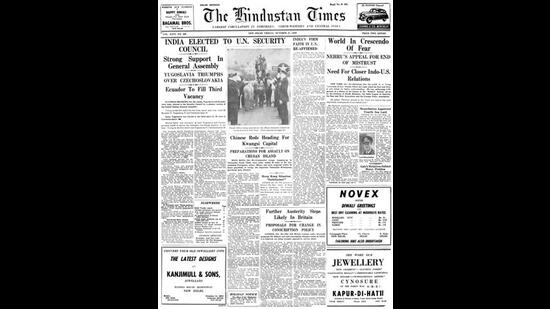
Voting in the first ballot for the three vacant seats was: India 56, Ecuador 57, Yugoslavia 37 and Czechoslovakia 20.
Later, Yugoslavia was elected to the third place by 39 votes to Czechoslovakia’s 19.
Second ballot was necessary as both Yugoslavia and Czechoslovakia failed to secure the necessary two-thirds majority in the first. Voting in the first ballot was Yugoslavia 37, Czechoslovakia 20.
The Assembly elected Yugoslavia two days after M Vyshinsky, Soviet Foreign Minister, had declared that Russia would consider her election as “illegal and unjust.”
India with 56 votes and Ecuador with 57 votes were elected in the first ballot. When the meeting opened, M Vyshinsky was ruled out of order as began attacking Yugoslavia for making “slanderous” statements on the question of the election.
The Assembly’s meeting was held to elect three Security Council members to take office in place of Argentina, Canada and the Ukraine, who retire after two years in office.
Loud applause greeted the announcement of India’s election to replace Canada as representative of the Commonwealth.
The Soviet Union had proposed Czechoslovakia, while the U.S.A. and a number of other delegations supported Yugoslavia.
Vyshinsky’s Protest
M Vyshinsky took the floor on a point of order immediately after te meeting began to protest against ‘a Press release by the Yugoslav delegation, which, he said, “slanderously distorted the attitude of the Soviet Union.”
Gen. Carlos Romulo, President of the Assembly, hammered in vain to rule the Soviet delegate out of order. M Vyshinsky continued speaking and only when he had finished was the President able to declare that all his remarks had been out of order.
The ruling was loudly applauded.
After Yugoslavia had been elected M Vyshinsky protested that the Assembly’s vote was a “violation of the Charter.”
M Vyshinsky said: “These elections are a violation of Article 23 of the Charter which requires geographical distribution.
“They also entail a violation of a firm tradition by which retiring members from the Council are replaced by countries of the same geographical region.”
Anti-Soviet Move Alleged
“Yugoslavia has been dragged into the Security Council not in accordance with a free election and with established traditions. but as a result of a behind-the-scenes plot between Yugoslavia and the U.S.A. and a number of other delegations who have decided to utilize for their own ends the political situation which has arisen between Yugoslavia on the one hand add the Soviet Union and the people’s democracies on the other.
M Vyshinsky concluded vehemently: “The Soviet delegation, with full determination, declares that Yugoslavia shall not, cannot and will not be considered as a representative of the Eastern European countries.
“The introduction of Yugoslavia into the Security Council shall be considered by the delegation of the Soviet Union as a new violation of the Charter undermining the very basis, the very foundation of co-operation in the United Nations.”
Earlier, M Vyshinsky had declared that the countries supporting Yugoslavia apparently counted on strengthening their position by transforming the Security Council into an obedient tool of the Anglo-American bloc.
After finishing the Security Council election, the Assembly elected the following countries to six vacancies on the Economic and Social Council; Mexico (57 votes), Iran (55), U.S.A. (54), Pakistan (52), Canada and Czechoslovakia (49 each).
The Dominican Republic was elected to a vacancy on the Trusteeship Council caused by the resignation of Costa Rica. Argentina and Iraq were also elected to the Trusteeship Council. The Assembly adjourned until later today.
Mr Stefan Werblowski, chairman of the Polish delegation, in a statement after the Security Council election, declared that the election of Yugoslavia, “the candidate of the U.S.A.,” violated the principles of the Charter and previous agreements.
“Such dishonest methods undermine the prestige of the U.N. and prevent it from fulfilling its basic tasks and aims.


