
 E-Paper



HT This Day: September 20, 1955 -- No discrimination against daughters
Women’s right to property share has been made equal to that of men by the Joint Committee on the Hindu Succession Bill. The Committee’s report was presented by Mr Pataskar, Minister of Legal Affairs, in Parliament today.

 Prefer HTon Google


Women’s right to property share has been made equal to that of men by the Joint Committee on the Hindu Succession Bill. The Committee’s report was presented by Mr Pataskar, Minister of Legal Affairs, in Parliament today.
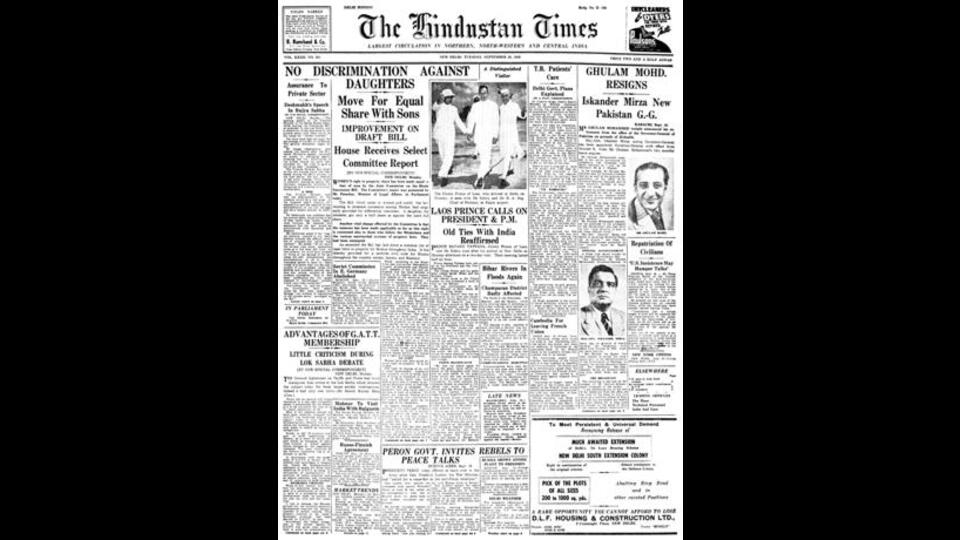
The Bill, which seeks to amend and codify the law relating to intestate succession among Hindus, had originally provided for differential treatment. A daughter, for instance, got only a half share as against the son’s full share.
Another vital change effected by the Committee is that the measure has been made applicable as far as this right is concerned also to those who follow the Mitakshara and the various matriarchal systems of property laws. They had been exempted.
As amended the Bill has laid down a common list of legal heirs to property for Hindus throughout India. It has thereby provided for a uniform civil code for Hindus throughout the country except Jammu and Kashmir.
While extending to the Mitakshara and matriarchal Maramakkathayam, Aliyasantana and Nambudiri systems of law the only exemption that has been allowed to remain is as regards the impartible estates of the erstwhile rulers of Indian States, succession to which is regulated by special covenants or agreements, and estates, succession to which is governed by existing enactments.
Neither the original Bill nor the changes seek to bring about abolition of the joint family system legally. When a male Hindu, for example, dies his share of the coparcenary property shall devolve upon the surviving members of the coparcenary except if he is survived by a female. The women then gets an equal share. Again when a heir to a share of any immovable property or of any business carried on by him or her is sought to be transferred the other heirs will have a preferential right to acquire that share by payment at value agreed upon between the parties or by court in case of no agreement. This right to a female to a share of the property does not, however, entitle her to a share of the dwelling houses until the male heirs choose to divide their respective shares therein. The woman has a right of residence therein.
NO LIMIT
Women have also been given absolute right to property. It is not limited.
The right to dispose of by will or other testamentary disposition any property which is being capable of being so displaced of, continues. A Hindu father may have spent a good deal of money in giring his daughters away in marriage. Under the Bill, as amended. the daughters have also equal right as the sons to share of property. The father can, however, dispose of the property taking into consideration the money already spent on the marriage of the daughters.
As regards sthanam properties peculiar to the west coast of India, the Bill provides for a notional partition before the death of the sthanamdar so that the property will not pass by rule of descent t a single heir but in accordance with the new law.
One change that has been made is that by revising the order of succession ament heirs to a Hind woman the properties inherited her from her father reverts to the family of the father in the absence of issue and similarly property inherited from her husband or father-in-law reverts to the heirs of the husband in the absence of issue.
Heirs falling in Class I to the property of a Hindu male may be listed. They are as follows: Son, daughter, widow, mother, son of a predeceased son, daughter of a predeceased son, son of a predeceased daughter; widow of a predeceased son; son of a predeceased son of a predeceased son; daughter of a predeceased son of a predeceased son of a predeceased son; widow of a predeceased son of a predeceased son.
In the lobbies there was among women M.P.s great jubilation as a result of the raising of the daughter’s share of property from half to one and providing everywhere equal rights to women.
Among those who had given expression to misgivings there was satisfaction that sufficient safeguards had been provided to prevent disintegration of properties.
The changes effected by the Joint Committee make the legislation an improvement over the lapsed Hindu Code which had only provided for half a share to the daughter.


