
 E-Paper



HT This Day: Nov 8, 1975 — Mrs Gandhi’s election upheld, unanimous verdict of Supreme Court
The five-member constitution bench of the court ruled that Mrs Gandhi had committed no corrupt practice and had not exceeded the ceiling in her election expenses.

 Prefer HTon Google


The Supreme Court today (November 7) unanimously upheld the election of Prime Minister Indira Gandhi from the Rae Bareli Lok Sabha constituency in 1971 and reversed the judgment of the Allahabad High Court setting aside her election and disqualifying her.
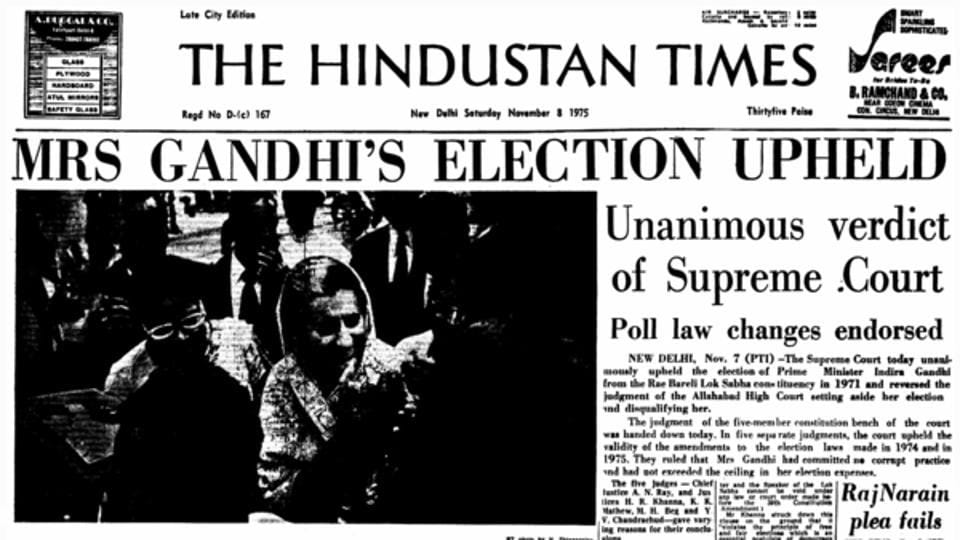
The judgment of the five-member constitution bench of the court was handed down today. In five separate judgments, the court upheld the validity of the amendments to the election laws made in 1974 and in 1975. They ruled that Mrs Gandhi had committed no corrupt practice and had not exceeded the ceiling in her election expenses.
The five judges - Chief Justice A. N. Ray, and Justices H. R. Khanna, K. K. Wathew, M. H. Beg and Y. V. Chandrachud gave varying reasons for their conclusions.
Chief Justice Ray, Mr Khanna and Mr Mathew have upheld the changes in the Constitution, barring one part, and election laws amendments in 1974 and 1975.
The three were unanimous in holding as bad the new Clause 4 of Article 329A of the Constitution which validated Mrs Gandhi’s election.
The Chief Justice, whose ruling was first handed down, upheld the validity of the changes in the election law made in 1974 and 1975 to decide, the High Court finding that Mrs Gandhi’s election was in valid because of the corrupt practices of using Government servants for advancing her election prospects.
He also upheld the Allahabad High Court judgment rejecting Mr Raj Narain’s contentions that the ‘cow and calf’used by Mrs Gandhi was a religious symbol and that she had exceeded the prescribed celling on election expenses.
The Chief Justice struck down Article 329-A(4) because it was “declaratory judgment and not a law”. The “constituent power” (legislature) could exercise judicial power “but it has to apply law”, he affirmed.
(Clause 4 of Article 329(A) lays down that the election to Parliament of the Prime Minister and the Speaker of the Lok Sabha cannot be void under any law or court order made before the 30th Constitutes Amendment).
Mr Khanna struck down this clause on the ground that it “violates the principle of free and fair elections which is an essential postulate of Democracy and is a part of the basic structure of the Constitution.
He said the validity of the other provisions of the 39th Amendment could not be assailed on the ground either of the wisdom of the legislature or the propriety or of the detention of some MPs at the time of its passage.
The court was filled to capacity by the time the five judges entered at 10.30 a.m.
Mr A K Sen and Mr J. B Dadachandji for the Prime Minister and Mr J P Goel and V Khandooja for Mr Raj Narain were among the counsels present. Mr Shanti Bhushan, chief counsel for Mr Narain, was not in the court.
Mr Ray took 50 minutes to reed extracts from his 90-page judgement.


