ICHR to exhibit Jammu and Kashmir’s history, ‘ancient links’ to rest of India
The exhibition themed ‘Jammu, Kashmir and Ladakh through the ages’ will provide visual narrative of historical and cultural continuities of the erstwhile state
The Indian Council of Historical Research (ICHR) is putting together an exhibition showcasing the history of Jammu and Kashmir (J&K), going back thousands of years, to dispel what it says is a myth that the region was isolated from the rest of the country before 1947, officials said.
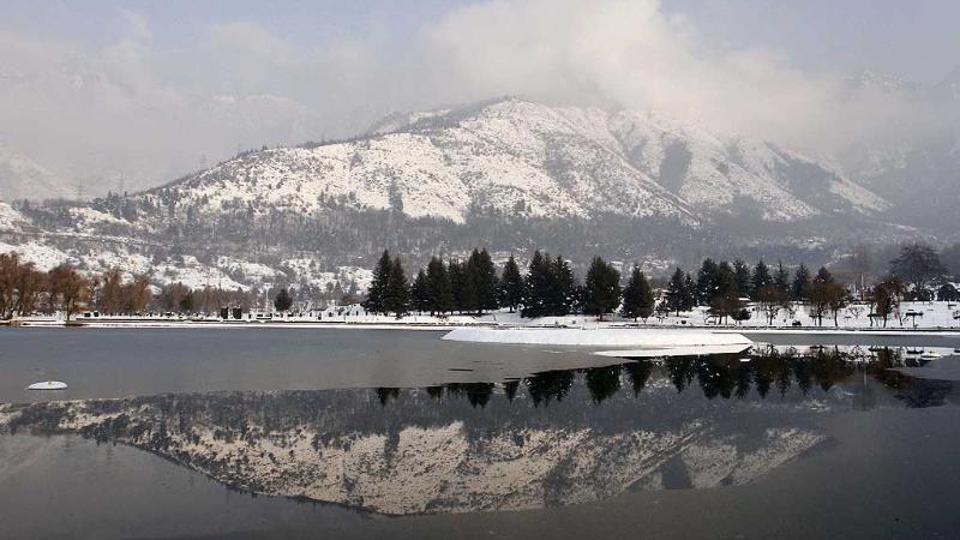
Snow-clad Zabarwan mountains in the Kashmir Valley. (AP File Photo)
The exhibition themed ‘Jammu, Kashmir and Ladakh through the ages’ will provide a visual narrative of historical and cultural continuities and the linkages of the erstwhile state with the other parts of India throughout the history of Indian civilisation, according to ICHR chairperson Raghuvendra Tanwar who has also authored two books on issues related to Kashmir.
Explaining the idea behind the exhibition, Tanwar said, “Having done two books on Kashmir, I realised that the true narrative of Kashmir has been misrepresented by foreign scholars and some of our friends and colleagues in India as well. Most people look at Kashmir as how it has evolved post 1947, whereas, we are a civilization that dates back thousands of years, and Kashmir has remained an integral part of it. People don’t even know what Kashmir was in ancient times. In fact, there is a myth that the region was disconnected with the rest of the country.”
The ICHR chief said that the exhibition will not look at Kashmir in a political sense. “Here, we will look at scriptures, architecture, trade commerce, the Harappan civilization, and how sages walked across Kashmir , the references of which are there in scripts dated back 2000 years ago,” he added.
The Union government, in 2019, scrapped article 370 of the Constitution that gave special rights to the erstwhile state, and has since spoken of how it has successfully integrated Jammu & Kashmir, now a Union Territory, with the rest of the country.
Shonaleeka Kaul, a professor at Jawaharlal Nehru University’s (JNU) Centre for Historical Studies and author of ‘The Making of Early Kashmir: Landscape and Identity in the Rajatarangini’, said that despite Kashmir’s prominence in public discourse in this country, it has remained absent from course curricula, textbooks and research programmes.
“This academic neglect of a region which, over the millennia, played an extraordinary role in Indic civilisation, has given rise to a host of misconceptions and misrepresentations. For example, a widespread notion has been that Kashmir was isolated and insular, and never a part of the Indic mainstream. This is simply untrue. However, all historical sources from at least 6th century BCE onwards attest to how early Kashmir was incredibly open, plural and cosmopolitan, and overwhelmingly Indic in her genesis and composition. The ICHR exhibition will provide, in an accessible, visual form, a corrective to such fallacies by showcasing essential aspects of the longue durée history of this prodigious land,” said Kaul, who is part of the core team working on the project.
Not everyone agrees.
Shachi Meena, an associate professor at Delhi University said that there is no such “myth” that Kashmir was not a part of mainstream India prior to 1947. “In fact, it was there in the very conscious mind of the emperors and rulers. Had it not been like that, why would the Mughal rulers go there? When Babar talked about the flora and fauna of different parts of Hindustan, he also included Kashmir.”
According to ICHR, the proposed exhibition will cover different themes of the J&K region including prehistoric linkages, evolution of social structures, Brahmanical literature, Greek and Chinese sources, travelogues, the sacred landscape, pilgrimages, temple architecture, trade routes, migration and interaction with other cultures.
The organisation plans to engage artists from across the country to start working on the exhibition. “In most cases, we already have visuals and we have to create legends. Here, we don’t even have visuals. Therefore, we will need artists to conceive the ideas for visuals. We have a team of scholars working on this and a budget earmarked for this project,” Tanwar said.
The council is likely to complete the project by the end of this year.
Fareeha Iftikhar is a Special Correspondent with the national political bureau of the Hindustan Times. She tracks the education ministry, and covers the beat at the national level for the newspaper. She also writes on issues related to gender, human rights and different policy matters.Read More
Get the latest India News, breaking headlines and real-time updates from across the country. Stay informed about politics, government policies, crime, weather and major national developments.
Home/India News/ICHR To Exhibit Jammu And Kashmir’s History, ‘ancient Links’ To Rest Of India

 E-Paper