
 E-Paper



ICMR invites companies to make monkeypox jab
The Indian Council of Medical Research (ICMR) on Wednesday invited vaccine makers, pharma companies and research and development institutes to collaborate on developing monkeypox inoculations and testing kits, the agency said in a statement, hours after India’s premier medical lab announced it had isolated the virus.


The Indian Council of Medical Research (ICMR) on Wednesday invited vaccine makers, pharma companies and research and development institutes to collaborate on developing monkeypox inoculations and testing kits, the agency said in a statement, hours after India’s premier medical lab announced it had isolated the virus.
Formally issuing what is known as an expression of interest (EoI), the ICMR kickstarted a process that is similar to the initial stages of pandemic, when an Indian company joined hands with the government to begin developing a Covid-19 vaccine after the ICMR’s National Institute of Virology (NIV) Pune lab isolated the coronavirus.
The document released by the ICMR on Wednesday said the research body was willing to make available monkeypox virus strains and isolates for research and development, validation as well as manufacturing using characterised virus isolates under a public-private partnership collaboration.
A virus isolate, or a live virus, is key for advanced research required to create testing kits, vaccines and therapeutics.
“The ICMR is in possession of characterised monkeypox virus isolates/strain and is thereby willing to collaborate… on a royalty basis on fixed term contract… for joint development and validation of five potential vaccine candidates, development of diagnostic kit, for detection of the monkeypox virus leading to product development,” the document said.
The document added: “The firm(s)/organisation(s) would be granted rights to undertake further R&D, manufacture, sell, and commercialize the end product(s) ‘vaccine candidate/IVD’ against the monkeypox disease under the defined agreement.”
The NIV announced earlier on Wednesday it had successfully isolated the monkeypox virus through the clinical specimen of a patient.
The monkeypox virus was discovered in 1958 during an outbreak in an animal facility in Copenhagen, Denmark. The facility received a continual supply of Asian monkeys and rhesus macaques, which were used for polio vaccine research. The first outbreak occurred two months after the monkeys had been received and the second outbreak occurred four months after the initial outbreak.
According to the World Health Organisation, which declared monkeypox a public health emergency on Saturday, there are currently over 18,000 monkeypox infections reported across 78 countries, with fever, body aches and skin rashes that later develop into lesions, as primary symptoms.
Dr Sumit Ray, head of the department of critical care at Holy Family Hospital, said developing a vaccine for mokeypox indigenously would be a good idea but India currently does not need mass vaccination.
“It would definitely be a good idea to develop monkeypox vaccine indigenously and it might not be very difficult and time taking because we already have smallpox vaccination available, and it is known to provide 85% efficacy. However, we might not need mass vaccination now and we can just focus on vulnerable groups,” said Dr Ray.
Earlier this week, central government officials said there were no plans yet to source smallpox vaccines, which are effective against monkeypox since both disease are caused by the variola family of viruses.
India at present has four confirmed cases of the disease, which spreads through close contact with an infected person who has developed lesions on their skin. These skin lesions are the main factor in someone being contagious.
Currently, there are only two locations that officially store and handle the variola virus under the supervision of WHO—the Centres for Disease Control and Prevention in Atlanta, Georgia, and the State Research Center of Virology and Biotechnology (VECTOR Institute) in Koltsovo, Russia.
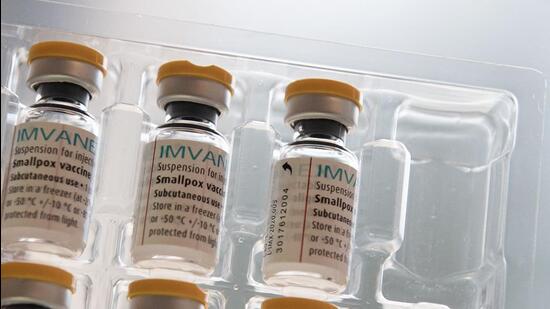
There is only one company manufacturing the licensed vaccine against smallpox, a Danish company named Bavarian Nordic. The company’s smallpox vaccine, known as Imvanex in Europe, Imvamune in Canada and Jynneos in the US, is a third-generation serum, which means a live vaccine that does not replicate in humans.
On Wednesday, Bavarian Nordic said US and European regulators have approved the use of Jynneos vaccine doses made at the company’s plant in Denmark as global efforts to tackle the monkeypox outbreak pick up pace.
The US Food and Drug Administration’s approval for the fill-and-finish plant will lead to the availability of an additional 786,000 doses of vaccine in the United States, Health and Human Services secretary Xavier Becerra said in a statement.
The fill-and-finish plants fill vials with vaccine produced in bulk and then package those for distribution.
(With inputs from Reuters)


