
 E-Paper



Will challenge EC’s electoral rollrevision move, say J&K parties
The meeting was held days after chief electoral officer Hirdesh Kumar Singh said people ordinarily residing in the region including migrant workers, businesspersons, students, and armed forces personnel will be allowed to vote


The “inclusion of non-local voters” in the electoral roll of Jammu and Kashmir is not acceptable to political parties here and the decision will be contested by all means, including in courts, National Conference (NC) president and former chief minister Farooq Abdullah said on Monday, responding to a move to allow so-called ordinary residents of the region (and not just those born there) to vote in the assembly elections -- like ordinary residents are allowed to in the rest of the country.
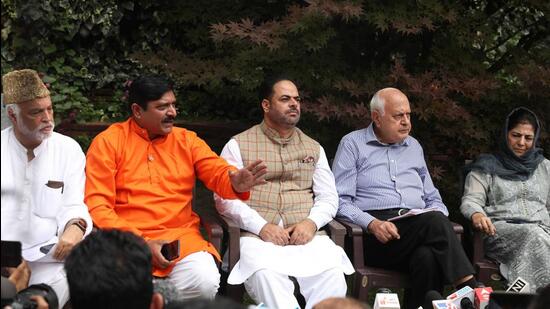
The identity of the people of the Union territory is under threat and political parties will fight together to protect it, Abdullah added.
Abdullah, who chaired a meeting of nine parties at his residence, said all participants were united against the move to extend voting rights to “outsiders”.
“The state’s identity is about to end. The Dogra, Kashmiri Pahari or Gujjar or Sikh, who reside here, will lose their identity. The assembly will be in the hands of the outsiders... We all oppose it and are not ready to accept it,” he said.
The NC leader’s remarks came days after chief electoral officer (CEO), Hirdesh Kumar Singh, on August 17, said the special summary revision of electoral rolls in the Union territory is likely to add 2.5 million new voters to the existing voters’ list and that “post-abrogation of Article 370, an ordinarily residing person can become a voter in J&K to exercise his right to franchise”.
Singh’s statement triggered a political row as several parties in the Union territory claimed the move was the “last nail in the coffin of electoral democracy” and was a “clear-cut ploy to disenfranchise the people of J&K”.
Three days later, the J&K administration issued a clarification, saying the reports of a likely addition of over 2.5 million voters is a “misrepresentation of facts by vested interests” and the increase in numbers will be on account of voters who have attained the age of 18 years as of October 1, 2022, or earlier.
Following the meeting on Monday, Abdullah said the parties will move court if non-locals are included in the electoral roll.
“There are a lot of things involved… one is to make people aware, that is our job first. Secondly, there are avenues where we can go to court. We are thinking on that aspect also,” he said.
“Why has only (J&K) been chosen for this; there must be some motive behind this,” he added.
The former chief minister also said he had urged lieutenant governor Manoj Sinha to call for an all-party meeting but did not get any response.
“We will hold a similar meeting in Jammu as this issue pertains to the people of J&K and we have to make them aware of what is happening,” he said.
“In September, we will be inviting leaders of all national parties to J&K to put our issues before them,” he added.
Besides the NC, the Peoples Democratic Party (PDP), Congress, Shiv Sena, Awami National Conference, Janata Dal (United), Akali Dal Mann, Communist Party of India (CPI) and Communist Party of India (Marxist) or CPI(M attended the meeting. Sajad Lone-led People’s Conference and Altaf Bukhar’s Apni Party did not attend the meeting.
CPI (M) general secretary Mohammad Yusuf Tarigami also said the party will “explore all possibilities of seeking justice from the highest court of the country”. The government’s clarification on the matter is unacceptable, he said.
While Lone did not attend the all-party meeting, he threatened to stage a protest, including a hunger strike, outside all constitutional institutions of the country if non-locals were enrolled as voters in the Union territory.
“We will wait till 1st October when the draft electoral rolls are published. If there is any wrongdoing ... if the electoral demography is sought to be changed, we will hit the streets, not only here but in front of all constitutional institutions of the country like Parliament,” he said.
The Bharatiya Janata Party (BJP), however, accused the NC, PDP and other parties of “spreading propaganda” to disrupt the peace in the region.
The BJP’s J&K unit president, Ravinder Raina, said there was no issue of “locals or non-locals” as the Constitution gives the right to every citizen to vote after attaining the age of 18.
“The Representative of the People Act was implemented across the country in 1950 and was extended to J-K after the abrogation of Article 370 (in August 2019). The revision of electoral rolls is taking place in accordance with the Act,” the BJP leader said at a press conference.
Congress president Sonia Gandhi is also answerable to the country after her party leaders took part in the meeting as the Act was implemented by the Congress in 1950, he said.
“There is no justification for their misleading propaganda. When PDP founder Mufti Mohammad Sayeed can fight and win elections from Uttar Pradesh and Congress leader Ghulam Nabi Azad is elected from Maharashtra, there was no uproar at that time,” he said, adding the BJP will launch an awareness campaign on the issue.
Sayeed, who is the father of PDP president Mehbooba Mufti, won from Muzaffarnagar Lok Sabha seat in Uttar Pradesh in 1989. Azad became a member of Rajya Sabha from Maharashtra in 1984.
Meanwhile, Lone explained the reason behind his decision to skip the all-party meet.
“If this effort (all party meeting) was serious, it would not be held under media gaze. Had it been serious, we would have met and you (media) would not even know about it. I don’t agree with politics of Farooq Abdullah but I have immense respect for him,” he said.
Bukhari of Apni Party, who also did not attend the meeting, said he had spoken to Abdullah.
J&K has been without an elected government ever since the BJP withdrew its support to Mehbooba Mufti’s PDP-led ruling coalition in June 2018. In May, a Delimitation Commission submitted its final report, paving the way for assembly polls.
The elections are likely to be delayed and could happen only in 2023 due to a delay in the publication of the final electoral roll by a month.
While the Election Commission of India (ECI) had initially directed that the rolls be published by October 25, CEO Kumar on August 10 said the final roll will now be published on November 25.


