E-Paper



In Bihar, forms, fear and the right to vote
Election Commission faces challenges in a voter verification drive, as many lack required documents, raising fears of disenfranchisement ahead of elections

 Prefer HTon Google


Hajipur/Saran/Danapur/Patna:
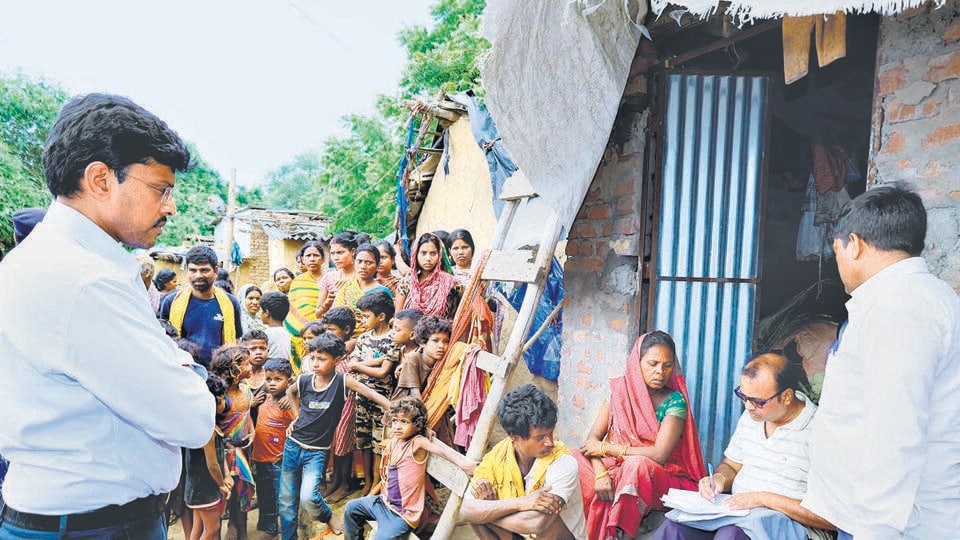
Jitender Kumar navigates the noisy and crowded main market in Danapur, Bihar like a man on a mission. Which the primary school teacher is. He is also behind schedule, despite setting out at 8 am. Then he’s at his next stop, a house in front of the kind of shopping complex that multinationals should have wiped out but couldn’t. He hollers, “Hum aa gaye hain (I am here)” as he walks past mounds of trash. Inside, there is commotion. Sanjay Gupta, Rupali Gupta, Riti Gupta, Dipanshu Gupta, he rattles the names off. “Have you filled the paper?”.
Sanjay Gupta, the head of the household, has filled the “paper” – a partially filled form given by the Election Commission of India (ECI) with details of a particular elector – but has made one mistake, pasting the photograph in the wrong box. “What’ll happen now? Will my name not come in the roll?”
Pulling out a dirty green plastic bag, Kumar assures him. “Hum hai na. Kuch harbarana nahi hai (I am here. There’s no reason to panic).” Inside, he has a sheaf of filled enumeration forms from other electors in the neighbourhood.
Instantly, he is battling a volley of questions – someone has an Aadhaar number, but no birth certificate. Someone has an electricity bill with an address, will that do? Someone is now married and lives in a different part of the district, so whose address should she give? Will an LIC certificate do? Someone has a PAN card only. Someone didn’t know the English spelling of their name and so has struck through the initial erroneous attempt. Someone hasn’t understood the meaning of EPIC (elector photo identity card). “There are so many types of questions, and to be honest, no one can give all the right answers,” says Kumar.
His white cap, now soiled with sweat, announces his identity. Kumar is a block level officer, one of 78,000 such that form the backbone of a novel but controversial exercise that has seen nearly 80 million pre-filled forms distributed in one of India’s poorest states. The exercise – called a special intensive revision or SIR – involves Election Commision of India (ECI) officials going door-to-door to physically verify the identity of each elector by authenticating one of 11 listed documents. ECI has released a detailed set of instructions and issued a string of clarifications, but the rules are complex and the documents required leave out the most-common Aadhaar, PAN or ration cards as authenticators.
The first deadline is July 25, by when everyone has to submit the form. For instance, heads of the household such as Gupta have to give their photograph, fill in their birth date, Aaadhaar number , and mobile number. They also have to provide details of dependants and provide their Voter ID (or EPIC) numbers, if these are available. Their names, addresses and EPIC numbers come pre-filled. Although the Election Commission has listed 11 documents that will be accepted, it has said that no one needs to submit them now. Instead, the focus of the first phase is to just collect the forms with the basic details. In phase 2, BLOs like Kumar will check the documents. And based on that, a final list of electors will be published.
ECI says this revision is required to safeguard the sanctity of the electoral roll but the Opposition alleges it a backdoor attempt to disenfranchise the poor, just months before a high-stakes assembly poll. But in the melee are also floating larger questions about the timing of the exercise, the relationship between an individual elector and the State, the precarity of marginalised groups such as lower-castes, economic migrants or women, and the morality of focussing on documentation in a country where informality is often a sanctioned-but-unspoken policy.
2
Since July 1, when the exercise began, Kumar has left the house every day at 8am and come back not before 7pm. ECI has insisted that the rules of SIR have not changed, but on the ground, the clarifications – one saying all documents will be needed, a second saying those who have their name in the 2003 voter roll can just cite that extract, a third saying even among those who weren’t in the 2003 roll, there are three buckets (those born before 1987 can just give their own identity proof, those born between 1987 and 2004 have to provide their own proof plus documents of either parent, and those born after 2004 will have to provide documents for themselves as well as both parents), and finally that no documents are needed at this stage – keep coming.
“Currently we are only insisting on a mobile number, date of birth, and name of father and mother. If anyone else wants to give documents of their own accord, then we take them. We are not insisting,” Kumar says.
HT has reviewed 60-odd forms across three districts, spanning rural, semi-urban and urban areas. In a majority of them, photocopies of Aadhaar and voter ID were attached (neither is among the 11 documents specified) . In many cases, the photos were in the wrong box, the date of birth or the names were smudged in ink, or crossed out for initial spelling errors.
Many voters said they knew that their names were in the 2003 roll, but didn’t have any idea how to check it, or added that they were dependent on BLOs. “I don’t even know how to check a computer. I have my voter ID but nothing more,” says Baby Devi, a resident of Tilhari village in rural Danapur.
ECI has said that 97% forms have been distributed and around half have been collected. HT saw that most households have received the form, but at least five BLOs confirmed that the number of collections is high because they are “ filling the forms ourselves by asking for Aadhaar and mobile numbers”.
ECI has said the 2025 SIR is akin to the 2003 iteration but three people involved in the 2003 process told HT there were differences.“Forms from electors to prove their parenthood or other document regarding citizenship was not required but BLOs were given strict instructions to visit every house and verify the voters physically,” said Pradeep Pandey, a retired deputy election officer and former BPSC member.
Each form has to then be uploaded on a BLO app. “But the app frequently stalls” says secondary school teacher Rinku Kumari, who is working as an assistant BLO. Or the QR code doesn’t scan, the session ends, and the OTP doesn’t come. To fill 15 forms, it can take upwards of two hours. In rural Saran, BLO Multan Ahmad said his assistant has to take the forms to his house in Hajipur town because he has WiFi. “Otherwise, the app doesn’t even work in our area most of the time,” he says. Rinku Kumari had also worked on the 2023 caste survey. “This app is causing more trouble.”
As Kumar walks through the market, he is constantly shooting out instructions– I gave you the form six days ago, you have to return it now, I’ll come back in the evening, keep it ready, why haven’t you signed the form yet, do anything but give the form, just sign and give it. Out of 859 voters in his block, he has uploaded 236 forms. Some ask him what documents the women of the households can give – some are married far away from their paternal homes, others dropped out so don’t have a school-leaving certificate, and in patriarchal set-ups, it is extremely uncommon for women’s names to be in land documents – and others worry if this will have an impact on their ration.
“It’s not the public’s fault. There is a lack of clarity, plus there’s no time,” Kumar admits.
Outside a small kirana store, he has his first fight of the day. Aging store owner Shravan Kumar hasn’t returned the forms for either him or his three family members for eight days now. “I told you to sign the papers, they are blank,” Kumar fumes. Shravan Kumar hits back. “No, you never told me. Plus I have only just applied for the ‘awasiya’ certificate,” he says. “Can I attach the receipt?”
3
In the maze of documents, there are two clear winners – the awasiya, or permanent residence certificate, and the jati praman patra, or the caste certificate.
ECI has listed 11 documents but many of them are outside the reach of the ordinary citizen. Most don’t have passports (only 2% of the state has it), birth certificates (birth registration stood at 3.7% in 2000 and 26.2% in 2007, the last year that would make people eligible to vote in 2025), government-issued ID for employees (government employees form 4.8% of the population, according to the 2023 caste survey), matriculation certificate (only 23% of adults finished school, according to the 2011 census), family register documents (a labyrinthine process that requires lineage papers and multiple verifications) or national register of citizen proof (the exercise hasn’t been conducted in Bihar).
Lounging under a tree in Chaharam village in Saran district, a group of eight men are in agreement – that ‘awasiya’ or residence certificate is the only option for them. Coverage in this village is poor, roughly 300 out of 800 electors are yet to get their forms. “I have eight people in my house. We had all voted in state and national elections also. But no one has graduated school, and no one was born in a hospital,” says Lal Babu Rai. “Hence, we have applied for the awasiya at the local block.”
To get a residence or domicile certificate, one has to fill a form at the block or circle office, with documents such as tax receipt of municipal bodies, passbooks, electricity bills, Aadhaar or any other document where address is mentioned. Then, the application is verified by the local revenue official. The process can take between two and three weeks and is free – but in usual circumstances.
“Getting any paper issued is a problem. A few years ago, I spent 400 rupees for Aadhaar. Now, I have spent ₹200 for one person’s certificate. Then, I might get it after two weeks. If you want it quicker, you have to give ₹400. Yeh bhi acha hai (This is also good). The government makes rules and the staff get the money,” Rai adds.
Around him, a chorus grows. Dholan Rai wonders why the panchayat insisted on Aadhaar if it was useless. His wife Ladiya Devi was proud of her two documents – it’s a rarity in this village for women to even step out, let alone have documents – but her Aadhaar and voter ID cards are both useless now.
“What was the point of getting Aadhaar made? In villages, everyone knows everyone. Does the government think foreigners are settled in every village? We have been here for four generations, tending to buffaloes and the land,” Dholan Rai says.
In Jamnipur village dominated by the Manjhis, who hail from the Mahadalit Musahar caste, a group of 12 women is cleaning their courtyards in the afternoon while the men are at work. In this impoverished neighbourhood, vote is a zealously guarded commodity and the voter ID opens other doors – for ration, for elderly pension, for welfare schemes. Most people are landless labourers, making roughly ₹180 a day. Those more lucky are employed as sanitation workers, earning ₹7,000 a month.
“Our forms were taken five days ago. The master-ji (teacher) who came didn’t say anything. He took our photo, Aadhaar number and signatures, but didn’t mention why,” says Dharmsila Devi.
Phulan Devi backs her. “Yes, no one told her that voter verification is going on. We are born here, but don’t have a birth certificate, and we don’t own any land.”
The only “paper” everyone in the village has is a caste certificate, for which an application has to be made to the block development office and a verification done by revenue and panchayat process. The young people in the village have applied for a caste certificate through the vikas mitra – a quasi-government agent who helps local villagers access welfare schemes.
In Danapur, sub-divisional magistrate Divya Shakti said each day, she is receiving 1,400 applications for residence and caste certificates over the past week. “Normally, this number is around 300-400.”
4
At the centre of the chaotic enrolment and verification process are the 77,895 BLOs, who are simultaneously dependent on higher-ups for dissemination of forms but also hold enormous power in guiding many ordinary people who have little clue what the drive is about, or even the correct spelling of their names.
In Patna, Rishikesh Kumar was trained for two days in the last week of June before the drive kicked off. “But no official could prepare us for the kind of questions that have come – especially why Aadhaar or ration card is not being accepted, and whether people’s access to ration will be severed by this process,” he says.
He has added every elector to a WhatsApp group, saved their numbers, uploaded the 2003 roll of his booth to the WhatsApp group, and pasted stickers with his phone number at shops. “Many say they are illiterate and have no idea what document can work. We feel more tense for them,” he says.
For him, internet access is not an issue but the pre-filled form is. “The problem is that it’s pre-typed instead of a blank form. If there is a mistake in their name, gender, even Mr/Ms, there is no way to change it. They’ll have to wait till the drive is open and make a new application,” he says.
Ringed by paddy fields, Sabalpur has a different bouquet of problems. Here, BLO Multan Ahmad is stretched between managing his primary school and going door-to-door to collect the forms. Most people are labourers and artisans with little access to either documentation or education.
“We are in confusion. Every second, the order changes. Its seared into people’s minds that if they don’t have a document, then their names will be deleted from all rolls. We are accepting the online receipt generated for domicile or caste certificate,” Ahmad says.
He is worried about two things – one that people don’t seem to understand that Aadhaar and ration cards are not accepted, and two, that even he doesn’t know the logic behind their exclusion.
“After all my hard work, if someone’s name gets deleted, I’ll be blamed though I am powerless. Please tell the higher-ups to not delete any names because it’ll be difficult for me to live here,” he says.
In his village, Ravinder Paswan has lost his voter- ID and is apprehensive his name will be deleted. Dilip Pandit’s worry is that two members of his family are yet to get their forms. “The authorities have not given us pakka documents so why this tearing hurry?” he asks.
5
Though SIR is an electoral drive, the spectre of citizenship hangs heavy over the exercise. The years mentioned by ECI – 1987, 2004 – are when India’s citizenship rules were changed. And word has permeated to the ground that the strict guidelines on papers are because citizenship is on the line. “Basically, the idea is to prove citizenship,” says Divya Shakti, the bureaucrat.
A BLO manages a booth of between 800 and 1,200 people, along with 102 booth level helpers. 10 such BLOs are supervised by a mid-level officer, who reports to the assistant electoral registration office (AERO), who reports to the ERO, typically an IAS officer.
“We are currently not focusing on documents. The idea is to touch the maximum number of people. There has been no change in the SIR protocol and we hope around 90-95% forms will come back. We want to include everyone in the draft roll,” she says.
But there is a second round after the draft roll is published on August 1, when BLOs will go back to households to check documents as part of a process called local area verification. “If documents are not properly attached, BLOs will go to their homes. See, the final list of documents is not exhaustive. The power to decide will lie with the ERO,” she says.
To be sure, this protocol might change after the Supreme Court’s observations on Thursday.
The government believes concerns about the drive are overblown – after all, caste and residency certificates are commonplace, many people have their ancestors’ names in old British records called Khatian, and others have papers to trace lineage.
“And we are seriously considering allowing ration cards, using it as a linking document. We are in talks with ECI,” said a senior Bihar government official.
Divya Shakti underlines that to delete a person’s name from the record, a strict protocol has to be followed. “I have to give a reason why I am rejecting them, in a case by case manner after completing due diligence. This power is not arbitrary.”
But in the countryside, the perception is the opposite. In Baank village, 1979-born Mohammad Jalauddin is seething. “It is completely arbitrary. I saw on TV that if my name is in the 2003 roll, I am safe. But the BLO didn’t tell me. Earlier, they would give us 3-6 months to give some documents. Now it’s only three weeks. First time I am seeing this kind of survey,” he says.
His neighbour Taiyaba Khatun is more worried. She voted in the last Lok Sabha and assembly elections but has not got the enumeration form so far. “Will I stop being a citizen? I fear they want to remove the poor” she says.
6
As millions of people negotiate a maze of rules and documents, cottage industry fixes have cropped up. Some people are getting local cyber cafes to generate printouts of application receipts, others are asking panchayat chiefs to issue letters affirming their residence. In villages where migrant workers dominate, one member of the family has returned to click photographs of the forms and send it via WhatsApp. And women are going back to their ancestral homes to fill in details.
In Tilhari village, roughly half of the 900-strong population are Dalits, but caste certificates are out of the question because it takes three weeks here – far beyond the July 25 deadline. Instead, village chief Shakunta Devi and her husband Chandan Das have issued roughly 250 letters affirming the residency of villagers. Each letter is stamped with the panchayat logo, signed by the chief and has a photograph of the applicant affixed.
“The problem here is birth certificates and only 10% of people have caste papers. So what else can we do to help them?” asks Das.
Sitting in front of her is Parvati Devi who desperately needs the letter. She has no other document. “The BLO has said if you don’t give a paper, then your ration will be cut. Maybe my pension too,” she says.
But apprehension hangs in the air. “If the government-issued Aadhaar is not accepted, why will a flimsy piece of paper stand?” asks Ram Pukar Ram, a booth-level agent appointed by the Communist Party of India (Marxist-Leninist). There are 154,977 such agents across the state.
Chandravati Devi’s predicament is worse. Three of her nephews are migrant labourers; she has managed to contact two of them but the third, Kanhaiya Kumar, is in Punjab. “Look at the weeds growing in our house. My husband and child are disabled. I have to care for them. When will I go to collect the papers?” she says. She is a Jeevika didi, who is recruited by the state government to increase welfare enrollment. But she isn’t sure if that will count.
7
Across the state, opinion about the exercise is sharply divided. Many in urban centres and those who come from dominant communities are certain that it is required to excise illegal immigrants from the voter rolls. This feeling is shared by agents of the National Democratic Alliance. “Those who are genuine citizens have many documents to prove their ancestorship,” said BJP agent Sanjeev Kumar in Hajipur town.
But in the extremely backward and Dalit settlements, the tone is less sure – even if people have all the documents. “Why are they doing this exercise in such a hurry? Will they also cut our rations? I have submitted the documents but I am worried,” said Sunita Devi in Maner. Opposition parties share the anxiety. “Once the form filling is over, we have to see if their names come in the draft roll or not,” said Arun Thakur, an agent of the Rashtriya Janata Dal in Vaishali.
This exercise has also thrown up larger questions about how a democracy should tackle migration. Chief election commissioner Gyanesh Kumar has hinted that migrant labourers should vote in their place of birth, not work. But such shifts carry huge human costs -- one that is being discussed at tea stalls and railway stations, even as groups of men and women leave in search of a dignified living.
Akhilesh Kumar worked in a Noida factory for a decade before the pandemic pried millions of vulnerable people like him out of major cities. “I worked in a pan masala factory, but after what happened, I didn’t feel like going back,” he said.
He now works as a stone mason for roughly 15 days a month, earning ₹400 a day. “The BLO came and showed us the list. I said we don’t have any of this. We have ration, PAN, MGNREGA and Shram cards. We don’t have birth certificates. What will you check if we don’t have it?” he asked.
He reels off questions – why did we get Aadhaar? Why did we connect Aadhaar to voter ID? Why is the checking happening now, and in such a hurry? “You asked us to get something made, now you say it’s not valid. This is arbitrariness. But we don’t have the luxury to skip work and get new papers made.”
Back in Danapur, Jitender Kumar and Rishikesh Kumar have finished their rounds for the day. The cacophony of the market has slowed to a hum. As they walk into a kirana shop, they meet another BLO, Anil Kumar Singh, who has set up shop outside. Strewn across a wooden table are sheafs of half-filled documents. Singh was part of the 2003 exercise but is certain this time is more frenetic.
He pulls out a badly filled form and shouts, “Who is the woman mentioned here? What is her full name?”