
 E-Paper



In C’garh Maoist hotbed, conflict brews on communal lines
The uneasy calm comes from conflict, albeit one that is broadly disconnected from the government vs Maoist battle. Instead, it’s a communal conflict whose fault lines are becoming ever clearer in a state that will see elections in late 2023.


It is 10am, and a nervous silence hangs over the village of Gorra. The silence, by itself, is not unusual. The village is inside a dense forest, its 40 homes and 200 people, as in most tribal settlements, are set wide apart. Far away from any urban habitation, Narayanpur district, which houses Gorra, has for decades been known as the gateway to “Abhujhmaad” – 4,000 square kilometres of forest and hills only just beginning to be mapped by the government, and the most secure bastion of the Maoist leadership.
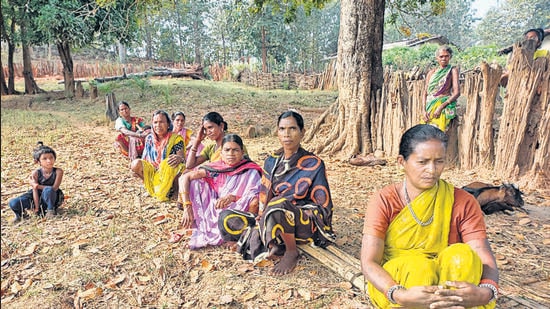
The uneasy calm comes from conflict, albeit one that is broadly disconnected from the government vs Maoist battle. Instead, it’s a communal conflict whose fault lines are becoming ever clearer in a state that will see elections in late 2023.
The eruption of violence
On December 31, the community elders of Gorra, called a meeting of its residents to discuss growing tension between 28 Gond families and 12 “Vishwasi” families, or tribals who have converted to Christianity. The Gonds argued that the “Vishwasis” had betrayed the faith, and urged them to return to the tribal fold. The Christians argued that they were still very much tribals, and were harming nobody. There was a scuffle amid heated tempers, and the matter was adjourned for a day.
The meeting reconvened the following morning, with tensions still at a simmer. With the Ekda police station in-charge Unishwar Joshi present, a fight between the two groups broke out, leaving nine people, including Joshi, injured.
In 24-year-old Jai Lal Dugga’s telling of events, the Christians were chased and assaulted. “The Gonds gathered from nearby villages and started beating us at about 10am. I was dragged out from my house and was mercilessly attacked. When I realised that I could be killed, I ran into the forest to save myself,” said Dugga, a Christian.
Lacchan Usendi (30), a Gond tribal, has a different account. “Around 200 youths who were Christians, gathered in the village and thrashed us with sticks. We had only called a meeting the day before, but they came prepared.”
Ram Der Dugga, the tribal chief of Gorra, said that things had come to this pass after three years of trying to persuade the converts to return to the fold failed. “They have stopped contributing to our age-old practices and even believing in our gods and rituals.”
The police said both sides suffered injuries, and two FIRs were registered. “A total of 15 people have been arrested,” said inspector general of police, Bastar range, Sunderaj P.
On January 2, the violence mushroomed, spreading to the district headquarters of Narayanpur, 18km away. By 11am, about 20,000 tribals gathered in protest against “illegal conversions”, some pouring in from the neighbouring districts of Kondagaon and Kanker. The mob turned violent, attacking the Vishwa Dipti Christian School and vandalising a church located in the school premises. Armed with sticks, the mob broke a statue of Mother Mary, and went on a rampage for an hour.
As an underprepared district police attempted to control the situation, the mob turned on them too, leaving Narayanpur’s superintendent of police Sadanand Kumar with head injuries. “I rushed to the spot with a policeman and started shooing away the miscreants who were armed with sticks and rods. I was told that they were moving towards the school building where children were also present. When my team and I were vacating the premises, someone from the front came and hit me on my head; the wound needed six stitches,” said Kumar. Six other policemen were injured.
The district police have since registered four FIRs under the sections of rioting, unlawful assembly, promoting enmity between groups, criminal conspiracy, and deliberate and malicious acts to outrage religious feelings.
Political connection
The heightened police action in the aftermath tells a story of political involvement.
Police first arrested five people for the violence on January 2 – Pavan Kumar Nag (24), Atul Netam (24), Ankit Nandi (31), Domendra Yadav (21) and Rupsai Salaam, the Narayanpur district BJP president. A resident of Remavand village, 8km away from Gorra, Salaam leads a group called the Janjatiya Gaurav Manch, which began an anti-Christian movement in Narayanpur in 2012.
On January 8, six more people were arrested, including Mangau Kawade, a right-wing leader. “He is close to the BJP and constantly called meetings in these areas,” said a police officer. A total of 36 people, including seven Christians, have been arrested so far.
The Congress says that these arrests show that the BJP is behind the communal violence that broke out in Narayanpur. “There were churches and Christians even when the BJP was in power but nothing happened then. Now when the people of Bastar are emerging out of Naxalism into the mainstream, the BJP is instigating people on this issue of conversion,” said Shailesh Nitin Trivedi, a senior Congress leader in Chhattisgarh.
The BJP, on the other hand, has characterised this as a “fight for tribal existence”. Former BJP minister and Narayanpur MLA Kedar Kashyap said, “Tribal leaders of Narayanpur and Bastar are leading this protest. The party will always support issues which are related to tribal pride, culture and existence.”
The conversion conflict saga
The first documentation of identifiable fault lines between Christian and non-Christian tribals appeared soon after Independence, but in north Chhattisgarh. “In the early 1950s, an official of the Orissa State Department of Tribal Welfare, Bala Saheb Deshpande, contacted Vijay Bhushan Singh Deo, the then king of Jashpur, who gave him land and support for the purpose of containing the spread of Christianity,” said Parivesh Mishra, a historian and political commentator based in Chhattisgarh. Jashpur district is 500km from Bastar.
In 1952, an ashram was established in Jashpur, which later became headquarters of the RSS-backed Vanvasi Kalyan Ashram. Its permanent office was inaugurated in 1963 by then RSS chief MS Golwalkar. By 1993, BJP leader Dilip Singh Judeo, two-time MP and the son of Vijay Bhushan Singh, began a “ghar vapsi” campaign, through which he held mass programmes where converted Christians would rejoin the Hindu faith. Judeo died in 2013, and the campaign is now run by his son Prabal Pratap Singh Judeo, who is secretary of the BJP’s Chhattisgarh unit.
Judeo told HT that conversions were “going on at the behest of the Congress” and that he was preparing for a “ghar vapasi campaign” in Bastar in February.
Experts said that the BJP’s interpretation has always blurred the lines between tribals and Hindus, which has itself been a matter of strife. “Dilip Singh Judeo, for instance, enforced the idea that all tribals are Hindus first. There has been opposition to this idea – in Chhattisgarh, Jharkhand and elsewhere – because tribals opine that their existence dates back to a period where no modern organised religion had formed,” historian Mishra said.
For the last 40 years, Bastar has been in the throes of an altogether different conflict. Beginning in the 1980s, Maoists solidified their presence in the seven districts of Bastar, the different factions merging into the banned CPI (Maoist) in 2004. In 2009, then-prime minister Manmohan Singh called Maoism India’s biggest internal security challenge.
With the violent conflict consuming much of the region, there was little evidence of religious fissures in Bastar post the creation of Chhattisgarh in 2000. But, in a note in July 2021, the Sukma superintendent of police Sunil Sharma first flagged the possibility of conflict. “Christian missionaries and converted tribes are reaching the interiors of the district and are luring local tribals. We cannot deny the possibility of conflict between converted tribals and locals. Officers should keep a close eye and if there is any illegal activity, appropriate legal action should be taken and information should be passed to senior police officials,” the letter, dated July 12, said.
For the past four years, there have been several incidents of violence between Christians and tribals across Bastar. A fact-finding team led by Irfan Engineer, director, Centre for Study of Society and Secularism, claimed in a December 25, 2022, report that between December 9 and December 18, there were a “series of attacks in Narayanpur, and 15 villages in Kondagaon. “Those displaced were told to give up their Christian faith and convert to Hindu religion failing which they were threatened their village or face dire consequences including death,” the report said.
Police record show that in the Bastar division, 14 cases have been registered under the sections of rioting and assault related to such disputes. In these cases, 158 people have been prosecuted, police said.
Politics of conversion
One of the central issues in the conflict is the “delisting” those tribals who convert to Christianity from benefits they get by virtue of being members of a Scheduled Tribe. In Chhattisgarh, the benefits of being from an ST include 32% reservation in government jobs and educational institutions.
“Why should they be considered STs if they are Christians? This will stop conversions,” BJP secretary Judeo said.
Legal experts, however, say that this has been a sticky constitutional issue for decades, and as it stands, a change in religion does not necessarily mean the loss of tribal status. “The Centre has formed a commission in 2022 to review and revisit the situation with regard to converted Dalits. For STs, as it stands, despite conversion, members of a notified Scheduled Tribe retain their tribal status if they continue to follow their traditional customs, and rituals. A change of status does not necessarily mean the stop to being a tribal which is a social combination and not a religious group,” said Abhinav Shukla, professor at the Hidyutullah National Law University in Raipur.
At the centre of debate, then, is politics, and more specifically assembly elections approaching in late 2023. Bastar has a total of 12 assembly seats that have swung between the two principal parties in the state, the BJP and the Congress. In 2003, the BJP won 9 and the Congress 3, in 2008 the BJP 11 and the Congress 1, and in 2013, the BJP 4 and the Congress 8. In 2018, however, the Congress won all 12 seats.
A senior Congress leader in Raipur alleged that this was at the heart of the growing tension in Bastar. “For the past two years, the BJP has been pushing the conversion issue in Bastar to regain ground. This has given them an election agenda, and they are now organising meetings about conversion in urban and semi-urban areas in the region, pushing it as a ‘tribal pride’ issue,” he said, asking not to be named.
Sukhman Potai, a Christian and president of the Massih Ekta Samaj in Bastar, said the “whole fight is strategically orchestrated”. “Nothing like this has happened before. There are only 20,000 of us in Narayanpur, and the number of prayer halls built in huts, are 50. How can we be a threat?” Potai asked.
A senior BJP leader, however, disagreed both on the numbers, and the scale of the perceived threat.
“They have made more than a thousand prayer halls and churches in Narayanpur, and their population is around 70,000 which is a matter of concern,” the leader said, asking not to be identified as he is not authorised to speak over the issue. In Census 2011, the population of Narayanpur was 130,000, with only 600 recorded as Christians. A senior district official said, “In the villages inside the forests, even when ‘conversions’ do happen, they are not official or documented.”
Back in Gorra, Jai Lal Dugga lives with a sense of foreboding. After the clash in the village on January 1, he moved to Narayanpur, but has now returned to the village. “In the night, nobody sleeps. Nobody knows when the next attack will take place. Life in our village is no longer the same.”
 ABOUT THE AUTHORRitesh Mishra
Ritesh Mishra is the State Correspondent for Chhattisgarh with Hindustan Times. He reports on Maoism, internal security, politics, mining, governance, and major developments shaping the state. Based in Raipur, he has covered Chhattisgarh since 2016, reporting extensively from the Bastar region and other conflict-affected areas. With nearly two decades of experience in journalism, Ritesh has built a reputation for ground reporting from some of India's most challenging terrains. His coverage spans Left-Wing Extremism, counter-insurgency operations, elections, tribal affairs, environmental issues, infrastructure, mining, and socio-economic developments. He has reported on major security operations, policy initiatives, wildlife crime, and the changing dynamics of conflict and development in Central India. Before moving to Chhattisgarh, Ritesh spent eight years reporting from Madhya Pradesh, covering politics, administration, crime, development, and social issues. Throughout his career, he has reported on various forms of extremism in Central India, combining field reporting with in-depth analysis to produce accurate, balanced, and impactful journalism. Prior to joining Hindustan Times, Ritesh worked with The Pioneer and The Free Press Journal, where he covered a wide range of beats and honed his skills in political, investigative, and field reporting. His reporting is marked by exclusive stories, extensive fieldwork, and a commitment to factual, on-the-ground journalism that brings complex issues to a wider audience.Read More
-kW0H-U20214218012MgB-250x250%40HT-Web.jpg)


