
 E-Paper



In Telangana, the new government lifts Kaleshwaram irrigation project out of troubled waters
Two months ago, six piers of a barrage on Mallana reservoir, part of the Kaleshwaram Lift Irrigation Project, sank. The new CM must handle the colossal mess

 Prefer HTon Google


Ten years ago in 2014, when India’s youngest state Telangana was born, K Chandrashekar Rao (KCR), the founder of the then Telangana Rashtra Samithi (TRS) fought for the creation of a separate state rallying his verbal screed around Neellu, Nidhulu, and Niyamakalu (water, funds, and jobs). In the run-up to the announcement of statehood, people of Telangana, high and low, were swept with emotion when their ‘Dora’ or ‘Master’ promised to deliver to them security in the form of water, funds for development, and employment in government and public sectors - all which were allegedly arrogated by Telugu speakers on the Andhra side of the border.
Right by water
Upon coming to power in 2014, when KCR, the person of the hour, became chief minister, the ball was set in motion to deliver on his first promise -- taking water to the doorstep of every household and irrigating swathes of land in the state. And so, the blueprint for the Kaleshwaram Lift Irrigation Project (KLIP) was commissioned. But before this astounding ₹80,000 crore project took off, Mission Bhagiratha, a drinking water scheme that was conceived by KCR in 1996-97, during his term as a minister in Chandrababu Naidu’s cabinet, much before the creation of Telangana had to be completed first.
Abutting ‘Mission Bhagiratha’ infrastructurally was ‘Mission Kakatiya', a special scheme to renovate 46,531 tanks and lakes, storing 265 TMC water across the state in five years. Work on KLIP would be carried on coterminously, even as the two projects were underway, the government had decided. At that time, these three water infrastructure projects were estimated to cost the state government ₹2 lakh crore.
The responsibility of implementing these projects was entrusted to T Harish Rao, his nephew, who also was the minister for irrigation and finance in the first term between 2014 - 2018. The success of both the ‘Missions’ earned KCR praise from Prime Minister Modi and even others who were philippic against him. It was this achievement that was a powerful arrow in his quiver and was used alongside the predilection of Telangana statehood to return to power in December 2018 with a handsome majority.
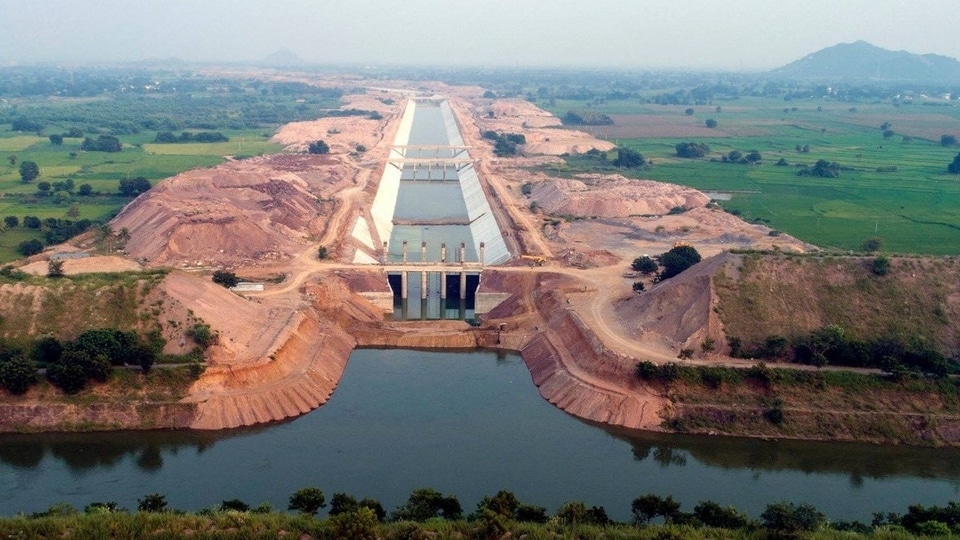
A bigger mandate only meant weightier projects. And so, in 2019, Kaleshwaram was presented in India and worldwide as the biggest lift irrigation project ever to stand. It was inaugurated in June 2019, just six months after KCR returned to power for the second time.
For starters, Kaleshwaram was envisaged to irrigate 45 lakh acres of farmland across 20 of the state’s 33 districts. The multi-purpose project was designed to be a smart solution to solve three problems: irrigate arid patches of land, help generate power, and provide water to industries, which promised to employ youth, many of them fresh graduates.
At the time of the inauguration, KCR said, “I have turned parched earth into verdant farmland. This project built over the confluence of the Godavari and Pranahita rivers, along with the reservoirs will relieve us from water stress and ensure the people of Telangana have their own source of water.”
While the project had faced initial setbacks in 2020 and 2021 because of excessive rainfall, all civil engineering defects were seemingly looked into and in December 2022, the entire project became functional and earned laurels from Senators in the USA and several chief ministers in India.
Pride has its fall
However, what started as a project to ease the hardscrabble life of a tenant farmer, turned to be the proverbial noose for KCR and his government just as he was seeing off his second term with a flourish.
In the first week of November 2023, a loud sound reported by villagers living close to the Mallanna Sagar reservoir - the jewel in the Kaleshwaram crown and the largest reservoir on the Godavari river basin - turned out to be the sound of six of the 11 piers in Block-7 of the Medigadda (Lakshmi) barrage sinking and drifting.
Swift action meant the irrigation department calling for an immediate investigation of the foundation of all eight blocks with a total of 85 gates as a “measure/purpose of safety”. L&T Infrastructure, which built the structure too joined the investigation.
What followed were a series of accusations and counters, and political mudslinging until the National Dam Safety Authority (NDSA) visited the site and raised concerns over the stability and structural integrity of this crucial piece of infrastructure in the region. In its detailed report, the NDSA said the sinking of the piers was due to a combination of issues involving failure in planning, design, quality control, and operation and maintenance - virtually throwing the Telangana government and L&T under the bus.
Calling for a structural restoration of the Medigadda barrage constructed downstream, the report said, “The damaged Block-7 has to be structurally restored. It cannot be repaired. It has to be removed and reconstructed. The other two barrages of the KLIP constructed upstream also need to be thoroughly examined considering the commonalities. The likelihood of the failure of other blocks exists and this would warrant rehabilitating (reconstructing) the whole barrage”.
Biksham Gujja, an international water policy expert said, “I view the situation as grim. The cost of recovering and restoring these piers and the required repairs may run into thousands of crores.” The project cost escalated by ₹40,000 crore to ₹1,20,000 crore with more than six commercial institutions funding it at high interest levels. While questioning the project viability, he wondered how the state, which repays ₹18,000 crore every year paring its debt would be able to sustain this project.
Those who have watched K Chandrashekar Rao’s political journey over the years say he was seemingly obsessed with the Kaleshwaram project. Technical compliance, fiscal profligacy, adherence to ecological, and topographical principles were all casualties in the process.
It was meant to be the salve for many a wound he’d festered over decades of his life in politics: His wounded Velama caste pride from having to be a lieutenant, to the moneyed Reddys and Kammas who dominated Andhra Pradesh’s politics since the 1950s, the ardent desire to be known as Telangana’s maker, and beyond all, to be the mythological sage Bhagiratha, the bearer of the Ganges to southern India -- Kaleshwaram was his raison d’etre.
IYR Krishna Rao, former chief secretary of Andhra Pradesh said, “When regional parties come to power with such full majority, they think they’re almost invincible. The KCR-led government in the second term became so arrogant that the engineers and irrigation experts just could not raise their voices. It is KCR’s designs that have landed the project in trouble.”
The inheritance of many losses
Criticism from experts, environmental activists and administrators led to an intense source of debate for the new Congress government that has just come to power, inheriting the KLIP white elephant, and a ₹6.71 lakh crore debt due to other borrowings.
However, R Avadhani, a senior journalist who has authored a book on the shortcomings of the Kaleshwaram project believes the burden on the exchequer is the tip of the iceberg.
Current Telangana chief minister Revath Reddy has more to worry about. The Rehabilitation and Resettlement (R&R) is not complete, farmer suicides have mounted because of livelihood loss, and those who have opted for cash compensation for turning in their land have not received their full dues. “The social and economic fabric in the 14 villages, where land was acquired for the Mallanna Sagar reservoir is in shreds. Having lost their land, livelihood, and sense of belonging, the villagers are directionless,” he laments.
“KCR said 12 industries will come up. I have not seen a single brick being laid in the last 4 years. There is no income-generating investment either that we can make because of the non-clearance of assured payments,” said Mohammad Hyattuddin, a farmer turned activist whose 18 acres were seized.
Hyattuddin has moved the Telangana high court, the National Green Tribunal, and the Supreme Court asking for the compensation process to be settled fully. Avadhani, who has tracked and documented the whole R&R process says the government’s decision to compensate the farmers in tranches has left them with little power to invest in land elsewhere.
“The government promised ₹7 lakh per acre and a 200 sq yard house site with money for construction for each farmer who gave his land away. However, this compensation is being made in parts leaving the farmers to spend the money in the absence of a job.”
Villagers said the government also stopped paying for rental accommodation beyond six months even if the villagers’ houses were under construction. Only 4,000 of the total 6,500 houses have been constructed.
A total of 175 cases are pending in various courts and tribunals. Hyattuddin is joined by many petitioners who have questioned the central government’s role in ignoring the faulty designs of the KLIP.
“In one month, the BJP government had 30 clearances in 2017 without visiting or inspecting the project site. However, the KCR government commenced and completed a lot of work on the project in 2016 without securing clearances from the Central Water Commission, the Hydrology Clearance, and the Forest Clearance. How was that even possible?”
No government official from the KCR regime was ready to comment on the record about the status of the Kaleshwaram project.
Belling the cat
Chief Minister Reddy and the irrigation minister Uttam Kumar Reddy have asked for a review of the entire project. “I have ordered a comprehensive probe into the matter and have also asked for a report on the viability of the project. We are also thinking of involving the Central Bureau of Investigation to delve into the financial misdemeanour," Kumar Reddy said.
Even a single mistake in a project of the size of Kaleshwaram can prove to be very expensive. Chief engineer Muralidhar Rao and his team of engineers told the government the Medigadda project, which cost ₹4,600 crore, was unsafe due to two compromised pillars, necessitating an immediate evacuation of water to prevent further damage.
For the dwindling reserves and chronic mismanagement of funds, IYR Krishna Rao said, “ The Centre is equally culpable in these projects for allowing Telangana to borrow hand over fist. So, the question of fixing responsibility has to come from the Comptroller and Auditor General of India.”
To right the many wrongs done by the previous Bharath Rashtra Samithi government, the Congress has to look for new financial allies who can ensure the farmers are compensated fairly and equitably in compliance with all local, state and federal labour laws. L&T’s refusal to invest in repairing the project, unless a new agreement is signed, is another bone of contention that the current establishment has to deal with.
Pentapati Pullarao, economist and author said wryly, “The implementation of the six guarantees and other welfare promises alone is going to cost ₹1.2 lakh crore per annum. To add to it, the ghost of the Kaleshwaram is now staring at them.”


