
 E-Paper



Inclusive set-up will help region stability, says India at UNHRC
New Delhi’s position was outlined by Indramani Pandey, India’s permanent representative to the UN in Geneva, while addressing a special session of the UN Human Rights Council on the situation in Afghanistan


India on Tuesday called for an inclusive and broad-based arrangement in Afghanistan that represents all sections of society, and asserted that Afghan soil must not be used by terror groups such as Lashkar-e-Taiba (LeT) and Jaish-e-Mohammed (JeM) to threaten any country.
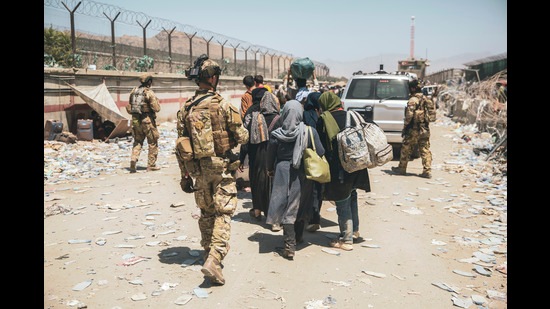
New Delhi’s position was outlined by Indramani Pandey, India’s permanent representative to the UN in Geneva, while addressing a special session of the UN Human Rights Council on the situation in Afghanistan.
India has been watching the security situation in the war-torn country with growing concern following the collapse of the Ashraf Ghani government, and the takeover of Kabul by the Taliban on August 15. It has insisted that any future set-up in Kabul must be inclusive and preserve the gains of the past two decades in order to ensure legitimacy.
In his statement at the UNHRC session, Pandey said India hopes “there is an inclusive and broad-based dispensation which represents all sections of Afghan society”. He added: “Voices of Afghan women, aspirations of Afghan children and the rights of minorities must be respected. A broad-based representation would help the arrangement gain more acceptability and legitimacy.”
As with all recent official statements from the Indian side following the Taliban takeover of Afghanistan, there was no criticism of or direct reference to the militant group in Pandey’s statement. However, he pointedly raised India’s concerns related to the “precarious” security situation in Afghanistan.
“Stability in Afghanistan is linked to the peace and security of the region. We hope that the situation in Afghanistan does not pose a challenge to its neighbours and its territory is not used by terrorist groups such as Lashkar-e-Taiba and Jaish-e-Mohammed to threaten any other country,” Pandey said.
UN human rights chief Michelle Bachelet told the session the rapid seizure of the country by the Taliban has “raised grave fears of a return to past patterns of human rights violations, and stoked desperation among many Afghans”. She warned there were reports of summary executions of civilians and “hors de combat members of the Afghan national security forces”, restrictions on rights of women and recruitment of child soldiers.
Bachelet said the onus is on the Taliban to translate their pledges to protect human rights into reality. “I strongly urge the Taliban to adopt norms of responsive governance and human rights, and to work to re-establish social cohesion and reconciliation,” she added.
Pandey also said the world community must provide full support to the Afghan people’s desire for peace, stability and security, and enable women, children and minorities to live in peace and dignity.
He said that as a neighbour of Afghanistan, the current situation in the country is of great concern to India.
“We are closely monitoring the rapidly evolving security situation in Afghanistan and we continue to call upon parties concerned to maintain law and order, ensure the safety and security of all Afghan nationals, UN personnel and diplomatic staff members, and observe human rights and international humanitarian law in all circumstances in Afghanistan,” he said.
Pandey also said that a “grave humanitarian crisis” is unfolding, and the world community is concerned about increasing violations of fundamental rights of Afghan citizens. “Afghans are worried about whether their right to live with dignity would be respected,” he said.
Thousands of internally displaced people are facing an acute shortage of food, medical care and shelter, and basic rights of civilians, children and women, including freedom of speech and opinion, access to education and medical care, have been drastically hampered by the current situation.
“We call upon all the parties concerned to allow unhindered access to international assistance for all those who are in the need of it,” Pandey said.
The envoy noted that India has significantly contributed in recent years to the development of Afghanistan through large infrastructure projects and connectivity, humanitarian aid, human resource development and capacity-building, and smaller high impact community development projects.
This includes projects in critical areas such as power, water supply, road connectivity, health care, education and agriculture, and Indian development ventures covered all 34 provinces of Afghanistan. India also provided 75,000 tonnes of wheat to Afghanistan to strengthen food security during the Covid-19 pandemic.
“Our millennia old friendship with Afghanistan rests on the strong pillars of people-to-people relationship. India has always stood for a peaceful, prosperous and progressive Afghanistan. India stands ready to assist our friends from Afghanistan in fulfilling their aspirations,” he said. “We hope that the situation stabilises soon and the parties concerned address the humanitarian and security issues.”
India was the largest regional donor to Afghanistan with pledges totalling almost $3 billion. Following the Taliban takeover, India withdrew its envoy and diplomatic staff from Kabul last week, and has evacuated about 620 people, a majority of them Indian nationals, from Afghanistan.


