E-Paper



India engaged with US over H-1B visa issue, says MEA
External affairs ministry spokesperson cited a US Homeland Security notice on H-1B visa rule changes, noting stakeholders have a month to submit comments

 Prefer HTon Google


New Delhi: India is engaged with the US and other stakeholders over the framing of rules for the Trump administration’s move to levy a fee of $100,000 for H-1B visas, with the ministry of external affairs (MEA) saying on Friday that the mobility of skilled Indian talent contributes to innovation and economic growth in both countries.
The new fee, announced by US President Donald Trump last week as part of measures to prevent the abuse of the H-1B visa programme — perceived as a “national security threat” — and to restrict the entry of non-immigrant workers, is expected to impact Indian nationals, who have accounted for almost three-fourths of all H-1B visas issued in the past decade.
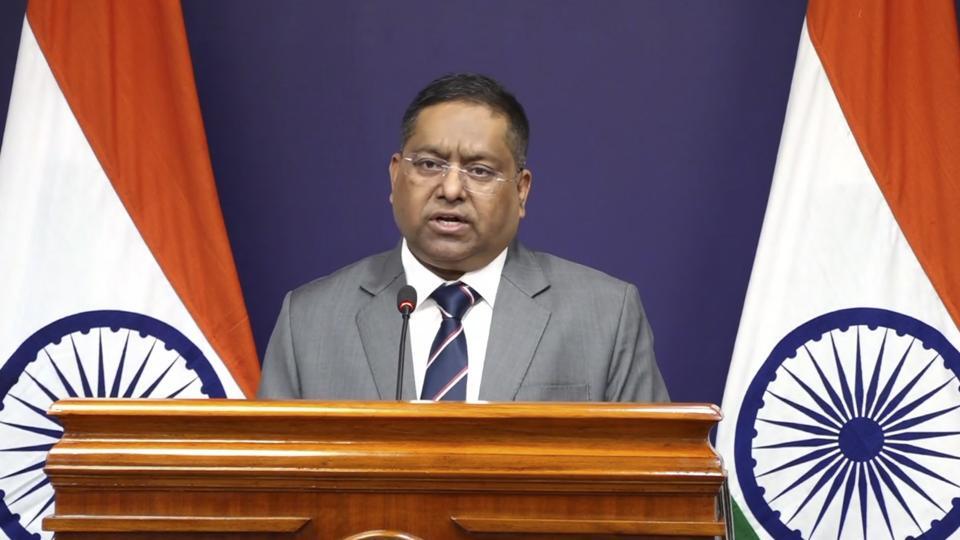
External affairs ministry spokesperson Randhir Jaiswal referred to a notification issued by the US Department of Homeland Security regarding the proposed rulemaking for changes to the H-1B visa programme, and noted that stakeholders, including industry and others, had been given a month to provide their comments.
Clarifications and FAQs were also issued by the US following the unveiling of the new measures, including the confirmation that the $100,000 fee would be levied only once for fresh H-1B visa applications.
“As to how it’s going to play out, this is still an evolving situation and we remain engaged at various levels,” Jaiswal told a weekly media briefing, referring to contacts between the external affairs ministry, the Indian embassy in Washington, and the US administration.
The Indian side believes that the movement of skilled professionals to the US benefits both countries, he said. “We have stated this earlier as well – that skilled talent mobility and exchanges between India and the US have contributed significantly to innovation, wealth creation, economic growth, competitiveness and productivity in the two economies,” Jaiswal said.
Also Read: H-1B visa fee higher than annual salary of most H-1B visa holders
“We want to remain engaged with all concerned, including the industry, and we hope that these factors will receive due consideration,” he said.
The massive hike in the fee for H-1B visas comes against the backdrop of a partial thaw in India-US relations, which were hit in recent months by Trump’s imposition of 50% tariffs on Indian goods, including a punitive levy over Russian oil purchases.
More than 70% of H-1B applications approved since 2010 have gone to Indian workers. The H-1B visa allows companies to employ foreign professionals in specialised sectors such as technology, engineering and medicine.
Jaiswal responded to another question on the Trump administration’s proposal to impose 100% tariffs on pharmaceutical products, large trucks and furniture from October 1 by saying that the concerned departments of the Indian government are looking into the matter to evolve a better understanding.
“As you are aware, India and the US are involved in [negotiations for] a bilateral trade agreement over the last few months. These ongoing discussions naturally cover all areas of interest to us,” he said.
After the US on Thursday unveiled the steep new tariffs – the harshest trade measures since the shock announcement on reciprocal tariffs in April – shares of pharmaceutical companies across Asia with exposure to the US market fell on Friday.
Also read: Has Trump effectively killed the H1B visa programme?
Jaiswal noted that external affairs minister S Jaishankar, accompanied by commerce minister Piyush Goyal, had met US secretary of state Marco Rubio and US trade representative Jamieson Greer on the sidelines of the UN General Assembly in New York on September 22. “The focus of the discussion was on trade and tariffs. Other aspects of our bilateral relationship were also reviewed,” he said.
In response to yet another question, Jaiswal said the US had repatriated a total of 2,417 Indian nationals between January 20 and September 25. The issue of deportations is back in the news after American authorities sent back 73-year-old Harjit Kaur, who had lived in the US for three decades.
The Indian side, Jaiswal said, wants to promote legal pathways of migration and is opposed to illegal migration. Once the Indian nationality of any person who is in any country without legal status is proven, they are taken back — and this is also the case with the US, he said.
Indian authorities have clamped down on illegal migration, which undermines efforts to promote legal migration, and several ministries have worked closely with state governments to “crack down on agents [and] people who are promoting illegal migration”, he said.