
 E-Paper



India, France, Australia trilateral meet on April 13; Indo-Pacific on agenda
The India, France, Australia trilateral dialogue is scheduled a week after the French-led La Pérouse joint naval exercise in the Bay of Bengal ends on April 7.

 Prefer HTon Google


The foreign ministers of India, France and Australia will hold a trilateral dialogue in national capital Delhi on April 13 to discuss steps to strengthen maritime security and collaborate on shared challenges in the Indo-Pacific region, people familiar with the development said.
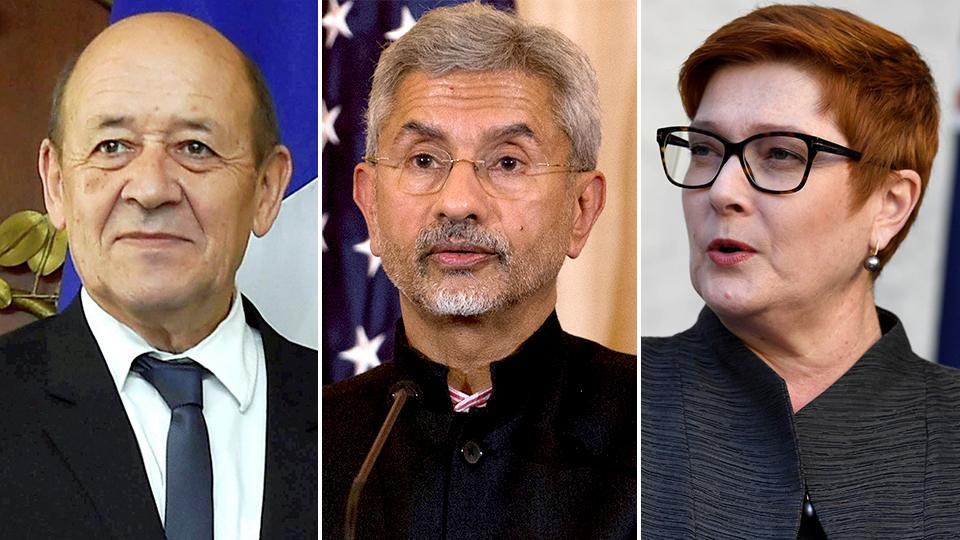
The meeting will be held on the margins of a conference on geopolitics, Raisina Dialogue, which will also be attended by heads of state of Rwanda and Denmark apart from 10 foreign ministers. Prime Minister Narendra Modi is expected to attend the opening and closing sessions of the event.
French foreign minister Jean Yves Le Drian will begin his two-day visit to India on April 12 evening. His meeting with Indian external affairs minister S Jaishankar and Australian foreign minister Marise Payne is scheduled for the following day. Drian is also slated to call on PM Modi and other top Indian leaders on April 13.
Also Read: Can Quad working groups lead to an Asian NATO?
India, France and Australia are on the same page on addressing the challenges in the Indo-Pacific. In recent days, France has come around to acknowledging the central role that New Delhi can play in the shared commitment to freedom of navigation in the South China Sea.
It is in recognition of the role that New Delhi can play that France decided to hold the La Pérouse joint naval exercise in the Bay of Bengal on April 4-7, and invited the Indian Navy to the wargame. The joint exercise, first held in 2019, earlier included navies from the other tmembers of the Quadrilateral Security Dialogue or Quad: Australia, Japan and the US.
“This (trilateral dialogue) will be a meeting of middle powers, who have democratic polity and have the economic strength and shared values to help each other in terms of trade and technology,” said a senior Indian official.
The three foreign ministers will discuss the global security environment and the Chinese posture in the Indo-Pacific.
French envoy Christophe Penot, who is an advisor to President E Marcon on Indo-Pacific, signalled the pivotal role that Paris expects New Delhi to play in the region when he briefed top diplomatic corps and heads of multilateral agencies in Paris this week. It is understood that Penot in his virtual briefing outlined the role of France, Australia and India in the Indo-Pacific with particular emphasis on New Delhi’s role in the efforts.
A former foreign secretary linked the emphasis on India to the government’s decision to stand up to China when it tried to expand its territory across the Line of Actual Control.
Also Read: Quad, France and UAE join hands in 2 naval exercises to dominate Indo-Pacific
“After India led by Prime Minister Narendra Modi stood up to unilateral aggression by the People’s Liberation Army in East Ladakh in May 2020, not only Quad powers but key strategic allies, France and UK, recognise the centrality of India in ensuring the right to free navigation in the Indo-Pacific,” the retired diplomat said.
Officials said it has helped that foreign ministers Jaishankar, Drian and Payne have a personal connect with each other apart from being representatives of democratic powers that have been brought under pressure by Chinese behaviour in East Ladakh, Caledonia and island territories, respectively, in the far Pacific.
While India and France have deep defence cooperation with each other, Australia under Prime Minister Scott Morrison has joined hands with New Delhi on not only pushing the pedal on bilateral ties but also close military ties through multilateral naval exercises such as Malabar 2020.


