E-Paper



India, Japan pitch for Assam to be hub of connectivity with Southeast Asia
External affairs minister S Jaishankar and Japanese ambassador Satoshi Suzuki visited Assam to review projects being implemented with Japanese support, and outlined a vision of Assam playing a crucial role in India’s efforts to link up with and benefit from new markets in Southeast Asian nations.

 Prefer HTon Google


India and Japan on Monday made a strong pitch for Assam to be a hub for connectivity and economic activities with Southeast Asia, with Japanese funding playing a key role in taking forward infrastructure and development projects.
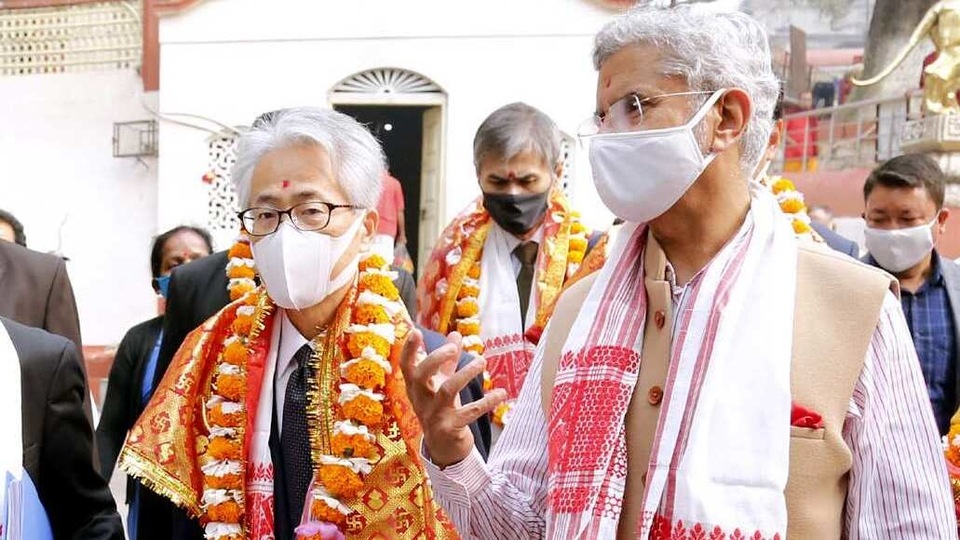
External affairs minister S Jaishankar and Japanese ambassador Satoshi Suzuki visited the north-eastern state to review projects being implemented with Japanese support, and outlined a vision of Assam playing a crucial role in India’s efforts to link up with and benefit from new markets in Southeast Asian countries such as Myanmar and Vietnam.
The visit was a follow-up to the meeting on January 28 of the Act East Forum, a special body formed in 2017 and co-chaired by the Japanese envoy and India’s foreign secretary to boost development of the northeast.
“Assam has long been the bridge between India and the world to our east,” Jaishankar told a symposium in Guwahati that was also addressed by Suzuki.
Assam’s role over the centuries in facilitating the flow of goods, people and ideas till as far as Korea and Japan was disrupted by colonialism and partition, and the “Act East” policy will create connectivity “to and within Assam, beyond to the northeast, then to neighbouring Myanmar and Bangladesh, but eventually push all the way by road, by sea, by air to Vietnam [and] Japan,” Jaishankar said.
Suzuki said enhancing connectivity across India’s eastern border is critical because the country “faces certain restrictions in the western border outlet”. He added: “Japan always takes a panoramic perspective in its diplomacy. The vision for a free, open and inclusive Indo-Pacific is at its centre, and India’s northeast, including Assam, occupies an important place in this vision.”
The northeast is “situated where India’s Act East policy and Japan’s vision for a free and open Indo-Pacific converge”, he said. “To be ‘free and open’ is critical here in Assam. That is why Japan is supporting various connectivity projects in this state,” he added.
Jaishankar said Assam has the potential to become the centre of a hub covering Myanmar, Bangladesh and Bhutan, and India has worked to coordinate with Japan’s projects in these three countries.
India, he said, intends to make the Brahmaputra River the main channel for movement of goods and people in an area ranging from the Himalayas to the Bay of Bengal by creating inland water connectivity to the key ports of Chittagong and Mongla in Bangladesh. India is also developing the Eastern Waterways Transport Connectivity Grid with support from the World Bank, and river ports such as Dhubri and Karimganj in Assam are being used to move goods to and from Bhutan and Bangladesh, he said.
New Delhi also plans to make Assam the hub for transmission of surplus power to the neighbourhood, and work is on to develop new transmission lines connecting Assam with Bihar through Bangladesh, Jaishankar said. Since Assam is a major producer of refined petroleum products, the government is trying to facilitate the sale of these products to the larger region through steps such as building a pipeline to Bangladesh to supply high speed diesel.
In recent years, Japan has backed several crucial infrastructure projects in the northeast. It signed a loan agreement of ₹1,600 crores for the 20-km Dhubri-Phulbari bridge on the Brahmaputra to be built at a cost of more than ₹6,000 crores. The bridge, which will be the longest river bridge in India, will shorten the travel time across the river in this area from more than eight hours to less than 30 minutes.
Jaishankar and Suzuki also visited parts of the Guwahati water supply system that are being renovated with a Japanese loan of ₹1,183 crores, which constitutes a major part of the total project cost of Rs. 1,443 crores. Japan is also backing the ₹1,460-crore Guwahati sewerage project with a loan of more than ₹1,000 crores.