E-Paper



India joins other nations in criticising Taliban's ‘ban on women’ in universities
The Taliban set up in Kabul ‘suspended’ university education for all girls in Afghanistan on Tuesday, the latest measure in a brutal clampdown on the rights and freedoms of women


India on Thursday joined other countries in criticising the Taliban’s nationwide ban on girls attending universities and called for the establishment of an inclusive government that respects the “rights of all Afghans”, including women and girls.
The Indian side further said it will work with international partners to counter terrorism in line with the UN (United Nations) Security Council Resolution 2593, which demands Afghan soil shouldn’t be used to threaten or attack any country or to shelter or train terrorists, including UN-designated terrorists and groups.
The Taliban in Kabul ‘suspended’ university education for all girls in Afghanistan on Tuesday, the latest measure in a brutal clampdown on the rights and freedoms of women. Girls have been unable to attend schools across Afghanistan since the Taliban assumed power in August 2021.
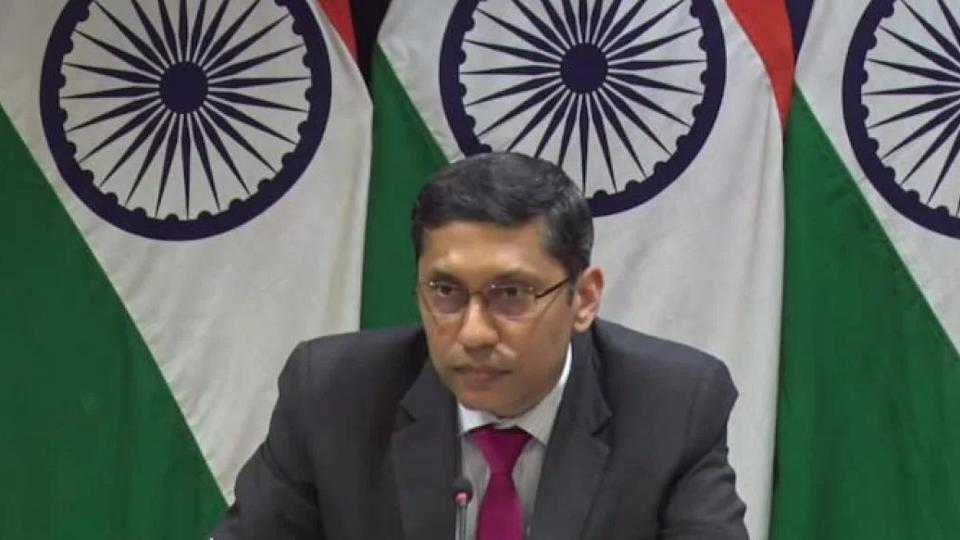
“We have noted with concern the reports in this regard. India has consistently supported the cause of women’s education in Afghanistan,” external affairs ministry spokesperson Arindam Bagchi told a regular news briefing.
“We have emphasised the importance of the establishment of an inclusive and representative government that respects the rights of all Afghans and ensures the equal rights of women and girls to participate in all aspects of Afghan society, including access to higher education,” he said.
Bagchi also pointed to UN Security Council Resolution 2593, which “reaffirms the importance of upholding human rights, including those of women, and also calls for full, equal and meaningful participation of women.”
Also Read: At UNSC meet on Afghanistan, India delivers a sharp message on Pakistan role
On Wednesday, the governments of the US, Australia, Canada, France, Germany, Italy, Japan, the Netherlands, Norway, Spain, Switzerland and the UK, and the high representative of the European Union strongly condemned the Taliban’s decision to ban women from universities and to continue to bar girls from secondary schools.
In a joint statement, these countries also criticised the Taliban for imposing harsh restrictions on the ability of Afghan women and girls to exercise their human rights and fundamental freedoms.
Responding to a question on the continued presence in Afghanistan of fighters from Pakistan-based Lashkar-e-Taiba (LeT) and Jaish-e-Mohammed (JeM), Bagchi said India will work with international partners to counter terrorism in line with UN Security Council Resolution 2593. In this context, he referred to the special meeting of the UN Counter-Terrorism Committee hosted by India in October and the holding of the No Money For Terror ministerial conference in November.
“We are interested in working with the international community against terrorism from wherever it emanates. Insofar as Afghanistan specifically is concerned, I would refer you to UN Security Council Resolution 2593, which has pretty strong language on what the expectations of the international community are vis-a-vis terrorism emanating from Afghanistan,” he said.
Also Read: ‘As a father to daughters...’: Rishi Sunak on Taliban’s university ban for women
Bagchi noted that India abstained when the UNSC approved a resolution for a humanitarian exemption to asset freeze measures against the Taliban on December 9 because of continuing concerns about the possible misuse of funds. The resolution was adopted by a vote of 14 in favour of the 15-member security council.
While India agrees in principle on the issue of access to funds for humanitarian measures, “there were certain concerns that we had and accordingly, we abstained on that resolution”, Bagchi said. “Clearly, we do believe there are possibilities of misuse of such opportunities and hence our position on that resolution,” he added.
Like other countries, India does not recognise the Taliban setup in Kabul. India had pulled out all its diplomats from Afghanistan after the Taliban takeover, and it re-established a diplomatic presence in Kabul by deploying a “technical team” in June.