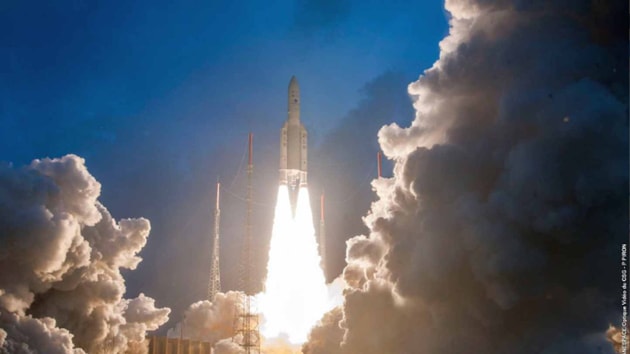
India’s heaviest satellite GSAT 11, weighing 5,854 kg, was successfully launched by the European commercial launch provider Arianespace in the early hours of Wednesday from Kourou space centre, French Guiana.
“GSAT 11 is an advanced communication satellite. It is the largest and heaviest satellite built by ISRO. It will fulfil most needs of providing broadband connectivity to rural and inaccessible gram panchayats under BharatNet project,” said ISRO chairman K Sivan.
Even with ISROs advanced ‘Bahubali’ rocket, the GSLV Mk III, India is not capable of launching this heavy satellite. GSLV Mk III can support a liftoff mass of 4 tonnes, which is double the capacity of its predecessor.
The satellite is the third of the four satellites that will high-speed broadband connectivity to all parts of India, bridging the rural and urban divide. Two satellites, the GSAT 19 and 29, have already been launched and the fourth GSAT 20 will be launched later next year.
The satellites together will allow for high-speed voice, data, and video-streaming services over diverse geophysical and climatic conditions.
{{/usCountry}}The satellites together will allow for high-speed voice, data, and video-streaming services over diverse geophysical and climatic conditions.
{{/usCountry}}This will further the Union government’s Digital India initiative by supporting BharatNet an ambitious optical fibre network connecting 2.5 lakh gram panchayats. The mission life of the satellite will be 15 years.
The satellite was launched by Arianspace’s heavy Ariane 5 launch vehicle (VA246) along with a Korean weather monitoring satellite. The total weight of both the satellites aboard the launch vehicle is 10,298 kg.
GSAT 11 had been schedules for a launch in May this year, but had been recalled by the Indian Space Research Organisation in April to carry out “some tests” after the space agency failed to establish communication with a satellite from the same series GSAT 6A.
“ISRO wanted to ensure that there was no possibility of a similar communication loss. Nothing was found on testing the satellite and it was shipped back to Kourou for launch,” said an official on condition of anonymity.