E-Paper



India maintains silence as China fumes over AUKUS
The new alliance called AUKUS was unveiled by Australian Prime Minister Scott Morrison, British Prime Minister Boris Johnson and US President Joe Biden against the backdrop of China’s assertive actions across the Indo-Pacific.

 Prefer HTon Google


India on Thursday opted to maintain a studied silence on the creation of a new security partnership by Australia, the UK and the US, apparently due to sensitivities related to the strategic situation in the region and ties with key partners.
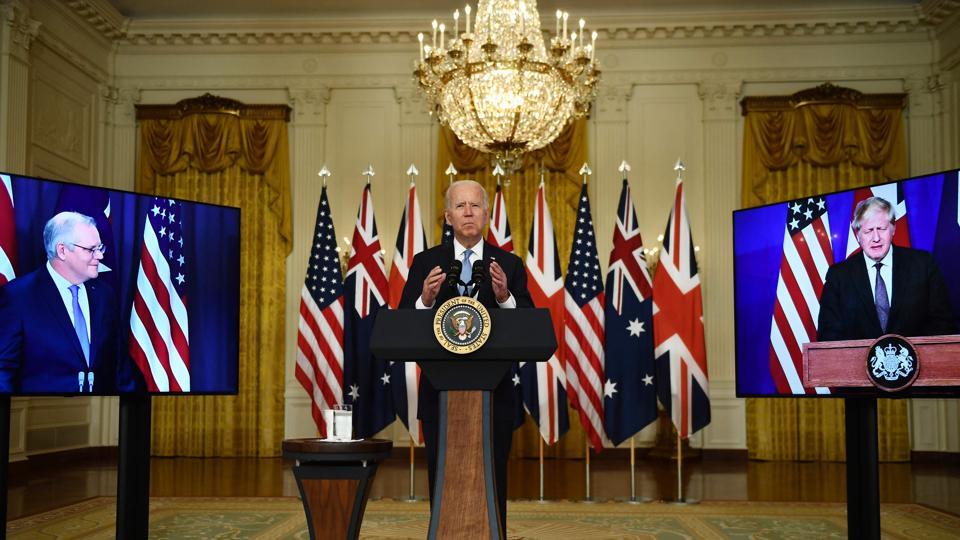
The new alliance called AUKUS was unveiled by Australian Prime Minister Scott Morrison, British Prime Minister Boris Johnson and US President Joe Biden against the backdrop of China’s assertive actions across the Indo-Pacific, and its first initiative is aimed at equipping Australia with nuclear-powered submarines.
China strongly criticised the trilateral partnership, saying it would severely damage regional security and spark an arms race. France was angered by Australia’s decision to scrap a $90-billion programme to build 12 French-designed submarines and instead opt for nuclear-powered vessels.
People familiar with developments said on condition of anonymity that India did not want to be seen as embracing a new security alliance that is a counter to China’s assertive actions, especially at a time when New Delhi and Beijing are engaged in a dragging military standoff along the Line of Actual Control (LAC) that is not close to being fully resolved.
At the same time, India is sensitive to the concerns of France, a key strategic and defence partner that has supplied advanced military hardware such as the Rafale combat jets, the people said.
Asked about the launch of AUKUS at a regular media briefing, external affairs ministry spokesperson Arindam Bagchi said: “I do not have anything to share on this at this moment, on AUKUS or related stuff.”
The new partnership was launched days ahead of the first in-person summit of the Quadrilateral Security Dialogue or Quad in Washington on September 24. The meeting, being held six months after the maiden virtual Quad Summit, will be attended by Prime Minister Narendra Modi, Japanese Prime Minister Yoshihide Suga, Australian Prime Minister Morrison and US President Biden.
On Wednesday, Australia’s top leadership spoke to their Indian counterparts to brief them about the launch of AUKUS. Modi said in a tweet he and Morrison had “exchanged perspectives on regional developments” and the upcoming Quad Summit. Australian foreign minister Marise Payne made a phone call to her Indian counterpart S Jaishankar, while defence minister Peter Dutton spoke to his counterpart Rajnath Singh.
Responding to another question at the briefing on whether the launch of AUKUS could dilute the impact of the in-person Quad Summit, Bagchi said the upcoming meeting of the four leaders in Washington stands on its own.
“I think the Quad summit stands on its own. It is extremely important as I mentioned. Clearly, the Quad partners attach a lot of importance to it. You can see that in the midst of the Covid-19 pandemic, an in-person summit is happening. I would not like to comment or speculate on the implications (of AUKUS). As I said, I don’t have much to say on the AUKUS initiative for the moment,” he said.
Bagchi noted that Jaishankar had highlighted the importance of Quad as a platform where four countries had come together for their own benefit and the benefit of the world.
The Quad is tackling the immediate issues of the day, including vaccine supply chains, education, maritime security, climate change, humanitarian assistance and disaster relief, and connectivity infrastructure, and its four members have a shared vision for a free, open, inclusive and prosperous Indo-Pacific based on respect for international law, he added.
However, France’s foreign minister Jean-Yves Le Drian and defence minister Florence Parly said in a joint statement that Australia’s decision to scrap the submarine deal was contrary to the letter and the spirit of cooperation between the two countries, based on a relationship of political trust.
Australia’s decision to go with the American choice leads to the removal of an ally and a European partner from a relationship at a time of “unprecedented challenges in the Indo-Pacific region”, and “marks an absence of coherence that France can only...regret”, the two ministers said.
The cooperation between the US and Australia through AUKUS is expected to build on the initiatives the two countries are engaged in under the framework of the Quad. AUKUS also dovetails with the Boris Johnson government’s tilt towards the Indo-Pacific under a comprehensive revamp of foreign and security policies in order to unlock new opportunities across the region.