E-Paper



India pitches closer security cooperation with Central Asian states
External affairs minister S Jaishankar said India would be a “trusted development partner” for Kazakhstan, Kyrgyzstan, Tajikistan, Turkmenistan and Uzbekistan.

 Prefer HTon Google


India on Friday appreciated the condemnation of the Pahalgam terror attack by the Central Asian states and said it is committed to expanding cooperation with the five countries in areas ranging from security to trade and regional connectivity.
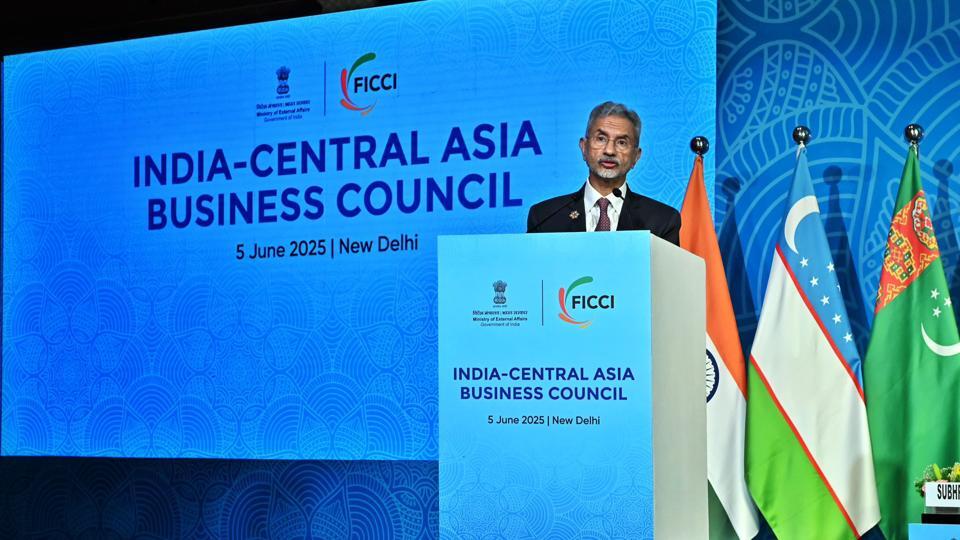
External affairs minister S Jaishankar, in his opening remarks at the India-Central Asia Dialogue, said India would be a “trusted development partner” for Kazakhstan, Kyrgyzstan, Tajikistan, Turkmenistan and Uzbekistan, providing community development projects under grants and offering training for professionals for different sectors.
“I appreciate that your countries stood by India and condemned the heinous terrorist attack that took place in April in Pahalgam,” he said in the televised remarks.
India and the Central Asian states, he said, are committed to advancing mutually beneficial cooperation across all sectors, especially defence, security, trade and investment, agro-processing, pharmaceuticals, regional connectivity, education, and new and emerging technologies.
This is the fourth edition of the India-Central Asia Dialogue, which was launched in 2019 to address common challenges such as security issues and to bolster trade, investments and connectivity. This year’s meeting focused on trade, connectivity, technology and development cooperation, and the six foreign ministers also discussed challenges to regional security.
Jaishankar noted that India remains a trusted development partner for the Central Asian states, offering training slots and scholarships and providing high impact community development projects under grants for socio-economic development. “Such projects have included equipping schools with computers, and providing hospitals with medical equipment,” he said.
India’s cooperation with the Central Asian states got a boost after it was raised to the leaders’ level as a virtual summit in January 2022, and there are now exchanges between the trade and culture ministers and national security advisers. “Trade, economic and investment ties between us have strengthened significantly over the last decade. Today, we are well-connected by multiple direct flights,” Jaishankar said.
“Our enhanced connectivity facilitates greater two-way tourist flows and businesses. A large number of Indian students pursue higher education in your countries, strengthening the bond between us,” he said, adding that India and the Central Asian states have created a legal and institutional framework that provides a foundation for mutually beneficial cooperation.
Ahead of the dialogue, the six foreign ministers participated in the India-Central Asia Business Council on Thursday to discuss ways to remove impediments to greater trade and investments. They also focused on cooperation in digital technologies, fintech and inter-bank relations.