E-Paper



India ready to work with any govt chosen by Bangladeshi people: Foreign secretary Vikram Misri
Foreign secretary Vikram Misri reiterated the Indian side’s stance that free and fair elections should be held speedily

 Prefer HTon Google


NEW DELHI: India stands ready to work with any government chosen by the people of Bangladesh in next year’s election, though New Delhi favours the holding of free, fair and inclusive polls at the “the earliest possible time”, foreign secretary Vikram Misri said on Monday.
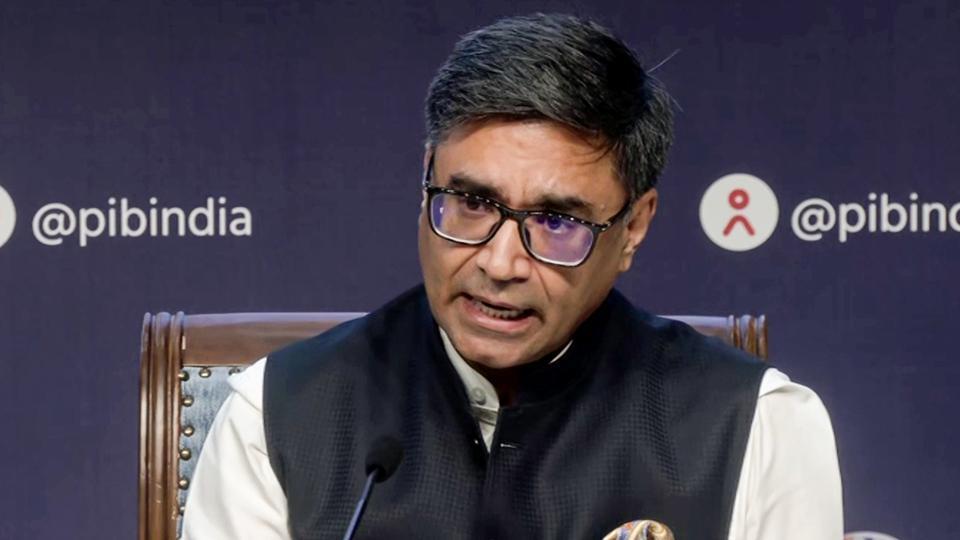
The Indian side has a stake in the peace, progress and stability of Bangladesh because these factors influence regional security and stability, and the two countries should frame a forward-looking and people-centric agenda, including greater physical, commercial and trade connectivity, Misri said while interacting with a group of visiting Bangladeshi journalists.
“We will work with any government that emerges through the mandate of the people of Bangladesh,” Misri said, referring to plans unveiled by the interim government in Dhaka to hold elections in February 2026. India “will not get into” the conditions that will shape the mandate, and New Delhi has continued to work with the caretaker administration formed after the collapse of the Sheikh Hasina government in August 2024, he said.
Misri reiterated the Indian side’s stance that free and fair elections should be held speedily. “I want to be very, very clear…that India is firmly in favour of free, fair, inclusive and participatory elections in Bangladesh and it is in favour of these elections being held at the earliest possible time,” he said.
“We are encouraged by the fact that Bangladeshi authorities themselves have spoken about a timeframe for these elections and we would look forward to these elections taking place.”
Misri also responded to a question on former premier Hasina’s presence in India affecting bilateral relations and the Bangladesh interim government’s demand for her extradition, saying the two sides can jointly work on this issue.
“All I would say is that this is a judicial and legal process. It requires engagement and consultations between the two governments. We are examining this issue and we look forward to working together with the Bangladesh authorities on these issues. Beyond that, I don’t think it would be constructive to say anything further at this point,” he said.
India-Bangladesh relations plummeted to their lowest point in decades after the interim government led by Nobel laureate Muhammad Yunus assumed power in Dhaka after Hasina stepped down following weeks of protests led by student groups and fled to India in August 2024. Since then, the two sides have repeatedly traded charges on the interim government’s handling of the repression of Bangladesh’s minorities. The Indian side has imposed several restrictions on the export and transit of Bangladeshi goods through Indian land ports and border crossings.
Misri dismissed the perception that India had “focused on only one particular set of people to the detriment of others” in Bangladesh as “completely unfounded” and “incorrect”. The two sides should adopt a future-oriented and people-centric agenda for their relationship “rather than look at it from the lenses of the past”, and put the people at the centre of all initiatives, including more intense economic linkages and physical or financial connectivity, he said.
He also said most trade-related disruptions have occurred on “account of decisions that have been taken within Bangladesh”. India remains ready to discuss all issues related to trans-border rivers, including the renewal of the Ganga Waters Treaty and the sharing of the waters of the Teesta river, under the bilateral Joint Rivers Commission, he said.
Misri responded to a question on Bangladesh’s complaints about the killing of its nationals by India’s Border Security Force (BSF) by pointing out that these “incidents take place in Indian territory” only after smugglers, criminals, human traffickers, cattle traffickers and arms traffickers illegally cross the border.
“They are therefore on the Indian side of the boundary, and when they engage in armed attacks on the border guarding forces on our side, the BSF, in self-defence, engages them and that is when some of these border killings take place,” Misri said. “The first place to deal with these is to deal with them upstream, in a sense to prevent illegal border crossings. If there are no illegal border crossings, there will be no border killings.”