E-Paper



India relations with Europe poised to grow to the next level: Jaishankar
German Chancellor Friedrich Merz will visit India on January 12-13 and this will be followed by a visit by the two top leaders of the European Union


NEW DELHI: India’s relationship with Europe is poised to grow, and both sides need to strengthen the partnership to bring more stability to the international economy and global politics at a time of churn on the international stage, external affairs minister S Jaishankar said on Wednesday.
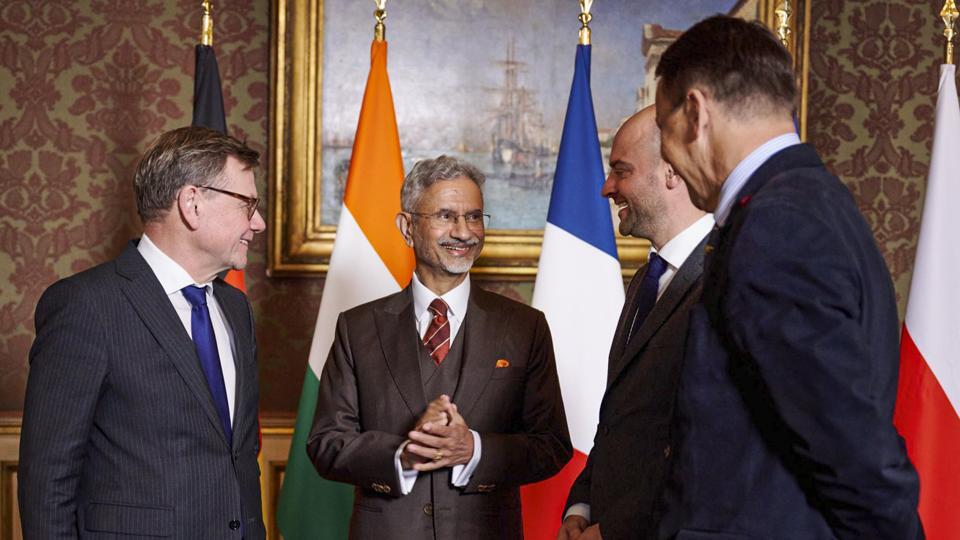
Jaishankar made the remarks while addressing the media in Paris after a meeting in the Weimar Triangle format with his counterparts from France, Germany and Poland, and came against the backdrop of a push by India and the European Union (EU) to deepen their partnership through a free trade agreement (FTA) and other initiatives.
India believes its relationship with Europe is “poised to grow to the next level”, and the two sides have been engaged in discussions on the FTA and cooperation in areas such as technology, semiconductors, railways, defence and aviation, Jaishankar told the news conference.
“There’s really a very substantive relationship [and] much more that can be done,” he said. “But other than that, there is a larger discussion today that the world needs about the global order – what kind of world do we want to live in, what would be the norms and the other related issues.
“And because Europe is such an important player in global politics, it’s also necessary that India strengthen its relationship. I think we can bring more stability both into the international economy and global politics.”
Jaishankar noted that the Weimar Triangle format meeting with German foreign minister Johann Wadephul, French foreign minister Jean-Noel Barrot and Polish foreign minister Radoslaw Sikorski had focused on three issues – India-EU relations, the Indo-Pacific and the Ukraine conflict – but didn’t provide details. He said India’s participation in the Weimar format talks for the first time reflected the country’s deepening engagement with Europe.
The Weimar Triangle format was launched in 1991 as an initiative of Germany and it includes France and Poland.
Another context for India’s participation in the meeting is a “world that is under churn”, Jaishankar said. “We have been witnessing for quite some years now that churn in the Indo-Pacific. Europe is going through its own challenging circumstances, many of which have strategic implications. But beyond that, there have been overarching developments that could redefine the global order itself,” he said.
“Among India’s major relationships, I believe that the one with the EU and Europe, and obviously with its member states, has the most room to grow today.”
German Chancellor Friedrich Merz will visit India during January 12-13 for talks with Prime Minister Narendra Modi and this will be followed by a visit by the two top leaders of the European Union – Ursula von der Leyen and Antonio Costa – who will be the chief guests at the Republic Day celebrations on January 26. India and the EU are expected to announce the finalisation of their FTA during this visit.
In February, French President Emmanuel Macron will visit India to launch the India-France Year of Innovation along with Modi and to participate in the AI Impact Summit.